


I’ve been enamored of the sound and cadence of Cake’s brass-boosted, half-sung, half-spoken-word style since the first time I heard the Fashion Nugget album playing on a boom box at a college party. One of the first pop songs my kids learned when they were little was The Distance, from that same album. They’d ask me to play it every time we got in the car.
If I were pressed to explain why I love the band so much, it would be hard to point to any single thing. To my ears, at least, they have a totally unique and irresistible sound. They brought trumpet and naked percussion back to pop music at a time when we were still recovering from a synthesizer hangover.
But more than anything, I think it was the half-sung, half-spoken-word, beat poet-esque delivery of lead vocalist John McCrea. It’s the kind of thing that grabs your attention and won’t let go. And underlying his delivery are songs that tell stories. If I could narrow my favorite songs of all time to a top ten list, Frank Sinatra — with its evocative descriptions and playfully odd themes — would certainly find its place squarely within that pantheon:
We know of an ancient radiation
That haunts dismembered constellations
A faintly glimmering radio station
While Frank Sinatra sings Stormy Weather
The flies and spiders get along together
Cobwebs fall on an old skipping record
Beyond the suns that guard this roost
Beyond your flowers of flaming truth
Beyond your latest ad campaigns
An old man sits collecting stamps
In a room all filled with Chinese lamps
He saves what others throw away
He says that he'll be rich someday
We know of an ancient radiation
That haunts dismembered constellations
A faintly glimmering radio station…
— Cake, Frank Sinatra
If you don’t know it, I strongly recommend that you click here and listen to it. It’s a brilliant piece of writing and musical composition.
But alas, this post is not about Cake. It’s not about Frank Sinatra, either.
It is about a faintly-glimmering radio station.
Now, to set the stage, I’ve been obsessed with radio since I was a kid — not just the medium, but the aesthetics. I’m honestly not sure what started it. I remember being particularly struck, when I was a little boy, by a scene at the beginning of a film that shows a radio production using practically-generated Foley sound effects being performed during a live broadcast.
I loved the sound of the transatlantic accent used by old radio announcers, and I’d listen to my grandmother’s tapes of the lectures of Archbishop Fulton Sheen. I remember scrounging through the basement racks inside Boscov’s department store at the corner of Court St. and Water in downtown Binghamton, New York. It was there that I dug up copies of Orson Welles’ original 1938 broadcast of War of the Worlds and a cassette tape called “50 Famous Commercials From Yesteryear” — both of which informed my own voiceover work later in life, and led to me landing the announcer gig for this television show a few years back:
There’s just something magical about radio. I don’t know what it is. It’s not just the audio. It’s the ambience. A man sitting in a little soundproof booth, speaking carefully into a beautifully-constructed microphone, the needles on the monitors moving with his voice as an array of electronics he almost certainly doesn’t understand converts sound into radio frequency transmissions that travel long distances through the vast of night. From tuning in to Art Bell or Delilah on late night drives across the country when no other signal was available to scanning the weird spaces between channels for alien-sounding broadcasts on an old radio up in my attic to recording my own “radio shows” when I was a kid to eventually having a real on-air show of my own at the campus station in college, I can’t remember a time where it wasn’t something I loved.
One of my favorite experiences was with a weekly call-in trivia show broadcast from the SUNY Binghamton campus station, WHRW. It was called, Mad Trivia Party. And I was obsessed with it.
I think I was 16 at the time. I listened every week. Back then, of course, it was the very earliest days of the consumer internet, and there was nothing like Google. Even if you had somehow been given magical access to a good search engine, the odds that you could quickly find the answers to live trivia questions were practically nonexistent. The information simply wasn’t out there back then. Websites were niche, and limited.
So if you wanted to play to win at Mad Trivia Party, it was all about either:
a) Just knowing a bunch of random, interesting stuff, and/or
b) Being really good at looking things up in books on the fly
I remember there was a question once about the spelling of an olde English word pronounced, “Fanshaw.” I think that question lingered for a couple of weeks without being solved, until it was finally revealed to be spelled, “Featherstonehaugh.”
Now, I have no idea if that’s accurate in the slightest or totally apocryphal. But I can tell you that I believed it like Gospel at the time.
One week, against all odds, I managed to win the call-in show. I was elated. The “prize” for getting the most points on any given show was to be a guest panelist the next week. I’d never set foot on a college campus, and I was about to meet these people who had cred in the local nerd culture, which was my native element at the time. Some of them were regulars on the local computer bulletin board systems (BBSes). They were much older than me, and in my opinion at that age, way cooler. I felt very smart, very much a part of something I loved, and very excited.
One of my parents gave me a ride to the station, which was over 20 minutes away from our rural home up a dead-end road in Kirkwood, which is on the east end of nowhere. In fact, it could be difficult to get the campus radio station at my house because of the limited range of the FM transmitter. I remember always listening to it in the basement — whether because I wanted privacy, or because it was the only place I could pick up the signal, I can’t recall. Maybe it was both.
So I went into the studio and did the show. I met the panelists, who until that time I’d only known by their voices. The only female on the panel went by the pseudonym, “The High Mistress of Mosh,” and I’ve thought about that name every time I’ve heard the word “mosh” ever since. I don’t think I would have been more excited if I’d been invited to go on Letterman — and I was a fan of that show. To my surprise, they had another guest host — a guy who went by the handle “Fox” on the local BBSes. He was a vocal atheist, and I was becoming a zealous young Catholic. We’d tangled any number of times in the online forums when it came to matters of faith. And now I was sitting with him in a studio, and he was very nice to me, and even gave me a ride back to my Grandma’s house in the snow in his mother’s borrowed minivan.
I only ever made it on the show that one time, but it was a formative experience. I loved the participatory style, the camaraderie of the hosts, the inside jokes, the deeply local connection, and the fact that you could trust people to do a call-in trivia show honestly because they genuinely had no good way to cheat.
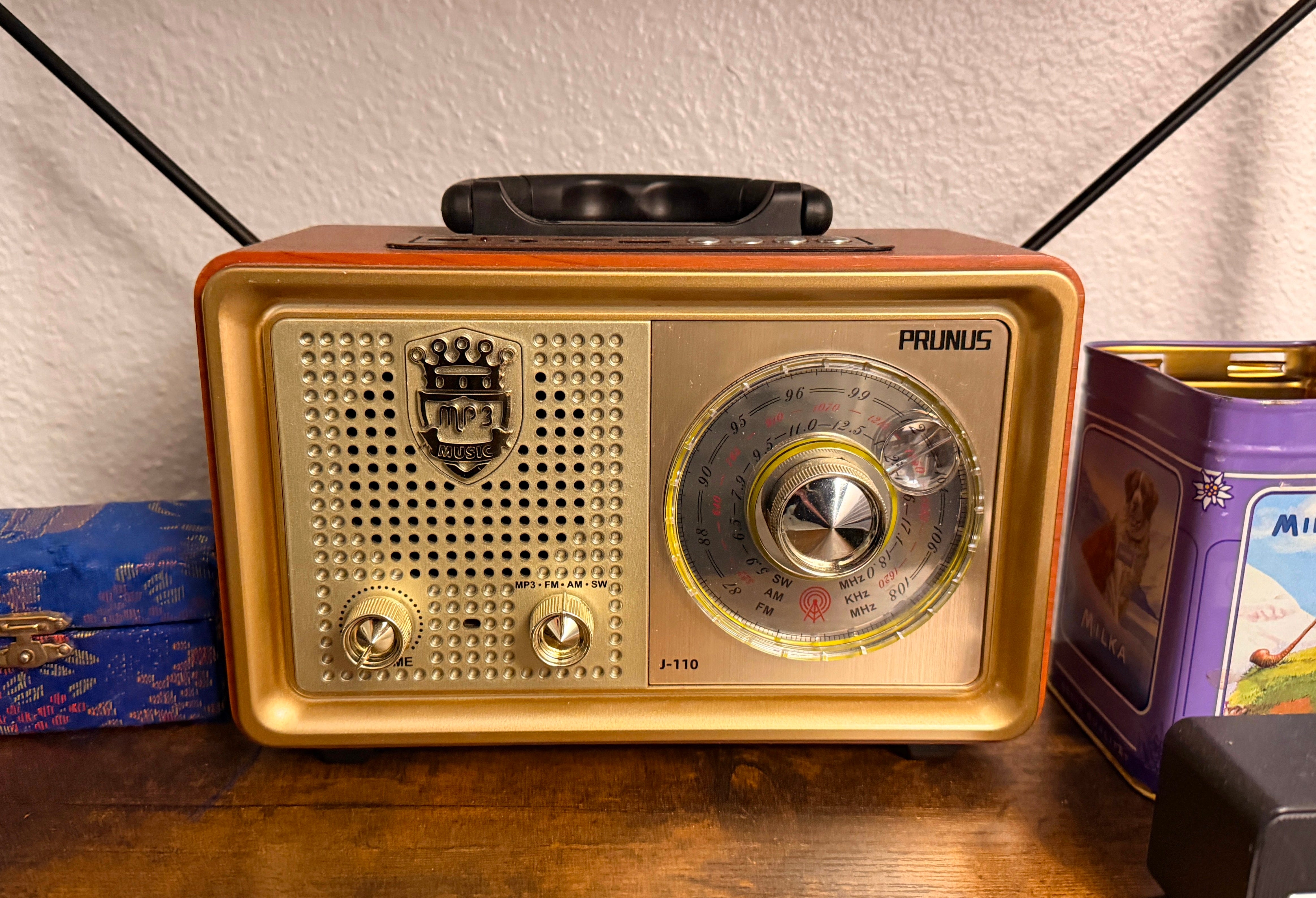
To this day, I keep this neo-retro-style radio on my bookshelf, just because in my eyes, this style of device is pure art:
Looking back on all this, I suppose it’s no real surprise that I became a podcaster when such a thing became a technical possibility.
But all of this is just prelude. I feel like I’m telling you the unnecessary backstory before you get to the recipe I’ve buried at the bottom of the page. So let me get right to it.
There’s an old radio station that was built around 1940 right here in Raleigh — the suburb of Cary, specifically — that has some cultural notoriety. It’s called WPTF, and though the building looks like it could use some serious TLC, it’s actually still active as a transmission station. It’s a ghost building, in the sense that nobody works out of it. It’s even reported to be the site of an old bomb shelter.
The broadcasts it transmits come from a newer studio quite a distance away in North Raleigh — much closer to where I live, actually — and the old radio tower and art deco building housing the AM transmitter equipment sit almost completely hidden behind a gate, which is itself behind a copse of mature trees, nestled on the other side of a set of railroad tracks, off of a random stretch of East Chatham St.
I’ve driven by it dozens of times without ever even noticing anything was there:
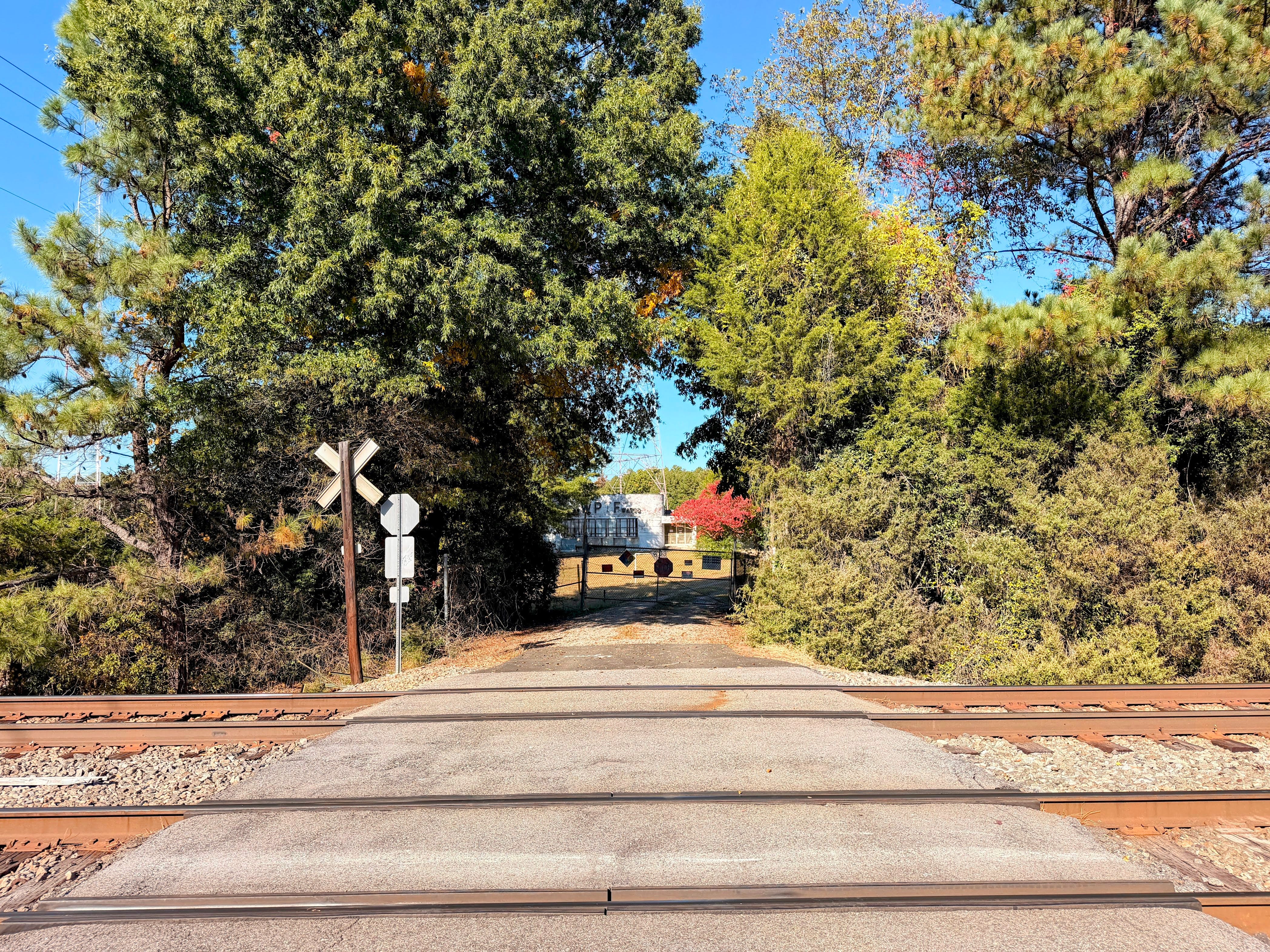
But today, I went looking for it. I’ve been curious about it for a while, because it’s the building that WSQK 94.5 FM, “The Squawk” — the radio station that prominently features in Season 5 of the Netflix hit series, Stranger Things — is directly based on.
Here they are, side by side:
