


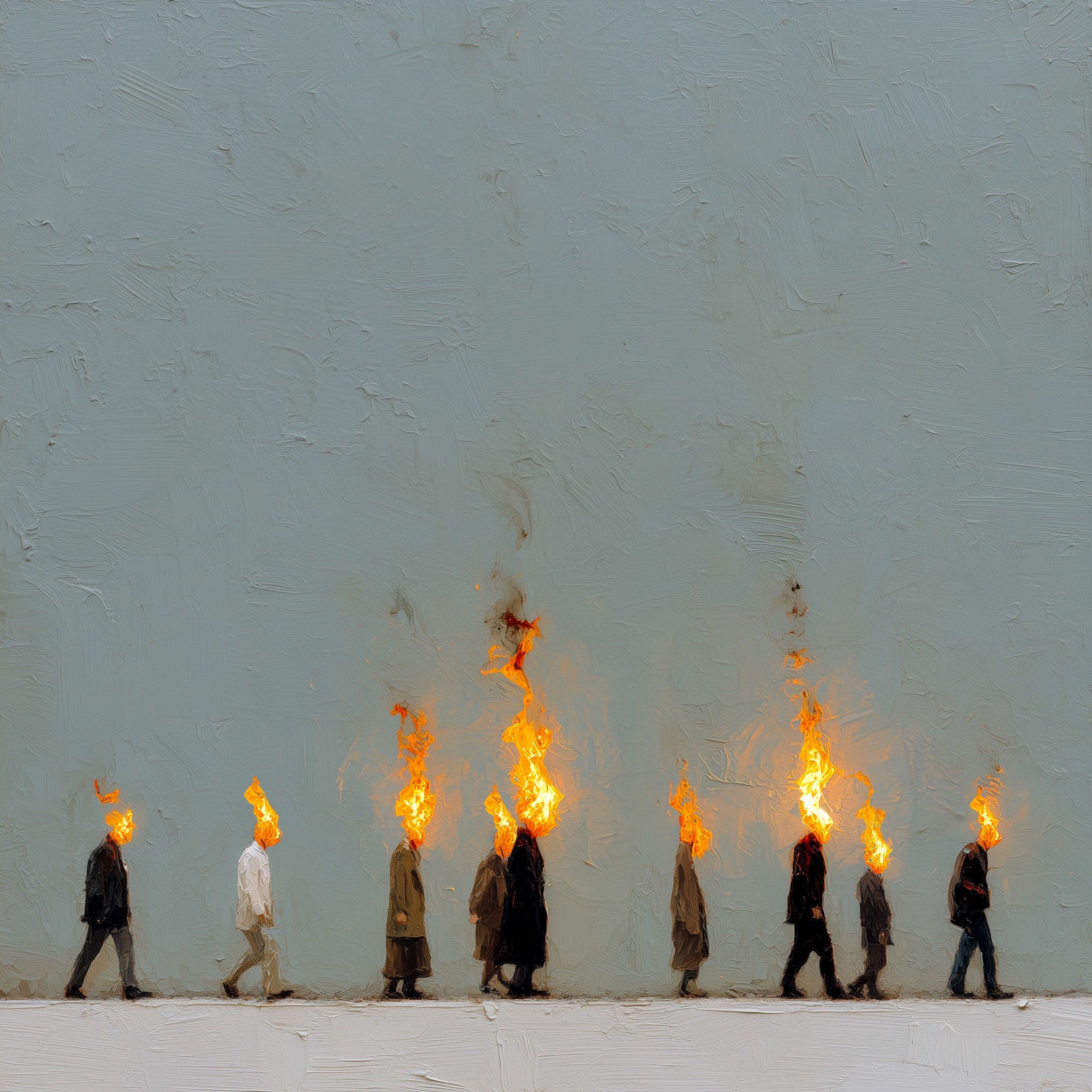
The image at the top of this post comes from the artist Luca Ponsato, and I find that I keep bumping into it in my travels online.
Every time I see it, it stops me.
Every time it moves me to consider and reflect on it and share.
Because if there’s one thing I’ve learned in my nearly half-century on this planet that is by turns wild, weird, wonderful, and sometimes outright unbearable, it’s that everyone really is going through something.
Nobody cruises through life scot-free. The one universal human experience is suffering. Not everyone gets to know joy, or love, or acceptance, or belonging, or success, or freedom.
But everyone, without exception, gets to know pain.
I recall when I was at the height of my own personal achievement, and we had a beautiful home we’d gotten for an absolute steal. It was in a great neighborhood, large enough for all my kids, with a gourmet kitchen for family meals and a pool for the hot months and a little casita out back where my father-in-law could live, and even enough room to entertain our friends. We didn’t have much of a yard, but we had big windows in the back that faced the open desert, which ran towards the horizon for miles. We saw the most incredible sunsets and thunderstorms, and at night, the twinkling lights of the far off suburbs to the south.


Sometimes I would walk through the house at night in the dark while everyone was asleep, and stop in the living room and look out at the lights on the horizon, and I would think, “I’ve got every material blessing I could reasonably ask for, and I couldn’t be more unhappy.”
It’s been said so many times it’s a huge cliche, but that doesn’t make it less true: no matter how much nice stuff you’ve got, none of it matters without love, true companionship, and peace.
At the time I even had some version of faith, but it was taking a mighty beating.
And my marriage, even then, was as rocky as a pleasure cruise across the shoals in the middle of a storm.
I wasn’t ungrateful for what I had, I was just struck by the contrast. By how little it seemed to really matter, in the grand scheme of things.
Little did I know that I was about to lose all that was good, and that everything bad was about to get worse.
Nobody gets a free ride.
Sometimes these days when I talk to my friends, I want to blurt out the latest thing that’s crushing my spirit, but then they say something and I realize how much they’re hurting too. Drowning in too much responsibility, or feeling unloved by spouses, or worried sick about their business or their job or how they’re going to pay the bills.
So I put away my feelings, and I try to be the version of me they need instead. I don’t always do a great job, but I’d like to believe it’s something.
When you’re the kind of person who wears your heart on your sleeve, it can be easy to forget that just because hurt doesn’t show up on the surface in others the same way it does in you, it doesn’t mean everyone isn’t going through something.
Which is why it’s better to try first to be kind. Or to walk away from the person looking for a fight. Or to resist the mean joke or the verbal elbow from the top rope you want to fire back.
(This advice is also, maybe especially, for me.)
It’s why I want to be done fighting, even though it’s programmed deep into my code. I want to be done with drama that isn’t mine, and polemics, and politics, and the endless bickering over religion. I still care about what’s going on in our culture and our country, I still think the truth matters, but I don’t see what the point is in getting overly emotionally invested in things that are outside my control.
Free will is a hell of a drug, and people are going to do what they’re going to do. You can’t argue them out of it.
But you can do your best to love them, and you can invite them to an experience of something more.
I find myself increasingly filled with a hunger for beauty, for wonder, for art. I went to a used bookstore yesterday and came home with four books of poetry, one on religion, and one about the magic of creativity. This afternoon, I opened my door to a package containing yet another, on Ikigai: The Japanese Secret to a Long and Happy Life.
We only get one crack at this life, and if the results are any indicator, I’ve been doing everything all wrong. So it’s time to do something totally different.
As a culture, we’ve become so damn cynical; a civilization of scoffers. When I wrote that going to see Christopher Nolan’s Odyssey was an almost spiritual experience for me, I had people mocking me and calling me ugly names for sharing that I’d found meaning in something they were already dead-set on finding fault with.
But I just don’t care anymore what the scoffers think.
They have no answers to what ails us. They have no interest in lightening the burdens carried by others. They merely want to make the pain of their own nihilism (and it is a kind of nihilism, even if they’re believers) contagious, because they find it unjust that they should have to bear their suffering alone. It would be one thing to talk about the hard realities of life to try to make sense out of them in cooperation and solidarity with others, but instead they try to infect others with their pain in order to destroy.
They lash out to inflict what they already experience within.
As a a character from a different Nolan film wisely said:
“Some men aren’t looking for anything logical, like money. They can’t be bought, bullied, reasoned, or negotiated with. Some men just want to watch the world burn.”
But the joke’s on them, because the world’s already burning. The signature style of Ponsato’s work is that in every image, in every frame, someone or something is on fire. Almost always, the person engulfed in flame is doing some everyday activity, like working in an office, or mowing a lawn, or eating a meal.
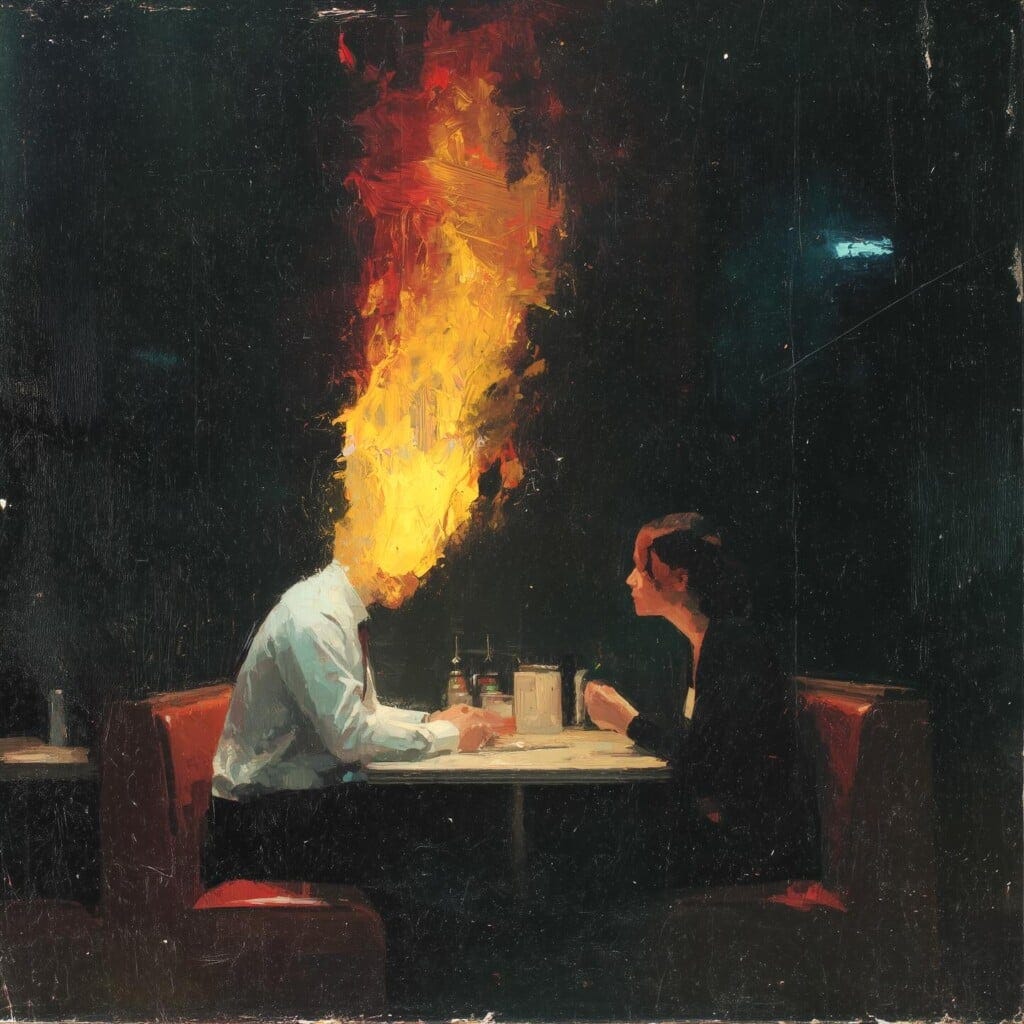
No doubt even his work is a target of the scoffers, because he uses generative AI to create it. But I’m not interested in the tools used; I care about the resonance of the scenes.
What Ponsato conveys through his images is that it’s not just the suffering itself that wounds us. It’s the fact that we carry it with us everywhere we go, almost always unseen despite its dramatic effect. We are immolated by it as we do the most banal of tasks. It is with us as we send emails, shop for groceries, drop the kids off at school, go to the gym, or share a meal with loved ones. It consumes us as we stare blankly at night at our computers or our television screens.
“Attention,” wrote Simone Weil, “is the rarest and purest form of generosity.”
We long for connection, understanding, and witness. We long for escape from a world where we burn without anyone caring enough to even notice. When we weep, how often do we do it alone in the dark?
Years ago, Michael Brendan Dougherty tweeted what to him must have been a throwaway line, because when I mentioned it to him later, he had no recollection of it. It was just three simple words, but they have stuck in my mind ever since, and I’ve repeated them countless times:
“Beauty is a salve.”
It is, I think, one of the only real ways to soothe our burning wounds. As I discovered in my old house, looking out across the desert at the sunsets and the storms, it’s not enough to replace a life that’s coming apart at the seams.
But I have grown to realize that it’s not nothing, either.
If we go into the world with enough receptivity, we can gather enough salve to soothe our wounds and get us through another day. And if we share what we find with others, we can help them to do the same.
But it’s not enough to just open our eyes.
We also have to lay down our arms.
We also have to open our hearts.
If you liked this essay, please consider subscribing—or send a tip (Venmo/Paypal/Stripe) to support me and my work.
Dude, you are knocking out banger after banger lately. And they all seem to speak directly to me. I recently decided to try making one of the front yard flower beds at my house as beautiful as I could make it. Nothing fancy. I'm not very creative, nor do i have the skills to really build anything. So all I did was clean it out, pull out the weeds, plant a few new bushes and flowers, bought an inexpensive stone bench and birdbath, put down some mulch, then a few granite pavers to make a walkway. It made the front yard look 1000% better. More importantly, it's a beautiful place to sit in the cool or the morning or evening. My wife, who doesn't really care much about landscaping or how our yard looks, couldn't understand why I did it. My only answer was that at this point in my life, beauty matters more to me than anything else. Now, like you said, if I can turn that into more than just an external, and apply it to all the human beings I encounter everyday, maybe I'll be a bit closer to the Kingdom of God. Alas . . .
A couple of months ago I realized that my season of essays and podcasts had ended. I have enough data points; more won't heal or bring peace. Now is the time for stories and music. Listen to some good fiction audiobooks while you're driving, or some Voces8. It helps.