


This is is a free post made possible by paid subscribers.
Writing is my profession and calling. If you find value in my work, please consider becoming a subscriber to support it.
Already subscribed but want to lend additional patronage? Prefer not to subscribe, but want to offer one-time support? You can leave a tip to keep this project going by clicking the link of your choice: (Venmo/Paypal/Stripe)
Thank you for reading, and for your support!
The question of UHI — Universal High Income — came up on my most recent podcast with Kale Zelden.
Today, Elon tweeted about it, and I’ve been having discussions with people about what it means for most of the afternoon.
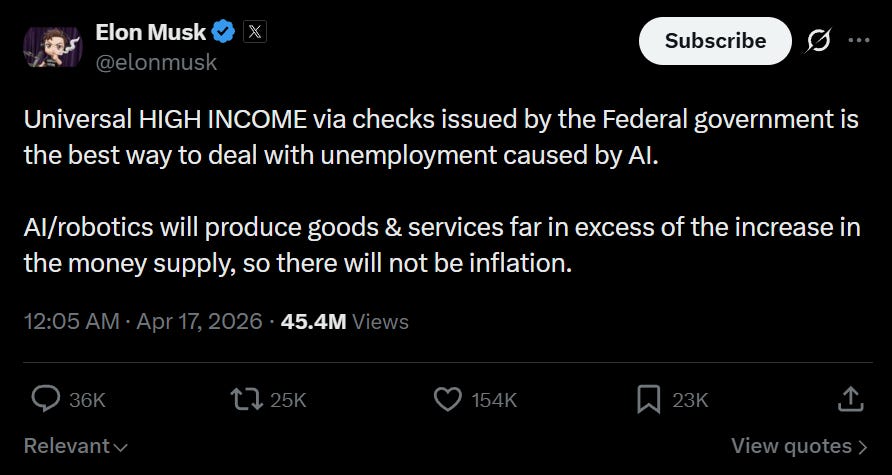
Very few people seem to get it.
So before I go spend the rest of my night DoorDashing (if you want to know where I fall in the hierarchy of great economic minds) I want to do my best to explain the issue here.
I am a not-unqualified admirer of Elon Musk as a singular innovator in the history of technology. I wouldn’t say I love this idea of UHI. But I do think it’s coming, and it’s preferable to the alternative — national insolvency under trillions in debt as low birthrates diminish the tax and labor base of every country, including the United States.
And so, I’m trying to grapple with what UHI will look like, and what the human cost of lost purpose and the flattening of competitive drives and the downstream psychological effects of moving from a scarcity framework to an abundance framework will be.
It is CRITICAL to understand that none of this happens without AI moving to space and deriving most energy for compute from solar in the near future. Elon says 30-36 months. 1 Million Tons of payload to orbit per year. That’s at least 10,000 launches annually. This is going to be the biggest industrial effort ever attempted.
The idea behind UHI might include distributed money initially, but as the paradigm takes root, it’s going to be more like “UFGS” -- Universal Free Goods and Services.
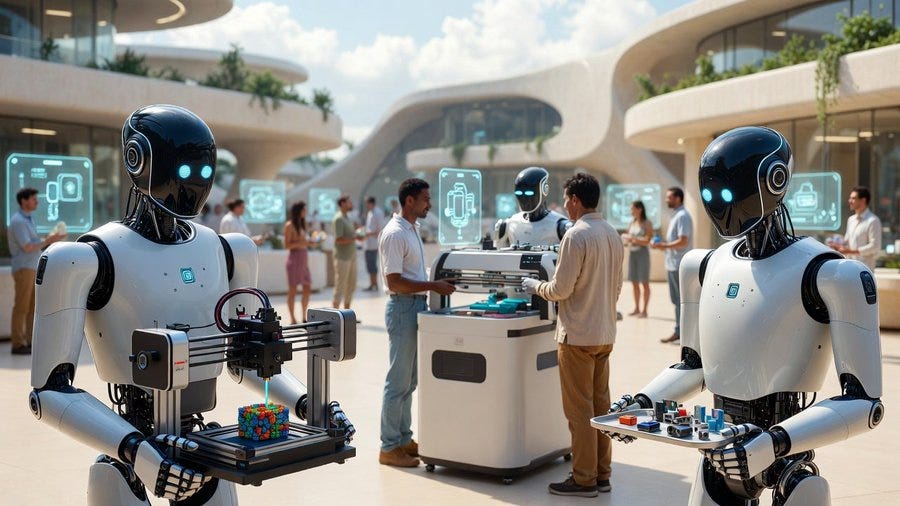
The idea, as I understand it, is this: After a large initial investment, AI & Robotics companies (and I suspect xAI/Tesla/SpaceX will pull far ahead on this because they’re tackling the limiting factors directly and have direct access to space) will use armies of synthetic laborers to provide services and manufacture material things.
Elon says there will be 10 BILLION robots in action by 2040. At minimum. And they will be Von Neumann machines -- self-replicating.
Because much of the compute will happen in space, powered by the insane amount of energy emitted for free by the Sun, the cost of accomplishing these tasks will diminish, while productivity will increase at a race that outpaces even a recklessly growing monetary supply. This creates a deflationary effect on currency and likely an end to existing monetary units as other units of value become more cogent for exchange.
As the delta between available goods/services and money widens, and more and more resources are taken from space, rather than from terrestrial sources, the cost of everything will be pushed so low that the scarcity problem will be effectively solved, and people will have everything they need and most of what they want even though their jobs are gone. They simply will no longer be needed to provide labor that can be done more cost-effectively by machines powered by free energy, utilizing free inputs (outside of CapEx, which will be inexpensive for the same reasons).
The governments of the world, if they still continue to exist in any meaningful way, will benefit from the same abundance. Whatever the new medium of exchange becomes, it might be distributed by governments to the people as a kind of payoff for handing over the economy to the machines. There are different models being proposed, from tax-based wealth distribution from the AI companies, to licensing of some kind, to shared ownership of the AI laborforce, etc. The exact structures have to be devised and worked out.
To my mind, the only real practical question is: can billions of AI-powered robots, harvesting from the superabundance of a nearly infinite universe of raw inputs that’s just there for the taking, produce more goods and services than we can ever use?
All the smartest people seem to think that they can.
There are lots of human questions that arise from a complete paradigm change of this nature. There are questions around robot sapience and ongoing alignment. There is a potentially massive loss of purpose and meaning and unrest and even suicidality that may come from that. There a million ways it could go wrong.
But to get to those in a way that we can meaningfully begin addressing them, we have to agree to the basic rough sketch of what the damn system would look like, and since human beings have never had access to a post-scarcity world, we’re having a really hard time imagining it.
It’s worth hashing it out. Because it seems very probable that it’s coming whether we like it or not.
If you liked this essay, please consider subscribing—or send a tip (Venmo/Paypal/Stripe) to support this and future pieces like it.
If we have abundance produced by robots, what will be the human toll? During COVID, when so many people were forced to stay at home because their jobs were non-essential, what happened? Despair, depression, loneliness, drug and alcohol abuse, suicide.
The powers that be need to take this into account.
As a human being, I have greater purpose than to be feed and tended to like cattle.
We have a historic analog: the modern superabundance of high caloric food. No one starves (well, almost no one).
And the result is runaway obesity.