


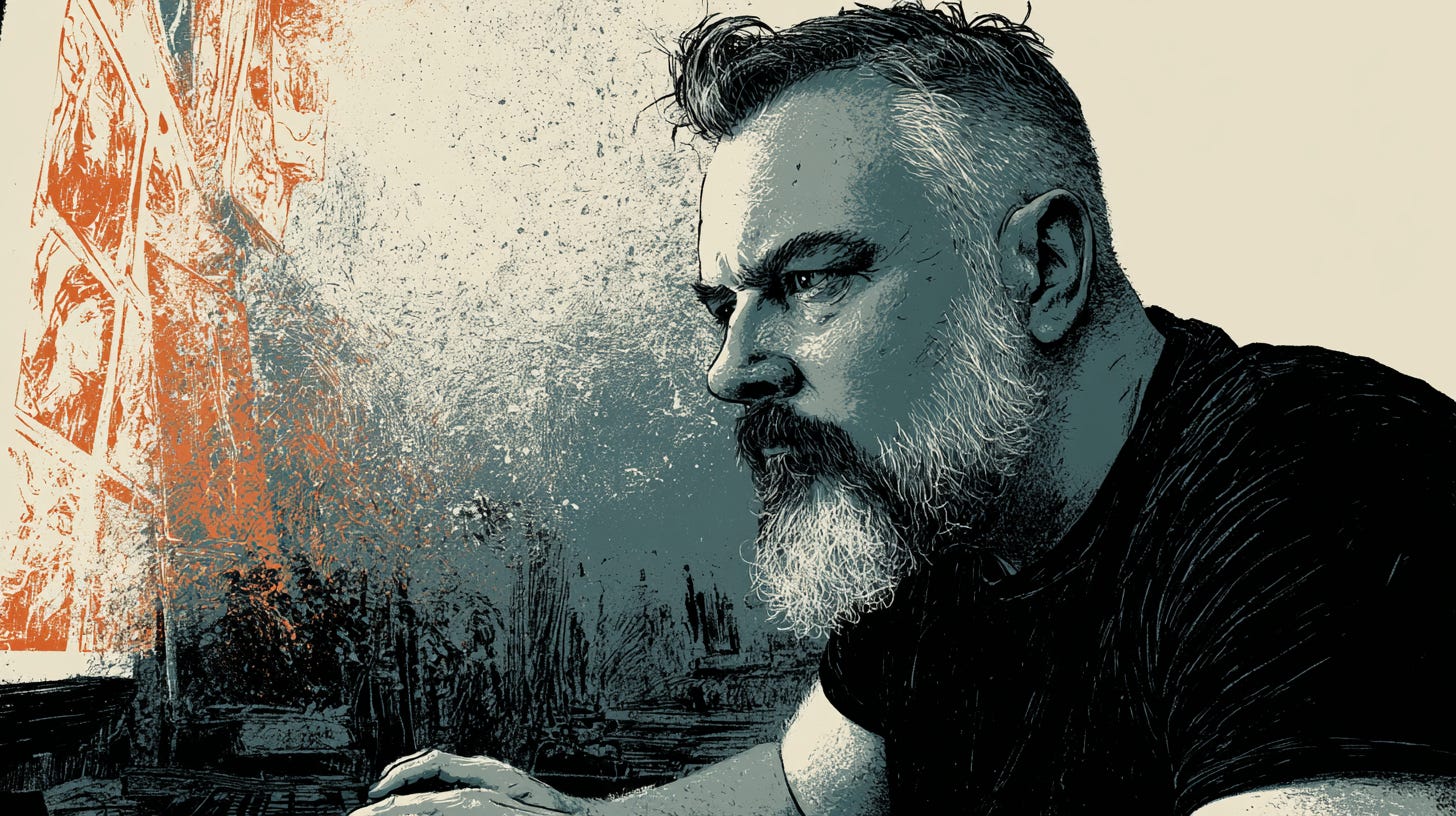
Someone online asked me about my writing process, and if I had any tips to share.
I never think I know how to describe it until I start…writing it down. Probably because I'm weird.
That said, since I have gone and written it down, I’d like to share it. Maybe it will help someone out there.
First, I think the process of writing is different for everyone. That's important. The way you go about it is likely to be as unique as your personality and the particular wiring of your brain.
I'm a very intuitive writer. I would never pass a grammar exam. I didn't even study it in school somehow. I never diagrammed a sentence. Almost nothing about how I approach my work is technical at all. (Feel free to laugh when I spell out nearly a dozen rules later on.)
For me, it's more like channeling something. There's a build up of energy, like static electricity, and when there's enough, it seeks a discharge. Often I know when it's time to write something because it starts writing itself in my head without any conscious effort from me. I just observe my thoughts rushing towards a topic, composing themes and sentences. Just enough to start the momentum. When I sit down, it just flows out of me and I'm often not sure where it came from.
It's the most Zen thing I ever experience.
It sounds weird as hell, but that's how it is whenever I write anything worthwhile.
Now, I can write about something that isn't like that, and when I have to, I usually outline, or at least gather datapoints, etc. I've written plenty of articles that way about topics I wasn't particularly passionate about.
Where I would say I probably get more technical (even though I said I didn't) can be summed up in the following list of fairly-flexible rules:
1. Writing is re-writing. I hate it, but it's true. The first pass almost never captures your thoughts in the best light. I coasted through my entire education turning in first drafts and getting As, and I thought that was how it worked. But when I realized the world is full of great writers, I came to the conclusion that I needed to up my game. Never publish a piece without at least one good editing pass. First drafts are lumps of clay. Subsequent drafts are where you add the fine details.
2. Read whatever you've written aloud. Like, the whole thing. Listen to the cadence. Hear how the words work together. Notice if you stumble because you've got words that are hard to say in a row. A piece that sounds good narrated is almost always a better piece to read. I don't know the inner mechanics of why, I just know it's true.
3. If you don't like what you've written, lower your standards. This advice came from a writing professor I had in college. I hated the advice at the time, but it was correct. You are your own worst critic. You will kill your own work if you let your inner editor have his way. He needs to STFU on the first draft. He gets his time on revisions. But sometimes, if something isn't working, you've got to downshift into a different gear. Let things be a mess on occasion. Do your best to get it there and then let it go.
4. Hemingway's advice to "write drunk and edit sober" was his own way of dealing with #3. But unless you're really good (and sometimes even if you are), drunk writing is almost always shit writing. (I've done some good high writing, but that's a different animal.)
5. Never under-index brute practice. I've been writing since I was about 5 years old. I won my first all-school writing competition in the 5th grade. I've been a professional (as in, paid work) since January, 2008, and I've put literally MILLIONS of words in print since then. At 1P5 alone I published over 1200 pieces in my own name. In 7 years. You will never reach your final form. Just keep working the muscle as often as you can.
6. If you want to write, you've got to live. Writing is a metabolic output of digested experiences. Do things. Anything. Put your phone down and observe. Look for scenes. Look for stories. Take photos. Take notes. Use these as fuel. You also need time to do nothing. Watch movies. Listen to music and podcasts. Play video games. Go for walks. Go for drives. Let your brain have time to churn through the compost you're feeding it.
7. Related to #6 - treat every piece of writing as a story. Stories are the most potent technology human beings have for conveying meaning. You're describing, relating, analogizing, painting mental images — even if you're writing non-fiction. You want people to feel like they're in the scene whenever possible. When a piece of writing offers people an experience, not just information, it stays with them.
8. Writers should be avid readers. I'm bad at this. My ADHD has gotten the best of me. I only get through books if I listen to them on audio versions these days. I need to change that, but it's hard. But even listening helps. I do read a lot of text every day, just not as many books as I should. Read in your genre of writing, but also read fiction. Never trust anyone who doesn't read fiction. I'm convinced they're all sociopaths. Fiction teaches us how to tell stories that others can inhabit. It teaches us how to describe worlds, but more importantly, it teaches us to observe and depict the subtlest aspects of human nature and interaction.
9. Write for yourself first, and the audience last. I'll let Rick Rubin explain that below, but where I would diverge from him is that I still keep the audience in mind. I would write things in my diary I would never write in public, but I write things in public a lot of people would never even trust to their diary. Find your comfort level on how much you're willing to bleed for your readers.
10. Be honest. There's a saying that goes something like, "There are many things that I believe that I shall never say, but I shall never say anything I do not believe." That's a good rule.
11. Read Orwell's rules for writing. Keep or discard as necessary. Never worry about the rules they taught you in school. End sentences in prepositions. Start sentences with "but" and "and." F*** rules. Writing is art. Develop your voice, and then treat that as your gospel.
Here’s legendary music producer and author of one of the best books I’ve ever read on creativity, Rick Rubin, who I mentioned in #9. This is actually really good advice that will help you get over a lot of mental blocks and fears of insufficiency:
If you liked this essay, please consider subscribing—or send a tip (Venmo/Paypal/Stripe) to support this and future pieces like it.
I've been using AI more. I have an "Assist" function with a slider where I can select how much I want it to change what I wrote. Here's three versions of your point #6 with the slider set to mild, medium, and wild. I only take what it spits out *if* I prefer it over what I had. And I take whatever bits or pieces fit. I do need to improve my Assist to model my style better - which it can do - I just haven't set it up yet. Here's the three variations...
If you want to write, you need to live. Writing is the metabolic output of digested experiences. Do things. Anything. Put your phone down and observe. Look for scenes. Look for stories. Take photos. Take notes. Use these as fuel. You also need time to do nothing. Watch movies. Listen to music and podcasts. Play video games. Go for walks. Go for drives. Let your brain have time to process the material you're feeding it.
If you aspire to write, you must first embrace living fully. Writing emerges as the creative transformation of absorbed experiences—a process where life becomes art through careful digestion. Engage with the world actively. Pursue any experience that calls to you. Set aside your phone and truly observe your surroundings. Hunt for compelling scenes and untold stories. Capture moments through photography and preserve insights in notes. These become the raw materials that fuel your creativity. Equally important is cultivating intentional stillness. Immerse yourself in films, lose yourself in music and podcasts, explore virtual worlds through gaming, or simply wander on foot or by car. Your mind requires this downtime to process and transform the rich compost of experiences you've gathered, allowing deeper connections and creative insights to emerge naturally.
If you want to write, you must first become a collector of life. Writing isn't born from thin air—it's the beautiful alchemy of lived moments transformed into words. So get out there and gather your raw materials. Pocket conversations overheard at coffee shops. Chase sunsets that make you forget to breathe. Document the way shadows dance across brick walls at 3 PM. Feed your creative engine with everything: the mundane grocery store interaction that sparks a character, the documentary that rewires your worldview, the song that soundtracks your next chapter. Your phone is a black hole for inspiration—put it aside and let your senses feast on the world's infinite buffet. But here's the secret ingredient: strategic emptiness. Your brain needs space to marinate in all this collected chaos. Binge that series. Take those meandering drives to nowhere. Let your mind wander through the gardens of boredom—that's where the magic cross-pollination happens, where random experiences collide and create something entirely new.