


People talk strangely these days.
Words that aren’t words. Phrases that feel alien. Boilerplate language that sounds like its stolen, perhaps unconsciously, from some influencer’s feed.
I got in an actual, honest-to-god argument with Merriam-Webster’s Dictionary the other day. Not the dictionary itself, obviously, the company that makes it. They posted something to their X account that I simply could not allow to stand.
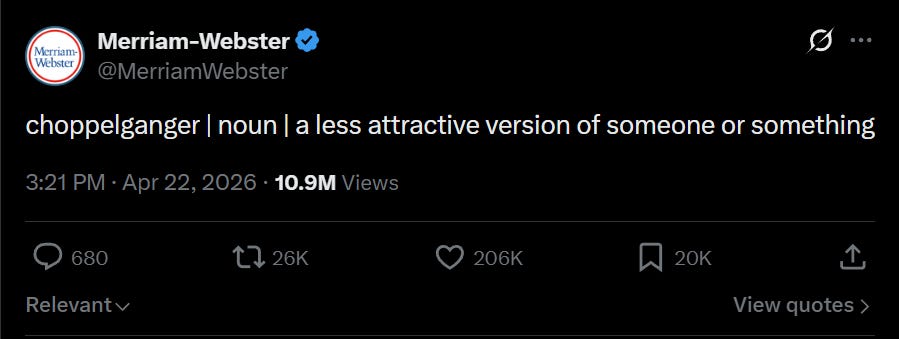
It was a definition for an entirely made up word:
“choppelganger | noun | a less attractive version of someone or something”
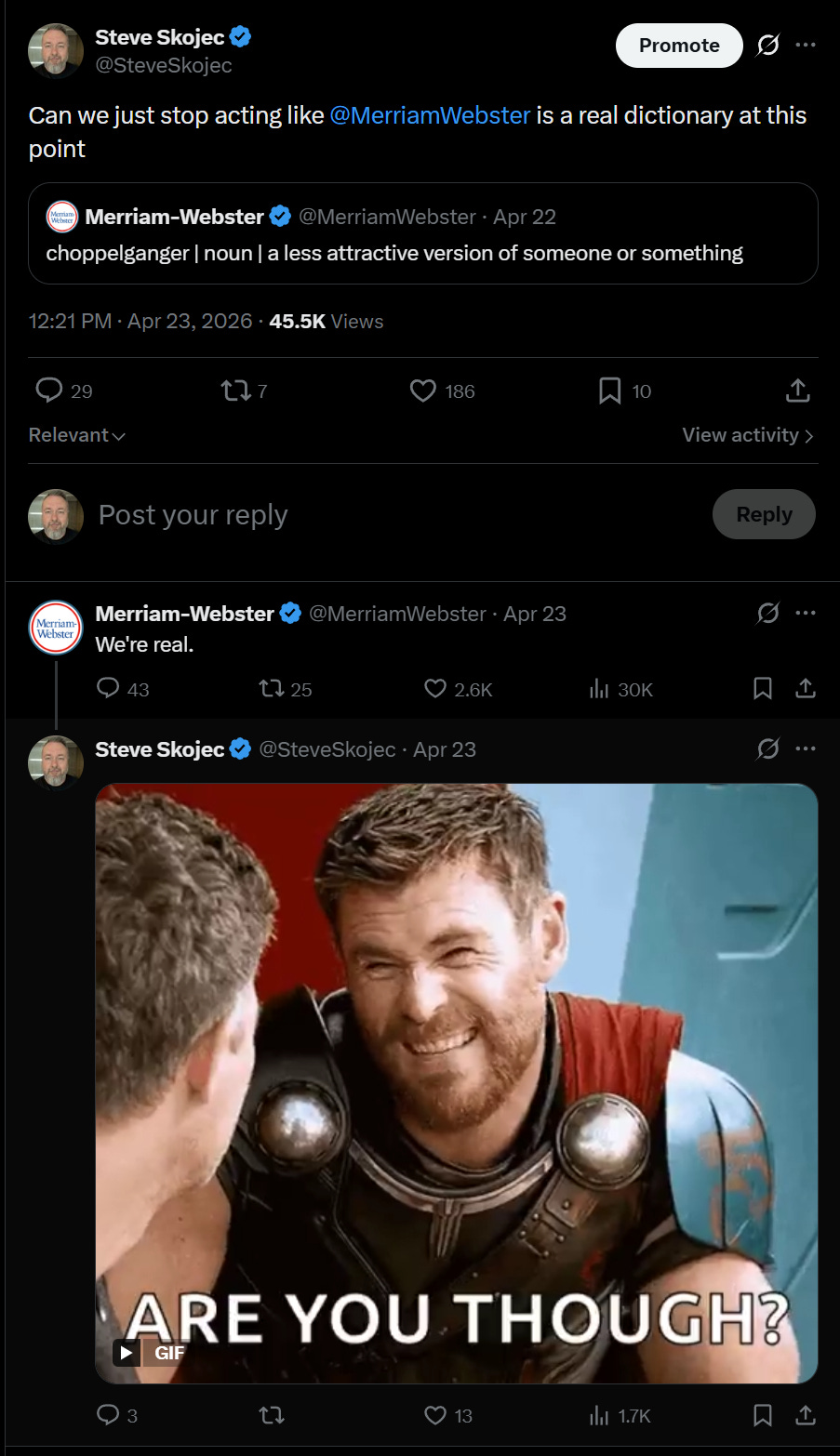
“Can we just stop acting like Merriam Webster is a real dictionary at this point?” I asked.
“We’re real,” they replied.
I hit them back with that one Thor meme. The one where he scrunches up his face and says, “Are you though?”
An argument ensued in the comments over whether dictionaries are descriptive or prescriptive that was so pedantic I can’t bear to bore you with the details.
But here’s the deal: I don’t just mean to say that there’s a problem with all the weapons grade slang Gen Z and Gen Alpha are introducing to the lexicon.
I mean, yeah, that’s a huge problem, but that’s not what I’m getting at here.
I mean that language is being re-calibrated to alter reality itself.
This is is a free post made possible by paid subscribers.
Writing is my profession. If you find value in my work, please consider becoming a subscriber to support it.
Already subscribed but want to lend additional patronage? Prefer not to subscribe, but want to offer one-time support? You can leave a tip to keep this project going by clicking the link of your choice: (Venmo/Paypal/Stripe)
Thank you for reading, and for your support!
Language is the most direct, most conceptually useful technology we have to convey meaning. We’re not telepaths. We use words. We tell stories. We describe, we detail, we define.
But I’ve noticed this thing creeping in, where the way we talk is actually being weaponized to strip away meaning. You see it in tech-related posts:
“Someone just quietly built a product that does this amazing thing, and changed the world overnight.”
Always dramatic. Always nonspecific. They know exactly who made the thing. But somehow it sounds more interesting when they act like they just stumbled upon some artifact of arcane technological power.
This type of language creeps across domains. In personal situations, it hollows out the real impact of the most important stories we tell.
The ones that most deeply affect our lives.
The greater the ambiguity, the more a person’s free will is claimed to have been washed away by elemental forces of fate and happenstance. The more we remove any semblance of ownership for the things we do, the more we seek to nullify the effect those things have on others.
Some people — even people who love to riff about agency and taking “radical responsibility” for your life and exhibit high executive function — will downshift straight into passive voice when it comes to talking about their questionable life choices. They take their ability to make decisions and bear responsibility and phrase them as though they’re environmental conditions — like the weather.
Sometimes it’s a simple dodge. The old, “I was young and needed money. I don’t know what to tell you.”
Sometimes it’s more sinister in its semantics. Hard to describe, but you can feel it when you come across it. It’s like the person is speaking some surreal jargon, where you know all the words, but they don’t add up to mean anything other than, “the buck doesn’t even slow down with me.”
Current relationship discourse is full of these neologisms, this collapse into passive voice.
People who live in active voice would just say what they mean:
Yeah, I chose to end this relationship/marriage.
I chose to remove you from our family.
I chose to exit my vows and stop working on it.
I did it knowing that it would hurt you, and I also chose not to engage with the hurt I’ve caused — or even admit that I caused it.
I’ve chosen to blame you for everything while paying lip service to “not being perfect,” which covers a multitude of ambiguous, unidentifiable “sins.”
I’ve chosen to take your inability to change into the person I demanded that you become and interpret that as a species of betrayal.
I also chose to see your unaltered differences as an implicit agreement with my decision to stop trying to make this work.
Instead they say:
The relationship/marriage “became” unworkable.
Boundaries “needed” to be set.
We “fell out of love” (“it was gravity, no one is to blame!”)
Things had “reached a point” where it was no longer viable.
It “became necessary to” protect myself and my mental wellbeing (at your expense).
It “had become clear” that it just wasn’t going to work.
Or how about just, “it was time.”
All the verbs are left to just wander around, in search of an actor.
I threw some of the language into ChatGPT, since language is what Large Language Models do. I asked if I was imagining it.
It said no.
“Passive voice,” it said, “is where agency goes to hide.”
I asked “Where the hell is this way of thinking, speaking, and acting coming from?”
“It’s therapeutic/legal/social-media divorce discourse,” it replied. “It gives a person a ready-made moral grammar for leaving while still feeling like the injured party.”
That seemed accurate.
It’s a subtle semantic shifting of culpability into a no-man’s land, or onto the other person’s plate.
The people who do it hide behind self-constructed walls. There’s always some new expectation, new rule (for you but not for them), some line in the sand that you are informed that you cannot cross. And that line is always well short of anything that looks like closure, or even an actual explanation.
If you’re on the other side of that semantic bulwark, you cease to exist as a real person. You are a construct, a compartmentalized avatar, sanitized and tucked safely away where your version of the story can never cause them to feel an ounce of responsibility or guilt.
After all, weren’t you the one who kept them from “becoming their best self”?
Weren’t you the albatross dragging them away from actualization?
Weren’t you the darkness in their visualization scheme?
“I know you’re hurting,” they might say, without acknowledging that they are the source of the hurt, or ever reckoning with its soundless depth. But their lip-service is guarded by a locked and fortified door. It’s never stated outright, but it has all the subtlety of a neon billboard reading, “You will not ever be talking about that hurt with me.”
I don’t know about you, but I can’t live that way.
I don’t always know how to do it, but I believe we should try to live in active voice.
Say true things.
Take ownership of what you do.
Believe it matters to keep trying when you promised you would, even when all seems lost.
Understand that your choices can wreak havoc on someone else’s world.
Do your best to own your failures. Do your best to make amends for your misdeeds.
Do not offer forgiveness you don’t intend to honor.
Do not demand from others what you yourself cannot give.
Seek truth, always. Even — and especially — when it hurts. And if you’re sure it’s true, you’d damn well better be able to explain why, especially if it deeply affects the life of someone else.
Especially when it’s someone you once claimed to love.
If you liked this essay, please consider subscribing—or send a tip (Venmo/Paypal/Stripe) to support this and future pieces like it.
Preach! You didn't need to ask an AI - I can confirm that this is a real thing. I think it's the natural evolution of corporate/HR bs speak, and is also a part of the fakeification/plastification/whatever you want to call it of every damn thing in the world. Fake wood floors, fake food, fake bodies, fake introspection, fake relationships, fake realization. All performative, existing only to be seen - no substance underneath. It's like everyone's happy living in a Potemkin world as long as it's postable.
Great article and so very true.
Let your yes be yes and your no be no.
The use of words with absolute meaning have been usurped in favor of ambiguity with a dash of "it's what I want it to mean" thrown in. They don't make decoder rings anymore.
Changing the meaning of words or better yet, making them up to fit a narrative, expecting a normal person to get it, not to mention having the ability to read between the lines is just plain.....wait for it....
neologistic.