


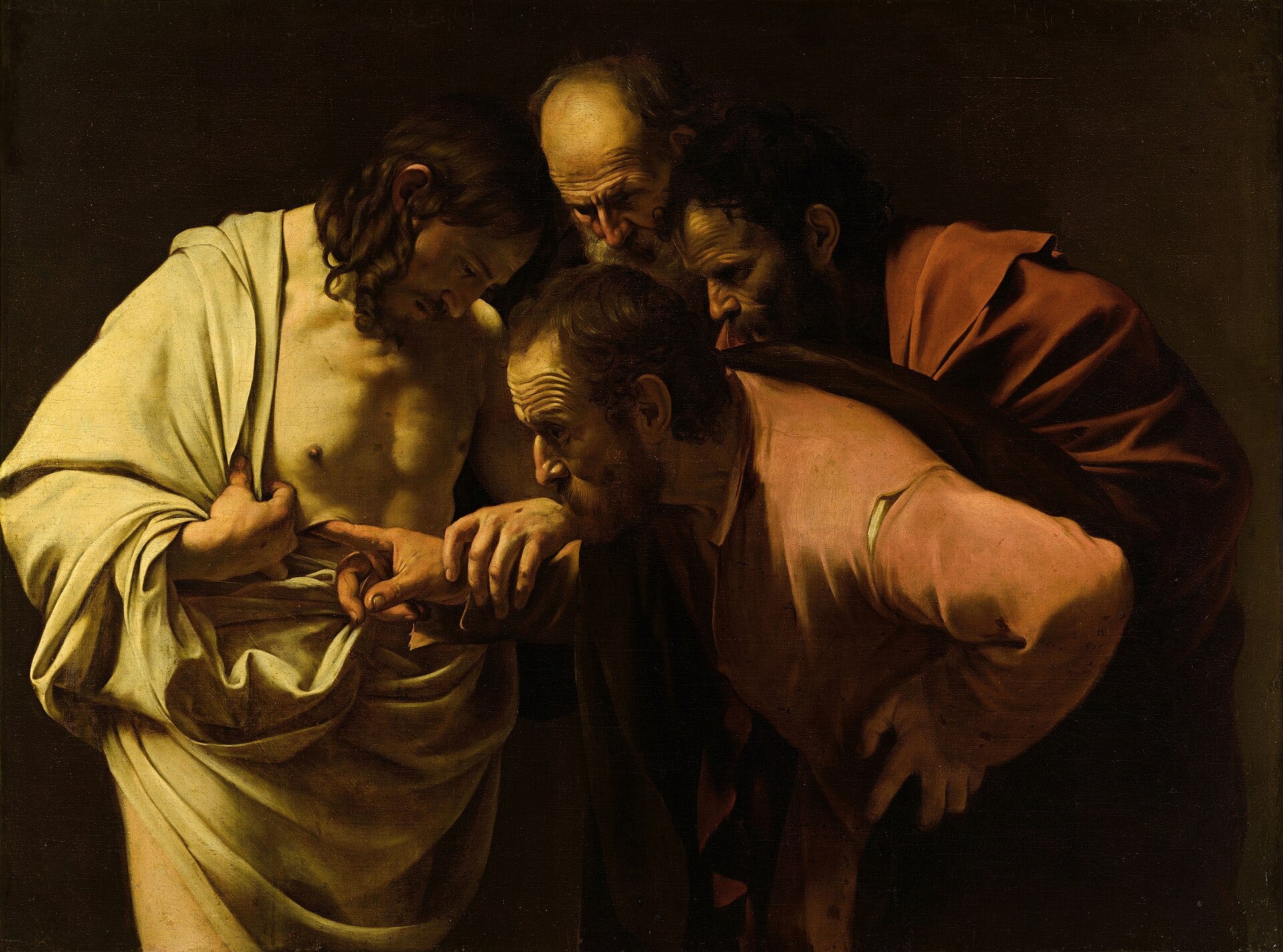
How many of us can truly say we know God?
Might seem like an odd question, coming from someone like me, but it’s at right at the bleeding heart of my struggle with faith.
I know a million theological propositions that I’m told are known about him, but I don’t know how we “know” many of those things, and more importantly, I don’t know him.
On a superficial level, I don’t know what he looks like, what he sounds like, whether he has a good sense of humor, what his interests are, whether his handshake is firm, if he’s a hugger or a bit more into personal space, what his favorite foods are, etc.
I’m being somewhat facetious here, but not entirely.
Obviously we don’t know these things about God, but there were quite a number of people who at least got to know these things about Jesus, whom not a single one of us has ever met, but are asked to believe is God-made-man. And these aren’t mere trivialities. They are all important embodied relational cues we use to understand the human beings that we love. There’s not a relationship we have with anyone on this earth where we don’t know the answers to most of the questions above, and many others besides.
And if you don’t know the answers to these questions, you don’t have an actual relationship with that person. That’s how it works. That’s how human beings relate.
So when I hear people talking about having a personal relationship with God, I always look at them like the “wait, you guys are getting paid?” kid from the meme.

How do you have a personal relationship with someone you’ve never seen, never had a two-way conversation with, and couldn’t pick out of a lineup if your life depended on it? I have online friends I’ve never met in person over decades of contact whom I know more about on a “personal” level than I know about God.
What I have instead is a list of propositions I have been told — by other human beings — that I am supposed to believe. And I have a list of threats about what will happen to me if I don’t.
I say “I” but I actually mean “we.” Because no matter how faithful you are to these propositions, unless you’ve had miraculous experiences (which are, by definition, hugely out of the ordinary), you don’t know God personally either.
You just have a different relationship with the lists than I do.
We are, of course, masterful at imagining we can at any given moment glean God’s presence, assume his intervention, and make some fragmentary assemblage of the coincidental breadcrumbs in our paths in our attempts to puzzle out the divine will. And because we believe that faith the size of a mustard seed can move mountains, we go all in on our conviction. I certainly did from the age of 15 to about the age of 43.
I was an altar boy, a lector, a CCD instructor, a youth group leader, a religious ed teacher, a door-to-door evangelist, an online apologist, and a writer of thousands of essays on the subject of faith. I got a four-year degree in Catholic theology. I did missionary work in four countries. I made it not just my personal mission to spread and defend my religious beliefs, but also my means of providing for my family.
I went all-in.
And so, when it all came apart, the consequences were as catastrophic as you might expect. Every egg was in that basket when the bottom fell out of it, and all of them broke when they hit the floor.
Of course, it didn’t happen all at once. It happened little-by-little. I felt my faith slipping through my fingers three full years before the last thread of religious conviction in my heart unceremoniously snapped.
I had a family. I had children who needed me to lead them by example. I had literally millions of readers at 1P5. I had a difficult marriage I’d been begging for God’s help improving. My entire social sphere, every single one of my family members and friends, were all Catholic. I had been not just “Steve” but “Steve the Catholic” for so long, there was no separable identity.
I also knew that, as a man of conviction and nearly compulsive honesty, I would not be able to keep quiet about the change in my beliefs. Telling the truth as I understand it is not just what I do, it’s who I am at a fundamental level.
And so, as any man of faith would do, I got on my knees and begged God for it not to happen. Literal tears, streaming down my face, beseeching him to renew my belief. On any number of occasions.
“Help me see what I’m missing,” I’d plead. “Help me to understand. Help me to believe in you and love you.”
I wasn’t praying for material goods. I wasn’t asking for a bigger house or a better job or a nicer body.
I was imploring him not to let me go.
But he did anyway, without so much as a barely-perceptible intuition that it was all for some higher purpose I just couldn’t see.
It’s been about 5 years now since my personal Thanos-snap, 8 years since it all started going. And I’m now not only not any closer to answers, but I’ve lost everything I had left that I cared about.
This isn’t a self-pity party. It’s just an honest assessment of the stakes.
Someone made the joke after listening to my discussion with Paul VanderKlay about all this that I was “Steve Job.” As much as I can’t stand the Book of Job and see it as an indictment of a God who treats us like disposable playthings, not beloved children, it hit the mark. (If only I had the material resources of Steve Jobs, though, so I could spend more time in contemplation instead of schlepping!)
The most obvious conclusion to me was one of the following:
God is not, in fact, loving, but is actually cruel and delights in the suffering of the people who try their hardest to please him.
God is not, in fact, there at all, so his failure to answer prayers is not an indictment of who and what he is, but rather an ontological misunderstanding.
I have been inclined to choose #2, but I am fundamentally not a materialist. I am, as I wrote recently, an agnostic who prays.
But this forces me out of the binary scenario I laid out above. And the only other option I’ve been able to conjure up is this: maybe God exists, but we don’t know nearly as much about him as we think we do.
This third option is inherently complicated. Religion is most compelling when it is dogmatic and authoritative. When each church tells you that they are, in fact, the only path to salvation, and all the other poor suckers trying to find their way through other means are in for a rude awakening when they die.
Who cares that they’re doing the best they can with what they know? They never for a moment had anything dispositive to go on, but damn it, they chose the wrong way of getting to God, so it’s hell for them for not solving the impossible mysteries of the universe with laser precision.
Offer people a “certain” way out of that, and that’s one effective way to get converts.
People who live with the fear of choosing wrongly, who have been told repeatedly by their religious leaders and teachers that leaving the path they’re on — or that the people they know and love who are on a different one — both lead to hell cannot, by definition, truly believe in the love and mercy of God. Somewhere, deep down, they know that the system is rigged. That they have been subjected to a test they do not have the resources to pass, and that a lot of it comes down to dumb luck (which faith you were born into or exposed to at the right time), perseverance in the face of legitimate doubts, and never second guessing.
So when someone in the club of the “elect” — someone who believes the same things that they do — falls away, they are struck with a kind of paralyzing fear.
“If it could happen to them, it could happen to me.”
They may not be conscious of the fear, but they react as though it is exceptionally dangerous. Like a contagion, which, left unchecked, might destroy them and everyone they love.
Thus they say things like, “You can’t lose your faith against your will,” or, “those who apostatize never really had the faith anyway,” or any number of similar thought-terminating cliches. This is the theological equivalent of wagon-circling.
They will ridicule, ostracize, and exclude as ruthlessly as necessary to spare themselves the need to face the reality that sometimes even believing in and knowing the faith with real depth and affection is not enough to stop a person from losing it.
Who Determines Whether a Scotsman is True?
The occasion for this reflection was a Substack I read yesterday by a Catholic writer who goes by K. Rose, called True Scotsmen Leave the Church: A defense of fallen-away Catholics and apostates.
I don’t remember where I came across it, but as I read it, I found myself thinking, “Wow, it sounds like she’s talking about me.” (Only later did I find out from the author herself that I was, in fact, one of the inspirations for the piece.)
She begins by describing the day she found out, as a married adult expecting a child, that her parents were getting a divorce after 27 years of marriage.
As someone whose 23rd anniversary is a little over a week away, and who is painfully concerned about the effects my impending divorce will have on my own children, I immediately felt the gravity of the comparison:
Most of my friends’ parents had gotten divorced during our school years—this was also the case for my husband. Going into marriage, I’d felt reassured that we had the example of my parents. Though very devoted to our vows, it is always best to a have a tangible example that a lifelong marriage is possible when you are surrounded by broken families.
You can imagine how the divorce impacted my feelings about my own marriage’s security. It did not do anything extreme, of course, but it made me nervous. If the most ideal example of marriage in my life could fall apart, was there really hope that mine could withstand anything?
My footing became a little more uncertain.
It makes us uncomfortable when we witness the failure of a deep truth in our lives. This is extremely understandable—we all want a steady, sure foundation to rely on. When the foundation cracks or breaks, the likelihood of other things falling apart increases. The entire thing may go up in flames. This is true of longstanding situations in our lives, such as our parents’ marriages, but it is also true of the lenses through which we view the world: our philosophies, our religion, our lack of religion. If truth itself can be undone, what is there?
The truth is, my failed marriage and my loss of faith are inextricably intertwined. I was never more convinced that any single event in my life was providential than the meeting of my wife. After four years at arguably the best university in the country for a Catholic young man to meet a good Catholic young woman, I had nothing to show for it but one brief relationship followed by a haphazard collection of crushes and a handful of first and second dates with various girls I didn’t ultimately connect with.
Then a series of unlikely coincidences led me not only to Phoenix, where I never intended or desired to go, but to the same workplace where I would meet my future wife, who followed her own string of odd coincidences there, only for me to have the specific spiritual knowledge she needed to overcome a particularly challenging situation that led ultimately to her conversion, and a very religiously intense first year together.
I was more sure that God had led us to be together than I’d ever been sure of anything that could not be empirically proven.
But the respective wounds we each carried with us, along with wildly different upbringings and personalities and neurotypes, overwhelmed the real attraction and complementarity that existed between us. It did this to such an extent that it came to feel as though God led us into a trap, inside of which we would both suffer without relief, no matter how much we prayed and begged and sought the aid of the sacraments, until at last the whole thing came apart.
And it nearly came apart a number of times before it actually did. The inefficacy of “the grace of the sacrament” couldn’t have become more clear to me within the marriage; as I have been forced to watch it end without my consent, I cannot help but concede that it was never healthy, and that we were both suffering dramatically within it.
So when Rose writes, “When the foundation cracks or breaks, the likelihood of other things falling apart increases. The entire thing may go up in flames.”
This is exactly what happened to me. Corruption in the Church alone wouldn’t have done it. My theological questions, objections, and doubts didn’t kill my faith on their own. It was the perfect storm of the theological as experienced through the personal that came down on my faith like a hammer blow and finally shattered the thing that had always been most precious to me.
And I assure you, I believed this was impossible. I believed it as surely as the people who try to make excuses for why such things can’t happen to true believers — though I never made those arguments myself. I never thought I would lose my faith, but I could certainly understand how others did. I came to that understanding by watching it happen to people I knew. People I respected and admired for their faith. People I loved.
Rose continues:
We like to reassure ourselves that our worldviews and beliefs are as obvious as 2+2 equaling 4, but we know that isn’t true. Quite frankly, if it were, we wouldn’t have faith itself, which is ultimately a gift from God. “Faith is a gift of God, a supernatural virtue infused by him. ‘Before this faith can be exercised, man must have the grace of God to move and assist him; he must have the interior helps of the Holy Spirit, who moves the heart and converts it to God, who opens the eyes of the mind’.”
It appears that our belief is, to some degree, out of our control—however, we know that God desires for all men to be saved, so it is not as arbitrary as some would have it. The burden remains on us, as God will do His part.
This is a terrible responsibility to have. I have felt its heaviness for ten years now. I once had a priest tell me in the confessional that faith can move mountains, but it is as fragile as tissue paper. I struggle to recall truer words, to be honest. The very thing that acts as the eyes of my soul and intellect could be obliterated.
There is not a creed in existence that is self-evident.
The most one can hope to figure out about God by the light of natural reason is the idea of St. Thomas’s unmoved mover, and even his “proofs” for the existence of a God without personal attributes appears to many philosophers as a case of special pleading. But even granting that Thomas’s reasoning is sound, we arrive not at a Father God, or the Trinity, or the “ineffable poverty of the divine, incarnate, crucified love” Von Balthazar speaks of, but the God of the deists; the divine watchmaker; the indifferent embodiment of cosmic life force who makes all things but does not care about or intervene in the affairs of men.
As for the question of faith in the specific God of a particular creed, this is one of those religious doctrines that seems to elude the most zealous of Christian triumphalists. They appear to think that man can gin up religious conviction all on his own. That faith is something earned through personal effort and a willing embrace of suffering, rather than a supernatural gift that can be given or withheld as God pleases.
More from Rose:
The existence of apostate Christians is not a secret one. Many are often very loud about it. Can you blame them? What else is there to do when everything you’ve believed falls apart? Stay silent? Do nothing? Is that what Christians do when they convert? Of course not. It is in our nature to share our stories when they are being rewritten.
This section felt very personally relevant to me. I had always been taught not to “scandalize” others through sinful behavior or the expression of religious doubt. But what I experienced was nothing less than the alteration of my entire worldview, and it was the worldview I had become famous for espousing. To fail to address my “deconstruction” felt to me like living a lie.
I had, frankly, a lot of explaining to do.
The reason I left 1P5, despite the fact that my work there provided adequately for my family for the first time in my adult life, was to avoid living this lie. I felt a duty to entrust it to someone who would carry out the mission in fidelity to those who believed in and supported it over the years. But the idea of retaining ownership of the thing so I could continue to benefit financially while hiring others to manage it and hiding my own loss of faith felt wildly disingenuous and dishonorable to me. And I was, after all, the face and main voice of the publication.
And now, here I am, 5 years later, living in a shoebox, barely scraping together enough money to pay my nominal living expenses through writing and delivering groceries almost every day of the week, wondering how the hell I wound up here at 48 years old, when I should have been planning for retirement in another decade or two, and enjoying the fruits of my labors.
So yeah, telling the story of what happened to me and why it happened was important, but it was also catastrophically costly.
Rose lists a litany of reasons why people may apostatize: Spiritual or sexual abuse, parents who prioritize religion over the wellbeing of their children (or who are pious at church but abusive at home), having an affliction like scrupulosity (which derives from obsessive-compulsive disorder) described as prideful or the work of demons, being subjected to deliverances over issues of mental health, being excluded because of a sexual orientation outside of your desire or control, or the torture of living with the interplay between scruples and religious guilt:
“It is Hell on Earth,” she writes, “to be so consumed by moral OCD that the only thing that brings relief is not thinking about your religion at all.”
This is something I’ve personally suffered from my entire life. It still afflicts me even now, after being gone for half a decade. I am still haunted by religious guilt and fear — things I hoped I would get some reprieve from after walking away. It is not the reason I walked away, but it certainly put enormous stress on my personal sensus fidei. Whereas other feel peace within the practice of their faith, I felt only constant pressure, stress, guilt, and fear. Only by living perfectly could I avoid these feelings, and I am far from a perfect man.
Rose again:
[M]any Catholics treat all apostasy the same way. I see the same platitudes given to those that are struggling: “Don’t leave Jesus because of Judas,” “The Gates of Hell won’t prevail,” etcetera. While true, platitudes aren’t infallible in the way our Church is, and people still leave.
I know a woman who entered two different convents and experienced spiritual and emotional abuse from the sisters at both of them. She was so convinced of her vocation to the religious life, but it was frustrated twice by abuse. I don’t know if she is practicing anymore.
What do you even say to that? She was one of the most faithful women I have ever known. She certainly put me to shame. What can I offer her besides prayers and understanding? Yes, understanding: I understand why she left the Church, if she did. I understand why those who experienced sexual abuse from a priest left the Church. Do you?
Some don’t. There is a common response to any sort of apostasy that drives me absolutely batty: “They weren’t really Catholic. They wouldn’t leave Jesus in the Eucharist if they were.”
I cannot stand it—the dismissive, pontifical hubris of it all. In many cases, it becomes the No True Scotsman fallacy: one insists on the truth of the Church, a counter-example is given, and they respond, “well, that person was never really Catholic.” I can’t tell if it is better or worse when the response is padded with something like, “it is truly horrible that they were abused, but they still [shouldn’t] have left.”
I watched that last line play out with my friend Joseph Sciambra, over and over again. The man was sexually abused by priests on multiple occasions throughout childhood and adolescence. He lived a profligate gay life that was not separable from these experiences — a life that was deeply harmful to him. When he tried coming back to church as a prodigal son, he suffered amorous advances from priests in the confessional, or told that his lifestyle wasn’t really wrong. When he tried to bring evidence of clerical grooming situations within dioceses to bishops — including “the good ones” — he got lip service at best. More often than not he was completely ignored.
And when he finally couldn’t take it anymore, and left Catholicism for Orthodoxy, which he felt had a much healthier clerical culture while still allowing him to be close to God, he was attacked, repeatedly, for his decision to leave.
Hell, for that matter, I’ve watched Rod Dreher go through this for the past two decades. He was a convert to Catholicism in the first place, but after covering the sex abuse scandal as a journalist broke his nascent faith in the Catholic institution and the clergy — largely because men he believed to be good men refused to stand up and oppose the evil that was going on — he had a decision to make: lose his faith entirely as anger and resentment consumed him, or keep it by turning to the Orthodox for something he believed Catholicism couldn’t give. For that, he’s been savaged by Catholics for as long as I can remember. And it’s unjust. He’s a good man, doing his best as life pummels him with his own sequence of unbearable blows.
A not insignificant aside: Rod was the first one to warn me that I was going to lose my own faith.
At the time, we knew of each other, but weren’t in any kind of regular correspondence. But he saw something in my writing, and he reached out, and he warned me what was coming if something didn’t change.
I listened, but I couldn’t find my way out.
I suspect this was always going to happen. Like Rose says in her piece, “We all want a steady, sure foundation to rely on. When the foundation cracks or breaks, the likelihood of other things falling apart increases.”
My foundation was always broken. I just didn’t know it. Eventually, under enough stress, the house was going to fall.
The Stories We Tell Ourselves About God
I began this piece by asking how many of us can say we truly know God.
That’s not just a rhetorical question. It’s a challenge.
Day in and day out, in my various interactions as an online writer on these topics, I have people tell me with certainty what God thinks, what he wants, how he desires for us to live, what I should offer up, what I should be doing, and so on.
And I have gotten into a habit of always pushing back:
“How do you know that’s what God wants? Did he tell you that?”
They always say yes. They always then proceed to say it’s in the Bible, or in some encyclical or catechism or similar authoritative source.
“That’s not what I asked,” I’ll say. “I asked if God spoke to you directly.”
Most people admit he didn’t. Some will try to conjure a subjective experience they had into a locution. But none — not a single one, not ever — has any evidence for their claim that they know beyond the shadow of a doubt that their belief, which is mutually exclusive of other people’s beliefs who also believe they know with certainty that theirs is correct, is actually truly the thought of God.
Which is why I think it’s important to make a distinction between “the mind of God” and “our conception of the mind of God based on the study of theology by men.” Because a lot of the answers to the questions we can’t seem to resolve may lie within the delta between the two.
One of those things, for me, is the inconceivability of the notion that an omnibenevolent God who is mostly hidden from the human race, with its universally limited intellects and imperfect wills, could ever justly condemn any of us to eternal conscious torment in hell — let alone the vast majority of us who are allegedly lost due to the “fewness of the saved.”
Without getting into the particulars of that discussion in this piece, which is already running long, I want to share something that my interest in the topic led me to. In his excellent book, That All Shall Be Saved: Heaven, Hell, & Universal Salvation, David Bentley Hart makes a key distinction I think we should all re-orient our religious epistemology around:
[I]t makes no sense to take a metaphysical principle as trivially true as “God is not an ethical agent” as a prohibition upon all moral interrogations of Christian teachings about God. In point of fact, a moral agent is able to fail to act justly precisely because he or she suffers the limitation of possessing goodness only by appropriation; he or she is good only so long as he or she willingly acts in conformity with Moral Agency as such. That infinite Moral Agency itself, however, suffers from no defect in respect of its own nature, and so is never unjust. So, if the traditional Christian philosophical claims about God are true, we are permitted to arrive at all sorts of analogical conclusions regarding how God might act, so long as our frame of reference is correct. If we know what it is for an ethical agent to act in accord with moral goodness, then we have some sense, however limited, of what moral goodness is in itself, in God who is its source and substance.
Now, obviously, this still does not mean…that we have any warrant for trying to pass judgment on what we take to be God’s actions in any particular isolated worldly event, since any such event is one whose causes and consequences and conditions and circumstances all quickly slip beyond our ken, and we can have no sense of how that event fits into the pattern of the whole of things. Any such judgment on our part would be made from an infinitely inadequate perspective. If, however, we are not confronted just by this or that particular contingent tragic or terrible episode or circumstance, of which we are trying to make sense within the context of all other contingent events and conditions, but are instead presented with a comprehensive story that purports to be nothing less than the total narrative and total rationale of all God’s actions in creation, then we may indeed pass judgment on that story’s plausibility. In fact, it is morally required of us to do so; not to judge is a dereliction of our rational vocation to know and affirm the Good. And here, recall again, we are not assessing God’s acts against some higher standard of ethical action; we are merely measuring the stories we tell about him against his own supposed revealed nature as the transcendent Good. It is our story that is being judged for its internal coherence, in keeping with our rational grasp of justice and benevolence, not God who is being judged according to some external scale of ethical values. Thus, for instance, it is perfectly permissible to say with confidence that God, by his nature, could not create a reality containing rational creatures, all of whom, for no reason save the exercise of the divine will, he keeps entirely ignorant of the Good during their lives, and then mercilessly consigns to eternal torment thereafter as a penalty for their misdeeds. Because he is the Good itself, God cannot be the author of absolute injustice, absolute evil; such an irrational possibility would be a limitation upon the infinite freedom with which he expresses his nature. [emphasis added]
This applies to more than just the question of hell itself, of course. It applies to all the stories we tell ourselves about God.
I had any number of doubts that I forcibly suppressed during my lifetime of religious belief, and I did so for the explicit reason that I was not allowed to ask those questions. I was supposed to fall to my knees and offer my assent, not point out the discrepancies until everyone I knew threw their hands up and abandoned the conversation.
I am not at all certain that I am correct about every objection. I am not at all certain that all the stories we tell are wrong. But it feels almost impossible to me that they could all be correct, and even before I lost my faith I was at times nagged by the sensation that I was defending something that was rationally indefensible because I was obligated to do so, not because it struck me as good or decent or true.
I simply reached a point where I refused to suppress the objections produced by the mind I was given — arguably by the same God I was asking these questions about — in the interest of honoring an obligation I never consented to in the first place.
The Most Consequential Dilemma
I can’t say there has ever been a single moment in my post-Catholic life where I felt proud of the decision to leave. I have often felt that it was inevitable, or painfully necessary, or freeing, or any number of things, but never once has it been something I am honored to proclaim.
I announce it because it’s so relevant to the kinds of people I talk to, and the meaning-making work that I do.
Still, I feel diminished by it. Materially, personally, socially, and spiritually. I know it is a source of pain and confusion to many people who care about me.
I am prone get combative about it when attacked, certainly, because there are a lot of absolute assholes out there masquerading as Christians, quick to condemn, or to tell me that 30+ years of study and practice is nullified by my apostasy and I can therefore no longer have an opinion on ecclesial matters that are currently unfolding. As though all that knowledge was simply erased by my recusal from the sacraments, because “sin makes you stupid” or some other equally low-res explanation.
Of course, those same people would almost certainly excoriate me if I made sacrilegious confessions by not having contrition for my theological defections on matters of dogma, or if I received the Eucharist without even believing it’s truly the body and blood, soul and divinity of Christ. They would not appreciate if my lips performed a dishonest recitation of the Nicene creed.
They don’t want me to fake it any more than they want me to be honest about what was lost, but they also don’t appreciate that I respect their beliefs enough not to pretend. They merely want me to suffer for having the audacity to tell the truth about what happened. For having the integrity to say, “I can’t do this because I no longer believe in it with the requisite conviction, and all the wishing and all the praying in the world hasn’t changed that.”
They want me to be evil, or driven by slavery to some hidden sin, because if I’m not, then it means it could happen to them, too, and they want to lash out at me for reminding them of that fact.
Rose touches on this point as well:
If someone can abandon something that was the foundation of their lives, full of so much opportunity to transform them, was it even real? It is natural to ponder this. I asked myself this about my parents’ marriage. Was it all a lie? Were they actually happy?
Without getting into the gritty details: yes, the marriage was real. They had been happy, but the divorce was not a surprise to at least one of them. In fact, it would be profoundly insulting to insist that it was all a facade because it fell apart in the end. Its dissolution did not nullify the twenty-seven years of partnership they shared, or the personal growth they went through as a result of the marriage.
It is equally insulting to suggest that someone was a fake Christian because they left the Faith. It devalues the changes they may have made in their lives, their struggles to be faithful, the ways they grew as people. Depending on the reason for leaving the Church, their departure may be more understandable than their staying. The more correct decision? No. Understandable? Yes.
Like I’ve said, we do this as a form of self-protection. Pretending that it wasn’t real protects the power of our beliefs, but it also protects us. If we pretend that every person who leaves the Church was an imposter, we shield ourselves from our own moments of doubt. I know most of you have had them.
I’ve stood on the precipice myself. I have seen myself in the apostates. It has utterly terrified me at times. What do I do? Feel angry at them, excuse it away, ignore them—anything but sit with the terrifying reality that I, too, could leave what has been my salvation for my entire adult life.
So was it real for me?
Yes. And also no.
Yes inasmuch as it was the core framework of my existence, taught to me from the time I was old enough to understand words. I grew up in a milieu where Catholicism was ground truth, the most important and consequential thing in this world and the next, where living it correctly meant a founded hope for heaven, living it poorly meant eons of suffering in purgatory, and living without it meant certain damnation.
Catholicism gave me a sense of purpose, identity, boundaries, and answers to life’s deepest questions. It gave me father figures in the priesthood when I was struggling to figure out the strained and often terrifying relationship with my real father. It imposed order on the chaos of my mind and the uncertainty of its ceaseless questions. It gave me acceptance among the men of my tribe, and a way to feel at home no matter where in the world I found myself — all I had to do was walk into a Catholic Church.
But it was ultimately insufficient, at least as it was constituted, to withstand everything my lived experience of being a Catholic threw at me. Some of its central claims appeared to me as not just tarnished, but corroded straight through. Some of its moral claims increasingly struck me as outrageous, and certain teachings I was obligated to assent to appeared too absurd to take seriously. It was by turns both too anodyne to prompt a contemplation of the transcendent and too harsh to make it possible to see God as Love.
And that, ultimately, lies at the heart of why I think I lost it.
The “no” in the yes and no question of whether it was real for me comes down not so much to an intellectual exercise, but the experience of divine love.
I can’t say I ever believed God loved me, and I’m not sure, therefore, that I ever loved him. What I was doing with him was a religious version of people pleasing — appeasing the angry deity in order to avoid his wrath. The occasional upswelling of zeal in my breast may well have been an incidental side effect of a psychological construct.
The God I believed in, frankly, was not lovable. He was aloof, capricious, arbitrary, angry, and withholding. And he appeared to feed on human pain, what with all the times I was told about him delighting in us offering it up, and all the saints saying we should run towards suffering. On the other hand, he seemed to always refuse to answer even my most fervent prayers for help with faith, hope, and love, with understanding of why things were happening the way they were, or to offer saving grace to heal my marriage, but was always ready to remind me I wasn’t doing enough for him (directly or through his countless human proxies) or to punish me for my sins — whether here or in the hereafter.
It doesn’t particularly matter whether you think any of that is true. It’s God as I experienced him, and your experience, if it’s different, is nothing like my own.
What many believers fail to understand is that religion — particularly the Catholic religion, with its intricate and extensive collection of rules and axioms and obligatory beliefs — is torture for some people. An endlessly growing chasm between expectations and what you get. A non-stop assault of guilt and obligation with no perception of mercy, peace, healing, or love.
When I read Rose’s concluding arguments in her full piece, what I see is someone struggling with some of the same things I am. She is both trying to reassure herself and her readers of her fidelity, and crying out for help making sense of a lived experience of a faith that is tearing her apart:
Perhaps you feel that you could never leave; maybe you are completely, utterly convinced. You have probably had a harder life than me. I am happy for you. I’ve had moments like that before—long ones—but it would be a lie to say that my moral OCD hasn’t done damage, or that the misery of feeling so restrained in what I may enjoy or do hasn’t crushed me, or that the goodness of those who wholly disagree with me (and the badness of those who fully align with me) hasn’t deeply challenged me.
Leaving would not be justified. It is never correct. It doesn’t mean it hasn’t been sorely tempting, though. Some have succumbed to the temptation that I have managed to fight. Am I better than them? I don’t think so. I think I might just have more willpower and openness to God’s grace. Maybe I’m just too scared of going to Hell after I die and that imperfect contrition keeps me going. (I am sorry to be so blunt. I do believe in and cherish my faith. I make it a point to be honest with you all, though. If Jacob wrestled directly with God and was still saved, I think I can share my thoughts and be okay.)
Truly, I have dragged myself across broken glass and ran through fire for my faith. I have denied myself many things, forced myself to be comfortable with what hurts, changed my life drastically. This does not make me special, but I cannot sufficiently explain how painfully difficult it is to be a Catholic sometimes as an autistic woman, and if it weren’t the truest thing in the universe, I would have nothing to do with it. If I were to fail in my fidelity, nothing would push me further away than being told all of it was a ruse.
She sounds a lot like I did back in 2018, when my own faith first started to flicker, then dim. And if she’s reading this, I would offer a similar warning to the one I received, though I can offer no wise remedy, inasmuch as I never found one.
It is both terrifying to consider losing a faith like that, and also sorely tempting, because you hope that on the other side you might actually find some relief from the chronic, relentless suffering that it causes you. And from the endless obnoxiousness, frankly, of far too many of your co-religionists. (I always say that Catholics comprise the subset of both the best and the worst people I have ever known.)
Rose appears to understand something I try to tell my older children, some of whom also no longer believe:
You cannot afford to take this lightly. You can’t just decide it doesn’t make sense and therefore, you’re done trying to figure it out.
If the things religion teaches are true, what you do with that is the most consequential thing that you will ever decide. You must wrestle with it. You must seek answers. You must try to to come to terms with what you do and don’t believe and why you do or don’t believe those things.
I battle with it every. single. day.
I talk to him, even though he never talks to me.
I try to be aware of my biases, my anger, my resentment, and my bitterness. Sometimes I let them win. Sometimes I keep them in check.
But one thing I’ve learned is that the people who condemn you for leaving or treat you like a leper because you’re on the outside looking in are the ones who are the most fragile in their own faith — and not in a way that involves a healthy struggle with it, like Rose is trying to do.
They choose not to think about it at all, maybe because they were taught by some careless priest (as I have at times been) never to even entertain a doubt, never to give the devil any quarter. You can’t guard your house from the noise you hear downstairs in the dead of night by pretending you didn’t hear it. You have to investigate. You have to be ready for the violence that the investigation may produce.
The people in my life whose faith is the most authentic are — and I am more certain of this than anything else pertaining to religion — the ones who never feel the need to hassle me about it. They know I know. They know I take it seriously. They don’t check in, they don’t ask how the struggle is coming along, they don’t mention it obliquely like they’re tiptoeing around a minefield. They are free to talk about their faith around me, and I’m free to talk about my doubt around them.
They treat me like a human being whom they believe God loves, and who is going through something for some purpose none of us understands. Whether I believe that’s what’s happening or not, they do, and they act accordingly. They trust the process. They actually believe that God is loving and good and merciful and has a plan for everyone, including apostates like me, and therefore, they feel no urgency to speed up his process through their own machinations. My doubts may at times present certain challenges to their faith, but their faith, lived authentically, presents real challenges to my doubts. And in this exchange, we are mutually enriched in our pursuit of truth.
If there is someone in your life who is struggling with faith, or has lost it already, it is of paramount importance that you understand this.
If you live as a Christian, and you are magnanimous and virtuous and kind, you are living testimony of the transformative power of your belief. If you profess being Christian, but are cruel and caustic and condemning, thinking you’re committing a work of mercy in your endless admonition of sinners, you are driving people away from God. I tell you this with absolute certainty. There have been so many times when my heart was softening and then I encountered someone like this, and I immediately reverted to battle mode, all softness evaporating like dew in the desert sun.
The phrase “Preach the Gospel; if necessary, use words” may be apocryphal in its attributions, but it is undeniably efficacious. Start there.
Your job isn’t to reconcile apostates and correct sins; it’s to show those people, the best that you can, that the answers they seek lie with the God you believe you’ve already found.
If you liked this essay, please consider subscribing—or send a tip (Venmo/Paypal/Stripe) to support this and future pieces like it.
Thanks ,Steve, for sharing this. And also for retweeting Rose’s essay on X earlier. Im not trying to be sappy, but your essay is beautiful and reads like a prayer from the aforementioned Job. Eloquent, earnest and honest. I intend to read this through again and really sit with it.
Keep going. When I was in a grey cloud a long time ago I came across a simple list of 12 ways to know God , and I printed it and put a tiny copy of it in several places desk drawer, bulletin board, in books as bookmarks and it fed me while I couldn’t stay recollected myself… https://www.peterkreeft.com/topics/12-ways.htm