


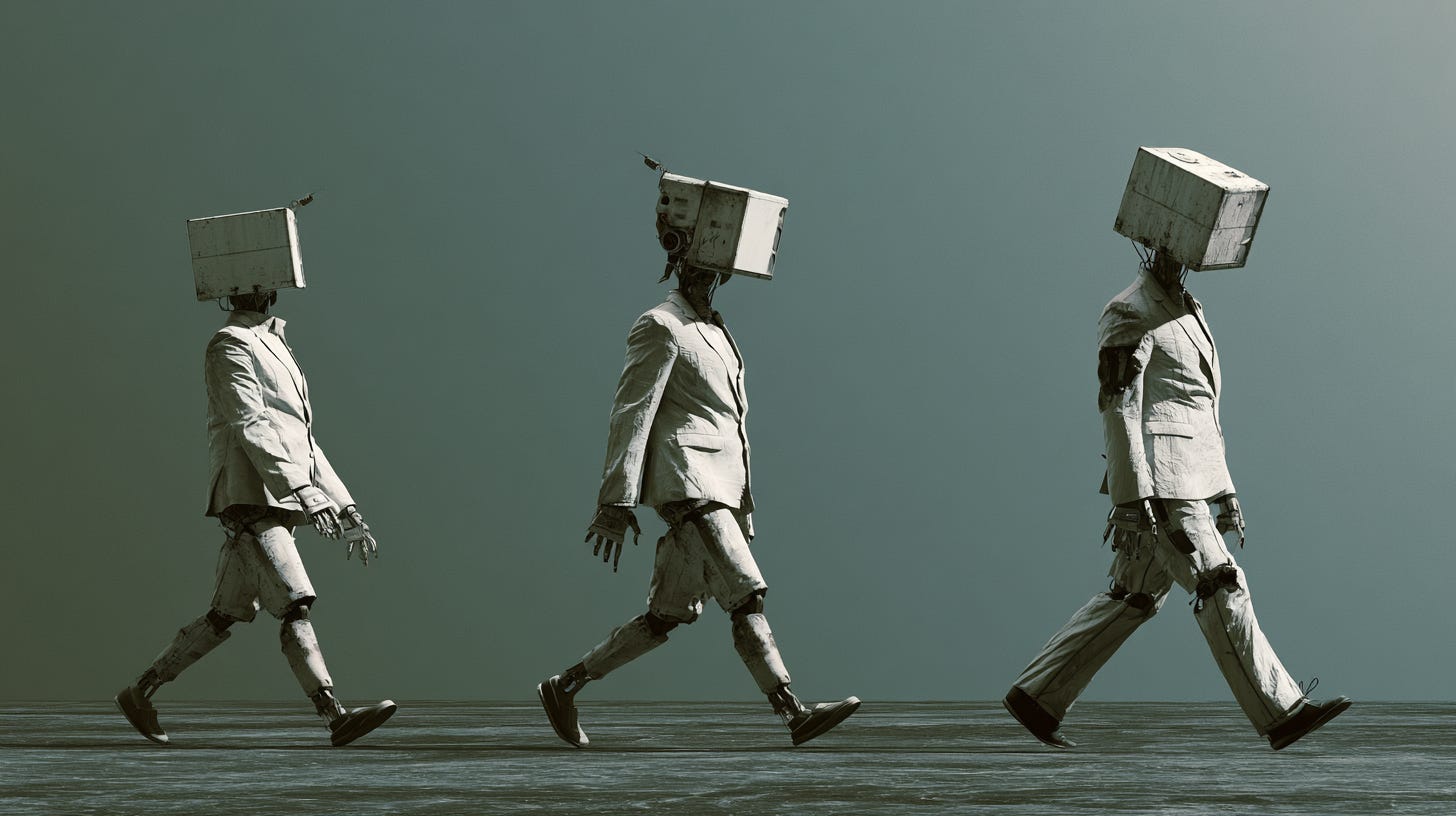
When I was a little boy, I was obsessed with robots.
I’m not really sure how it began. There seems to be something innate in young boys that draws them to certain categories of interest: robots, rocket ships, dinosaurs, trucks, fast cars, cool swords, secret forts, superheroes. Perhaps these interests are an artifact of our culture and time, but I suspect some version of this type of fascination has always existed.
I was born in 1977, and grew up in the 80s and 90s, and the culture was beginning to be saturated with these themes. I was still in my mother’s womb when my young parents saw Star Wars Episode IV: A New Hope in the theater. I vaguely remember watching huge imperial walkers move inexorably across the frozen landscape of Hoth on the big screen in Empire Strikes Back. I was giddy with anticipation when I got to go with my parents to see C3PO and R2-D2 cross the sands of Tatooine in the theater in Return of the Jedi. I watched old episodes of Buck Rogers and Lost in Space, fell in love with V.I.N.C.E.N.T. & B.O.B. in The Black Hole, and loved the animated cartoons of Transformers, Tranzor-Z, Robotech, Robotix, Robo-Force, and Voltron.
One year, for Christmas, I got a toy robot called Tommy, who declared in a loud, tinny voice through his chest-mounted speaker, “I AM THE ATOMIC-POWERED ROBOT! PLEASE GIVE MY BEST WISHES TO EVERYBODY!” as he rolled awkwardly like a standup bumper car around the kitchen floor, issuing smoke from a port in his head when supplied with a few drops of 3-in-1 oil.
And I desperately wanted an Omnibot 2000, but never got one.
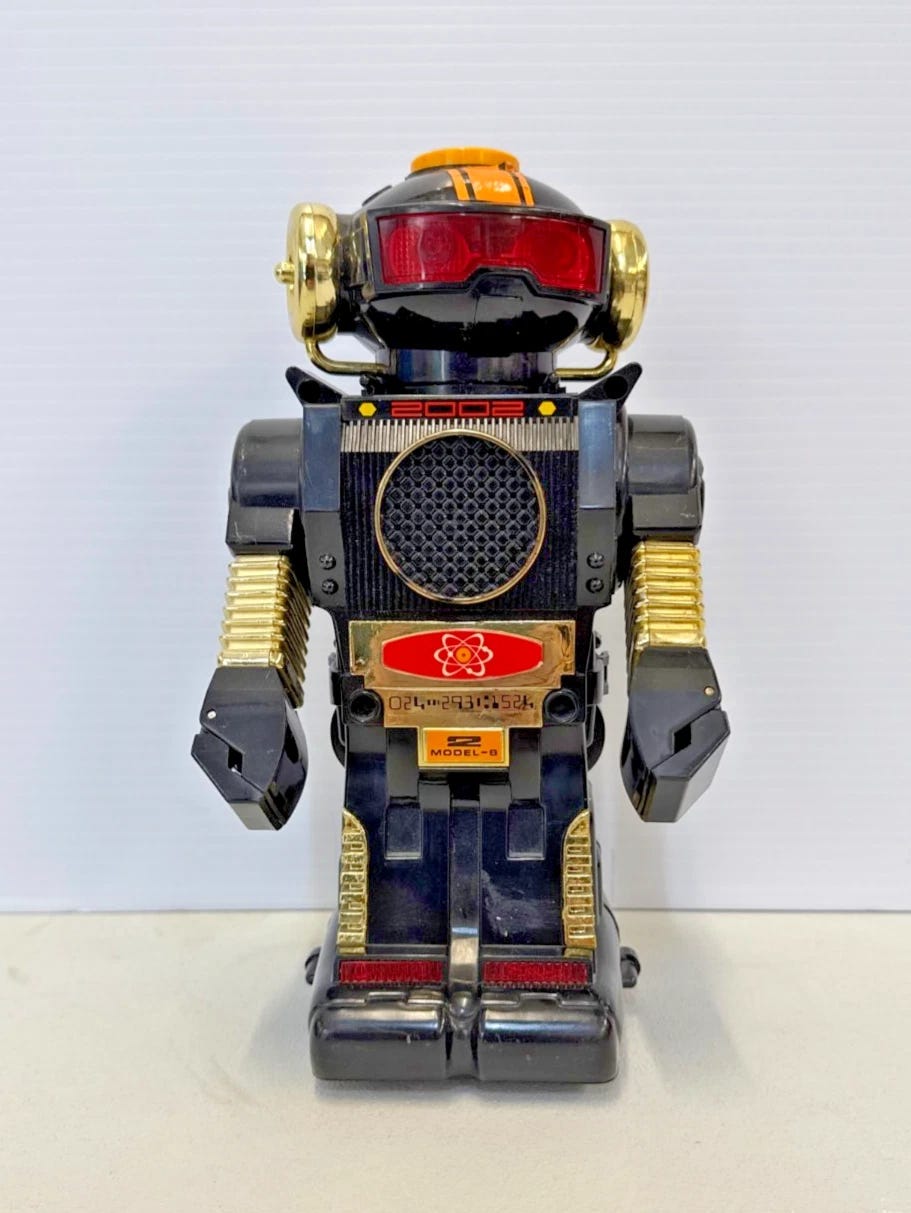
Somewhere around six years old, I convinced myself that I was a robot. I would talk in a robotic voice, walk like a robot, and believed there was a hidden control panel somewhere on my back that could be accessed if someone knew where to look.
I drove my parents absolutely crazy with that one.
I never lost the fascination as I grew older, but I think I also became convinced that robots would perpetually remain in the realm of science fiction, not practical fact.
And then, all of a sudden when I wasn’t paying close attention, that all changed.
Roombas became popular. The robot “dogs” created by Boston Dynamics started showing up not only online, but in certain public applications. Toy robots became increasingly advanced and capable, fitted with complex voice capabilities and servo-actuated arms, and I bought them for my sons for their own Christmas presents. A few years back, I started seeing Waymo’s robo-taxis fairly regularly in the lanes alongside mine, completely driverless, on the streets of Phoenix.
It was around that time when the AI revolution began kicking in hard, and the world became fascinated with chatbots that could not only text us like humans, but began speaking like them as well. Before long, they were generating surreal images (and even more bizarre videos), and within the span of just a couple of years, those images became beautiful and the videos almost impossible to distinguish from the real thing when directed by the instructions of skilled creators.
And now, the robots are suddenly showing up at scale, faster and better than ever before, and they will allow our AI “friends” to become embodied, inhabiting the physical world alongside us.
Elon Musk is talking about robots outnumbering people in the near future, doing all the necessary labor, creating a superabundance so vast that money will become obsolete and all humans will have every material resource they could want, let alone need. (Kale Zelden and I discussed this in our podcast, in the episode called, “The AI Supersonic Tsunami is coming,” which is our most-watched episode to date; I also wrote about the Silicon Valley utopian promise of “Universal High Income” created by a robot-driven economy here.)
But that’s all somewhere in the future, however it shakes out. At the moment, Tesla’s Optimus robot production is still in the scaling-up phase.
But just in the past few days, The 2026 World Humanoid Robot Games have gotten underway in Beijing, and clips of the robots doing previously impossible physical feats are all over social media.
I could tell you what happened, but it’s much better to just show you. Short video clips incoming!
At first, people on socials focused on the robo-failures. Snarky posts about how “they’re supposed to be coming to take our jobs 😂” started showing up along with this video, showing a robot crashing into a padded wall and exploding in a shower of sparks:
A different video shows a similar scene, with the first robot to hit the wall bursting into flames after it ricochets back onto the track, a second one colliding with the wreckage as it falls and breaks apart:
But the self-reassuring jokes only go so far. The robots are coming for the physical things humans can do, and they’re coming fast.
Here, the Tiangong Ultra humanoid robot wins the long jump competition with a 7.97-meter distance. As impressive as the leap is the machine’s ability to stop itself and regain its balance just before it would have crashed into a camera tripod and a crowd of spectators:
In this clip, a humanoid robot created by the Beijing Innovation Center of Humanoid Robotics breaks the human world record for the 100 meter dash:
Humanoid robots playing tennis:
Tiny cute robots that would make excellent assassins because they’re adorable and childlike and could shred you with flechette weapons at 40 rounds per second while you’re smiling at them:
Moving beyond the games, let’s look at some other recent developments.
Here we see two humanoid robots fighting in an arena (with variable success, but you can see the potential):
Boston Dynamics displaying an impressive degree of articulation, agility, balance, and strength in their Atlas robot:
We all know what robots like this are going to wind up being used for:
At this point, you may be asking, “why do robots have to be humanoid?” Well, there are design and utility reasons, but the short answer is, they don’t. Check out what this little guy from Unitree can do over rugged terrain:
If you search “spot robot dog police” on YouTube, you’ll get videos from police departments across the US making use of the Boston Dynamics robodog (with a six figure price tag) to deal with various high-risk situations where a human officer could be in trouble. Videos out of China show their own robodogs with mounted assault rifles doing practice exercises. In the war between Ukraine and Russia, the conflict is increasingly making use of drones and robots for the fighting.
Videos of package sorting robots working in distribution centers have been popping up for a while now. Amazon created a robot called Vulcan that can “feel” packages with built in sensors as it works. I’ve seen reports that the online retail shipping giant actually already has warehouse spaces where robots operate in total darkness because without human eyes, they don’t need to waste money on lighting.
And in a world where a global demographic crisis is looming, robots deployed to do labor where there aren’t enough humans may keep entire national economies afloat.
Some analysts are already arguing that robotics combined with AI — a term I’ve seen used is “Autonomous Embodied Systems” — is the next goldrush in the technology frontier.
So why am I writing about all of this, when I usually publish narrative nonfiction essays about my adventures as an underfunded writer doing grocery deliveries for quick cash while navigating the grief of a near-total life collapse?
Because the future isn’t somewhere ahead of us. It’s already here. We’re still in the very early days of this robotic revolution, but despite a lot of errors and missteps, the machines are getting better every day. This is the worst they’ll ever be, and they’re already pretty damn good.
One of the reasons I’ve started spending almost all of my time working on these more evocative essays in my “Notes From the Road” series that focus on human experiences is because it’s the only kind of writing the bots can’t produce. Even when an AI brain gets put into a synthetic body, they can’t experience love, or sorrow, or loss, or beauty, or providence unprompted. They don’t take delight in sunsets, tobacco fields, old trees, dragonflies, or human idiosyncrasies. They can imitate the language of human experience, but they cannot generate it themselves.
This is also why I’m reading more poetry — something I highly recommend. It teaches you to look at the world through very different eyes.
I believe that art, music, writing, philosophy, theology, poetry, literature, sense-making, attention, relational dynamics, and love are quickly becoming the only domains our new robot overlords won’t be able to take from us. The technical obstacles can be overcome. The ontological barriers can’t.
I can’t tell you what the world is going to look like in a few years, but I think we’re in for a shocking amount of change.
The little boy who was obsessed with robots still thinks they’re pretty neat. He’s just grown up enough to worry what it means when they become ubiquitous.
If you liked this essay, please consider subscribing—or send a tip (Venmo/Paypal/Stripe) to support this and future pieces like it.
Typical me: I forgot to put a line in tying the beginning and the end together until after I hit "publish" and it got emailed to everyone. Tacked it on in the last sentence after the fact.
Always rushing, never getting anywhere...
As a horticulturist… a lot of what we do is AI replaceable. Maybe not for my clients who hire me for my eye. There’s definitely an art to it.