


“There is no safe investment. To love at all is to be vulnerable. Love anything, and your heart will certainly be wrung and possibly be broken. If you want to make sure of keeping it intact, you must give your heart to no one, not even to an animal. Wrap it carefully round with hobbies and little luxuries; avoid all entanglements; lock it up safe in the casket or coffin of your selfishness. But in that casket—safe, dark, motionless, airless—it will change. It will not be broken; it will become unbreakable, impenetrable, irredeemable. The alternative to tragedy, or at least to the risk of tragedy, is damnation. The only place outside Heaven where you can be perfectly safe from all the dangers and perturbations of love is Hell.”
— C.S. Lewis, The Four Loves
“To really love someone,” she said — on a walk with me at night, or maybe on the beat up couch in the front room of her little rental house on Brady Avenue, I can’t remember which — “is to open yourself up to violence.”
I had never thought of it that way before. It hit me like a lightning bolt. The other, sharp-edged side of love.
But I was 22, and in my mind, it was a risk worth taking. Most likely a problem for other people, not for me.
She wasn’t my type. Physically, that is. Rail-thin, angular features, an asymmetric set to her jaw, a cultivated harshness of countenance that signaled not insignificant danger. I’d never have picked her out of a lineup as “most attractive.” But her mind was intoxicating, and she had a tendency to soften around me, and somehow that made her more beautiful than she was. She was still haughty, and playfully cruel, but something about me brought out the feminine in her. We spent countless hours talking, flirting, intellectually fencing, but never, in all those months we spent in close proximity to one another as often as we could, made it as far as a kiss.
And then, like Icarus, I got too close, and she melted. Found a pretense to become angry or defensive about something improbable and withdrew, her protective mechanisms finally activating after she realized I’d slipped past her guard. I saw her all the time that semester, right up until I suddenly never saw her again.
But the lesson about love remained.
And the lesson about love is true.
We have a tendency, some of us, with our big hearts and romantic sensibilities, to perceive our capacity to love as a kind of energy that can penetrate armor, soothe wounds, and heal what is broken inside of others. If they’re hurting from deep and nameless wounds, maybe we can love enough for the both of us. Maybe we can carry them until they can walk on their own.
We see the way they respond to our attention, our devotion, our desire to see the best in them and to elevate them in such a way that they become something more pure, more authentic to who they really are than when we found them. We truly believe that if we could get them to see themselves through our eyes, they’d know how incredible and deserving of love they truly are.
And maybe, just maybe, they’d love us back.
But I’m not above
making up for the love
You’ve been denying you could ever feel
I’m not above doing anything
To restore your faith if I can
— Billy Joel, An Innocent Man
But as my beard has turned white, and more life has spilled forth from me than I have left in my veins, I’ve come to understand that this way of thinking is a fantasy. The otherness of our beloved, whoever they happen to be, is inviolate. Sacrosanct. We cannot love them the way they need to love themselves, and it is often the case that we only think we can because we always wanted someone to do the same for us.
Two men I’ve known for years, both Catholics, both firm believers in the indissolubility of marriage, have recently revealed to me that their decades-long marriages are terminal. A number of others who I do not know personally have reached out over the past year since I disclosed what was happening in my own life, telling stories of their own.
Mostly, they have been men. Some are men who wanted desperately to love their wives into healing and happiness. They know full well that they are imperfect instruments, but they believed nevertheless in that power, in its ability to overcome all obstacles. And when it doesn’t, they inevitably feel like abject failures.
I wasn’t enough, they think.
I couldn’t give her what she needed.
I thought God meant us to be together, but why would he put us together if I couldn’t complete the mission? Why would he lead us to this if it was going to end up in catastrophe?
Why am I such a failure?
This thinking represents an almost messianic belief in the power of love. I used to believe in it too. I used to think I had what it took. I saw myself as a rescuer, and as irony would have it, wound up being perceived as the problem from which rescue was required.
It’s true that I didn’t even know how to fix me, let alone anyone else. But it’s also true that I had a deep need to love and be loved. Still, no matter how much love I felt, my sense of its transformative power seemed never able to reach beyond the confines of my own perception. Like a kid fresh out of a Star Wars movie stretching out his hand, screwing up his face in concentration while trying to use the Force to crush an empty soda can, I wanted to believe so badly in this power that I thought maybe, just maybe, my love could do something totally outside its natural scope.
And I wonder sometimes, if it were possible to go back, and take 25-year-old me out for a drink, if I could get him to even listen to what I’ve learned.
Because I know him, and the power of his belief, and the more I think about it, the more I believe he would disavow his future self. Maybe he’d get angry at what he might see as my attempt to dissuade him. I bet he’d double down, seeing me as a cautionary tale of a future wherein he didn’t try hard enough, and therefore failed. A version of him from another universe, where if I’d just loved more unreservedly, believed more fervently, attacked the limiting factor sooner, I would have succeeded like he intended to do.
You cannot teach someone the full weight of a personal understanding of defeat.
Do not let me hear
Of the wisdom of old men, but rather of their folly,
Their fear of fear and frenzy, their fear of possession,
Of belonging to another, or to others, or to God.
The only wisdom we can hope to acquire
Is the wisdom of humility: humility is endless.
— T.S. Eliot, 4 Quartets 2: East Coker
When a life-bond of any real duration ends, it is not the only thing mourned.
An entire constellation, a universe of memories and people and experiences and things has been built around that union.
It’s not just the past that feels lost, but the future itself that has been foreclosed upon.
Gone are the hopes of late night conversations, unhurried dinners, travel to those places out of reach when children were small and fussy and money was tight and the comforts of home always needed to be close at hand. Vanquished are the dreams of lazy Sunday afternoons sitting on the front porch holding aging hands, watching the grandchildren play in the yard as we anticipate dinner and conversation with our own children, now fully grown.
The better future we were working toward no longer exists. The time invested — more than a quarter of a human life — slips through our fingers like ash.
But it’s not just shattered dreams. There are the practical questions:
Will I choke on my dinner in my lonely apartment, and nobody will know? Will I slip in the tub and hit my head? What will I do, years down the road, when my knees give out and I need help to get around?
Will I die alone?
I have tens of thousands of family photos and videos on my hard drive. Who will I share them with? With whom shall I reminisce about the anesthesia nurse who delivered my son, or that scary afternoon when he fell out of a tree and hit his head, and had to be stapled back together at the hospital? Who will I talk to about that trip to Boston in 2007, or the Redwoods in 2017? Who will I ask the thing I can’t quite remember about the campground outside Yellowstone, or the stormy coast of Assateague, after we lost the baby that October?
How will I navigate every holiday, every birthday, every graduation, engagement, marriage, and birth? How is it fair to force our children to become diplomats managing our detente?
And will they think, because they’re half me and half her, that there’s an unresolvable war inside of them? Because our love broke, will they feel broken too?
I’ve gotten the hang of solitude a little better after all this time, but it sneaks up on me if it goes on too long, unbroken. How many years of this can I take? Is it acceptable not to hate myself for what I’ve done wrong or her for what she has, and if so, what does that mean for why we’re not together anymore? Am I allowed to pursue the desire not to be alone? Am I permitted to hope for love again, without worrying that it’s a betrayal of the sacred thing that mattered to me most?
And even if it were possible for me to meet someone new, why in the world would she want to enter into a life already fully formed, with so many children who are already my first priority? And what losses would she have to have suffered for her to want to be with me?
Last week was very full. My parents were in town, and I got to see them twice — once with my family, and once by myself — after being apart for nearly seven years. That distance was my choice, not theirs, and I had my reasons, but I’ve also realized that I’ve reached a place in my life where I’m ready to let those reasons go.
Is it forgiveness? Is it acceptance? Is it exhaustion? Is it the recognition that love is too scarce to squander, even when it isn’t perfect or easy all the time?
“I’m sorry it’s been so long,” were the best words I could find. “I had a lot of battles to fight all at the same time over the past few years, and it’s been hard.”
Maybe they understood. Maybe they didn’t. But it seemed to be enough.
As they sat in my tiny one-room apartment, barely big enough for the three of us, I showed them photos and videos of my road trip last fall, the one I took after the separation in the hopes of staying sane. The one that very likely saved my life. One video, one I hadn’t watched since I made it, was, in my memory, mostly a compendium of footage from the road. But as we watched it, and the tragic lyrics of the song it was set to did their work, scenes of being with my wife and children played across the screen, and suddenly the grief I’d made so much progress overcoming was an ocean, and I was drowning in it, being dragged into the deep.
The lyrics of that song spoke not just of sorrow, but the loss of identity that comes when a man who proudly put “husband and father” first in his self-description suddenly feels like neither thing will ever again be true, at least not in the way they were:
It’s not over
and it never was for me
If I’m not yours then
who else could I be?
You’re moving on
and I’m drowning in memories
But who else could I be
I broke down, hard, and in that moment, my mother crossed the room and put her arms around me where I sat. She didn’t say a word. She just cried with me as she held the large man who was once her firstborn little boy. In that moment, I realized that it was the first time since this all started that someone embraced me and held on and let it all flow through me.
I needed it more than I knew.
The next night, Kale Zelden came into town, on a road trip with his brother. We ate birria tacos at a place so loud we could barely hear ourselves think, then went back to my place and drank bourbon and talked until 2AM, real friends in the real world talking face to face, not just across hundreds of miles through the magic of a screen.
And then, just like that, everyone was gone, and it was a rainy Friday night, and I was alone again, trying to do deliveries through tears that wouldn’t stop. For one week, my life was so full again. My kids, my parents, my best friend, excavating the things I had finally stopped dwelling on every moment of every day, and when it was abruptly over, it felt like being deposited by a tornado on the shores of some forsaken land.
On Saturday morning, I woke up still feeling the emotional hangover. But I also quickly realized where I’d gone wrong. In asking all the questions about what had happened, I’d gone back to asking unanswerable questions about what happens next. And it’s the future I can’t see, more than the past I can’t change, that seems to drag me under.
The reason Nolan’s Odyssey was such an unexpectedly spiritual experience for me was because it told me, in different words, the same things all the dragonflies have been whispering for months:
You cannot control your fate. There is only the raft and the sea. You do not have your bearings or a paddle or a rudder or a sail. You must surrender to the storm to get where you are going. You only have the ability to do what lies within your power; the rest must be left to the gods.
As I was thinking about all of this, I ascended the steps of someone’s front porch to drop off their groceries. Looking to my right, a single symbol stood out among a large pile of junk. I didn’t see anything else. Only one thing existed:
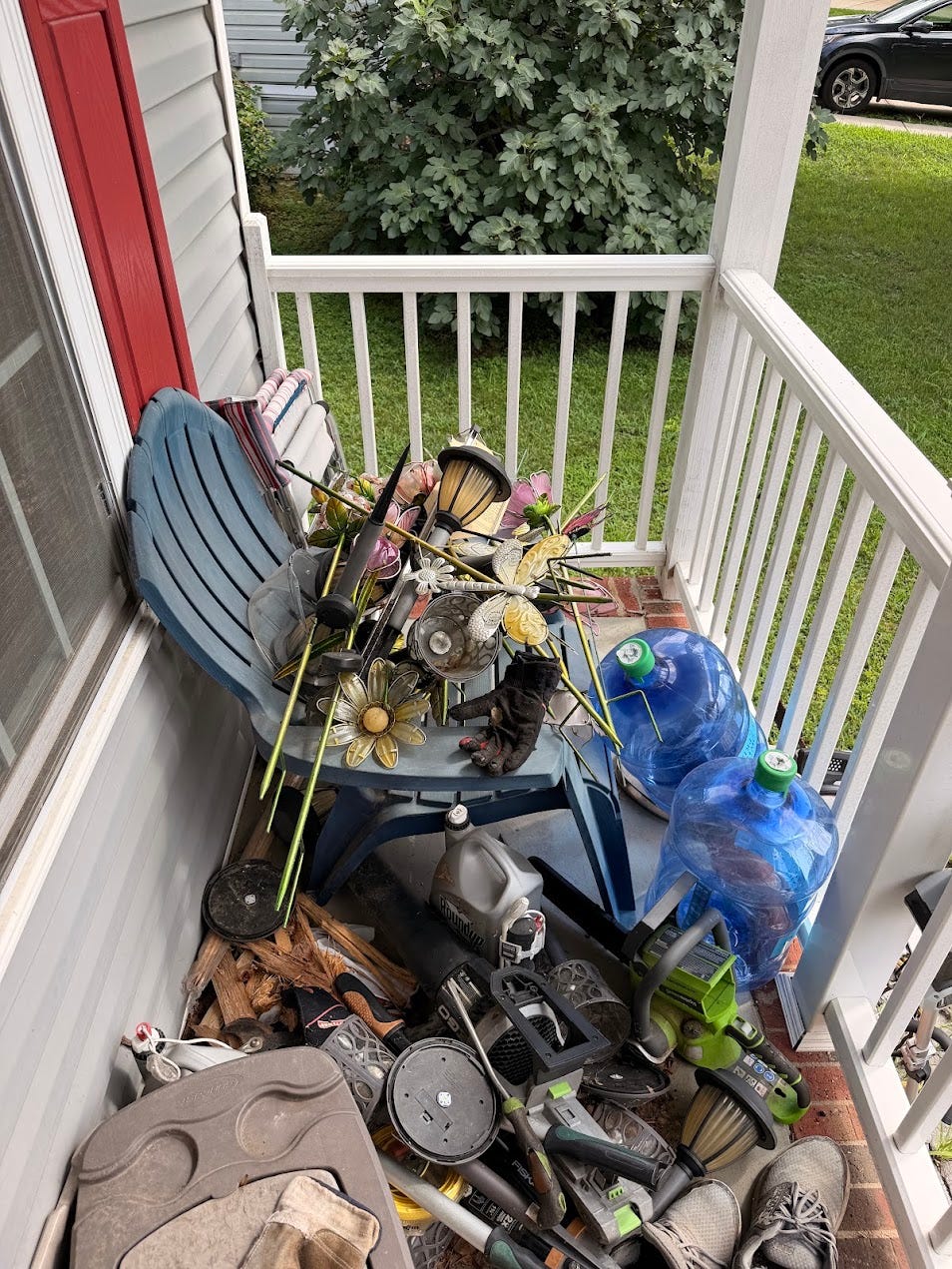
A single dragonfly ornament, perched right on the top of all the refuse:
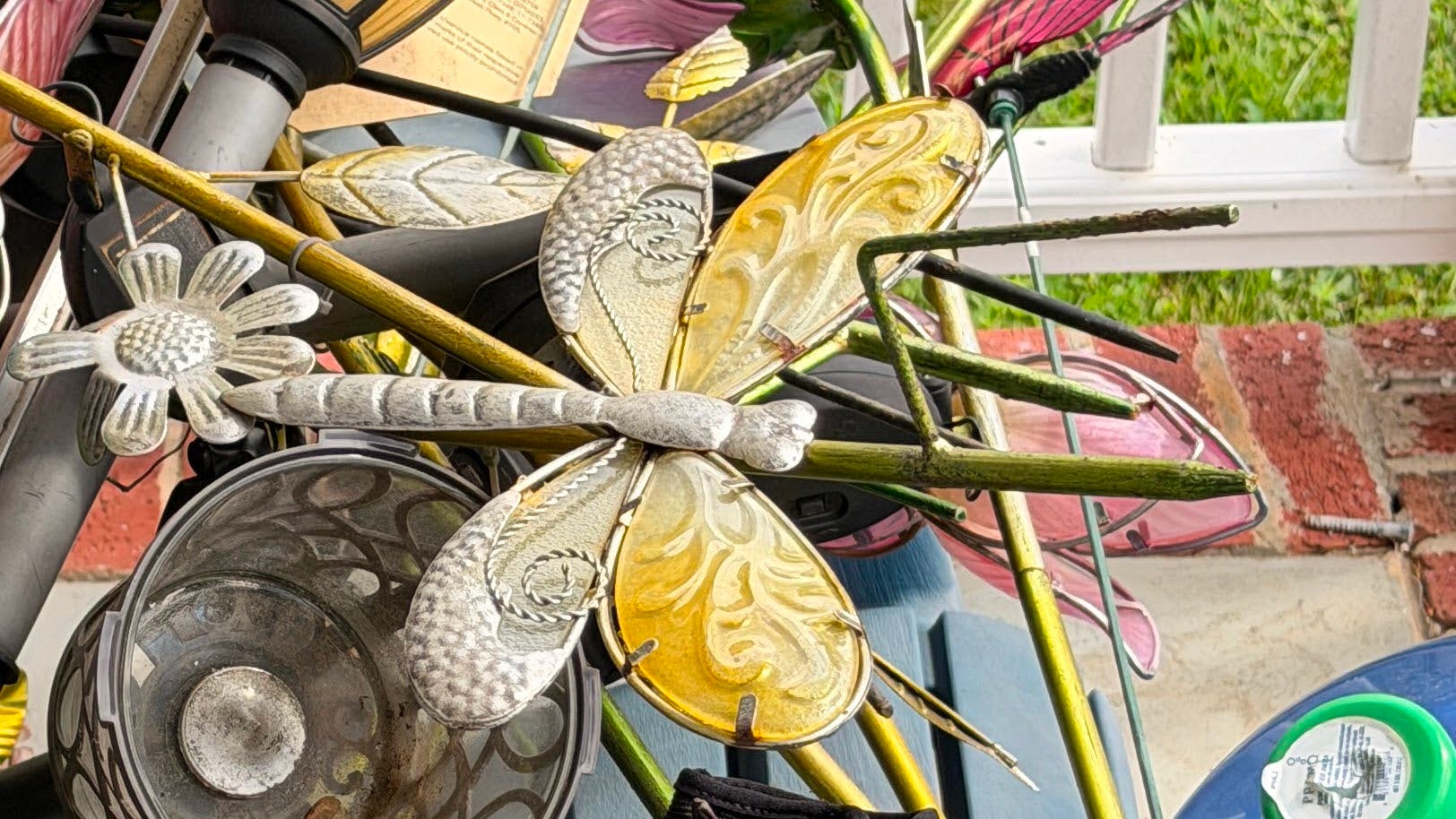
In that moment, I realized what I’d forgotten. I grasped the raft more firmly, and resigned once more to let the tide take me where I need to go.
I can’t imagine a future that could ever redeem a life so far adrift, but maybe it’s not within my power to do so.
“There are more things in heaven and earth, Horatio, than are dreamt of in your philosophy.”
My job is to hold fast, and ride out the storm. And this past week, I was reminded that though I am isolated for the moment, I do not have to face the storm alone.
“For us, there is only the trying. The rest is not our business.”
So here I am, in the middle way, having had twenty years—
Twenty years largely wasted, the years of l'entre deux guerres
Trying to use words, and every attempt
Is a wholly new start, and a different kind of failure
Because one has only learnt to get the better of words
For the thing one no longer has to say, or the way in which
One is no longer disposed to say it. And so each venture
Is a new beginning, a raid on the inarticulate
With shabby equipment always deteriorating
In the general mess of imprecision of feeling,
Undisciplined squads of emotion. And what there is to conquer
By strength and submission, has already been discovered
Once or twice, or several times, by men whom one cannot hope
To emulate—but there is no competition—
There is only the fight to recover what has been lost
And found and lost again and again: and now, under conditions
That seem unpropitious. But perhaps neither gain nor loss.
For us, there is only the trying. The rest is not our business.
Home is where one starts from. As we grow older
The world becomes stranger, the pattern more complicated
Of dead and living. Not the intense moment
Isolated, with no before and after,
But a lifetime burning in every moment
And not the lifetime of one man only
But of old stones that cannot be deciphered.
There is a time for the evening under starlight,
A time for the evening under lamplight
(The evening with the photograph album).
Love is most nearly itself
When here and now cease to matter.
Old men ought to be explorers
Here or there does not matter
We must be still and still moving
Into another intensity
For a further union, a deeper communion
Through the dark cold and the empty desolation,
The wave cry, the wind cry, the vast waters
Of the petrel and the porpoise. In my end is my beginning.
— T.S. Eliot, 4 Quartets 2: East Coker
If you liked this essay, please consider subscribing—or send a tip (Venmo/Paypal/Stripe) to support this and future pieces like it.
This Eliot poem is just so full of personally-relevant gems I couldn't include them all. So damn good:
"You say I am repeating
Something I have said before. I shall say it again.
Shall I say it again? In order to arrive there,
To arrive where you are, to get from where you are not,
You must go by a way wherein there is no ecstasy.
In order to arrive at what you do not know
You must go by a way which is the way of ignorance.
In order to possess what you do not possess
You must go by the way of dispossession.
In order to arrive at what you are not
You must go through the way in which you are not.
And what you do not know is the only thing you know
And what you own is what you do not own
And where you are is where you are not."
Dude, this slayed me.