



This is a free post made possible by paid subscribers.
Writing is my profession and calling. If you find value in my work, please consider becoming a subscriber to support it.
Already subscribed but want to lend additional patronage? Prefer not to subscribe, but want to offer one-time support? You can leave a tip to keep this project going by clicking the link of your choice: (Venmo/Paypal/Stripe)
Thank you for reading, and for your support!
When I was 19, half way through a gap year after high school and trying to figure out what was next, my uncle got me a job at a computer repair place. He was friends with the owners, and they were happy to take me on.
But only after I passed a test.
On my first day of work, they dumped a bunch of parts on a workbench and said, “build a working computer.”
Oh boy.
Now, I’d been the most tech savvy person in my family since I was little. I started using computers in the first grade and never stopped. When my family bought our first PC in 1987 — an 8086 XT with 640K of RAM, two 5.25” floppies, CGA graphics, and no hard drive — I was ten, and I figured out how to make it work.
Six years later, I bought my first PC that was truly mine — 486SX, 4MB of Ram, 128MB hard drive, and a combo of 5.25” and 3.5” floppies. It ran on Windows 3.1, had VGA graphics, and it was glorious.
But other than swapping out a modem, I’d never really worked on the guts of a PC. I knew the basic principles, and that it was a modular system where things got plugged in, not soldered, so the way I saw it, it was kind of like advanced Legos.
An hour or two later, I’d done it. I had a functioning system. I was proud of myself that day. I got the job — a job where I learned quite a lot, and which led me to go on to build every PC I’ve owned ever since — and other than the drama that came with a family owned business where several constantly-quarreling people were running the thing, I genuinely enjoyed going to work every day.
But somehow, in the intervening years, I became convinced that I had little to no mechanical aptitude. I felt like every time I tried to build a piece of furniture, or install an appliance or a ceiling fan, or do any basic “man” task, I was all thumbs.
I lost all confidence in myself. I stopped even trying.
Which is why what I’m about to tell you next came as a total surprise to me.
As I mentioned in my last post, I’ve been getting my new apartment set up, one puzzle piece at a time. Because it’s literally only 500 sq. ft., I can’t buy a bunch of stuff and hope it fits. And the last thing I want is clutter. I said it before and I’ll say it again: I have a chaotic mind, and I’ve realized how much more clearly I think when my external environment is calm and orderly. Something I’ve only really come to know since being on my own, living the fairly spartan way that men tend to choose when they are alone. I’m sure you’ve seen memes like this one:

I’m just slightly more bougie. I like a little decor. I need bookshelves to feel at home. Bit by bit, I’m finding things to optimize the space and keep it tidy but inviting. And most of that stuff is coming from Amazon. It’s the cheapest place, and the easiest to find reviews of the cheap foreign-made crap that passes for furniture these days. “This piece of foreign made crap is actually pretty good for the money” is the kind of review I look for.
Every single piece of furniture in this apartment was assembled by me. The bookshelf, the desk, the bed, the nightstand, the TV stand, the kitchen organizing racks, even my office chair. I’ve been getting a lot of practice in the “furniture broken down into a hundred pieces with 15,000 screws so it can fit in a tiny shippable box” category of home goods.
And then, last night, it finally happened. I opened the box to my rolling kitchen cart — I have almost zero space in the cupboards and with just enough dishes for me they’re already overflowing — and after taking out a dozen or two components, all wrapped in their little crinkly plastic bags, I had a problem.
There were no instructions.
I had two different sizes of screws, a bunch of random poles, some grates, a couple pieces of wood, a handle, a bag of wheels, some cross bars, and no idea how to put any of it together. It all sat in a sad pile on my folding table and the kitchen floor, taunting me. I had already cleaned the whole place and now I had this mess on my hands, and who knew how long it would take to get a response from the seller. I emailed them. I went through Amazon’s chatbot. I searched the internet for a manual. Nothing.
So I opened the largest picture I could of the cart, fully assembled, and I sat down to see if I couldn’t just figure it out. Like that old PC on the workbench.
It came together surprisingly quickly. There were “oh shit” moments where I was looking at pieces that had different holes than other pieces and wondering which section they went in, but process of elimination and deductive reasoning made shorter work of that than I expected. In about an hour, I had a fully functioning rolling kitchen cart, with zero pieces left over and not a single mistake made, and I was every bit as proud of myself as the day I took that pile of parts and built a computer.
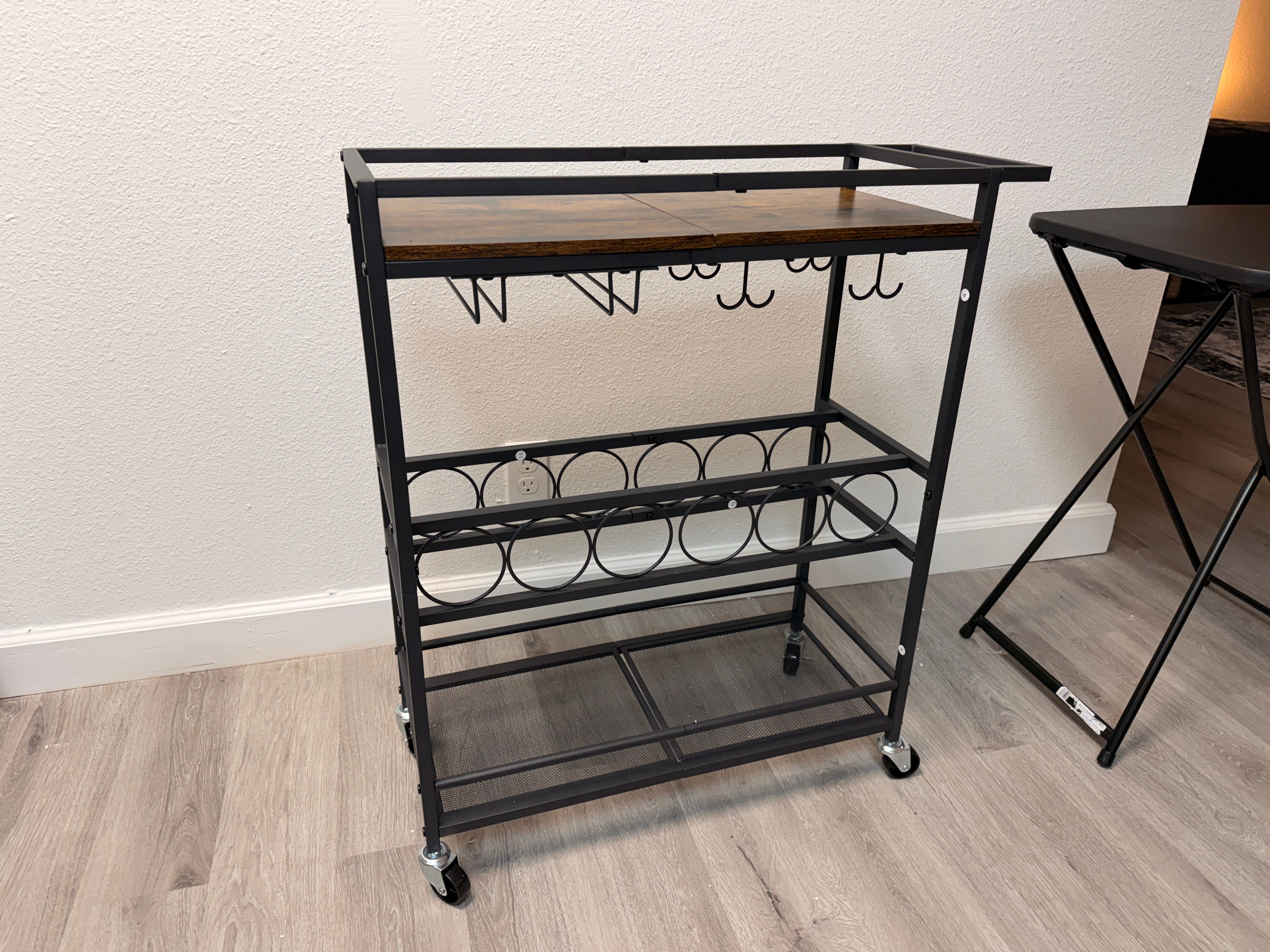
Actually, no, I was more proud. As silly as that might seem. Because I’ve spent decades thinking I’m an idiot with no spatial reasoning and no mechanical aptitude whatsoever. The weirdest thing was that I found it easier to put together by just modeling it out in my head than I ever do looking at step-by-step instructions, trying to infer three-dimensional layouts from weirdly flattened two-dimensional drawings.
This was a revelation to me.
I felt like I should have received some kind of weird Chinese furniture Mensa award.
And to their credit, they actually did send me the instructions today. As you’ll see in the exploded view below, the cart wasn’t exactly rocket surgery. Even so, that’s a bunch of pieces that don’t scream “we go in some logical order”:
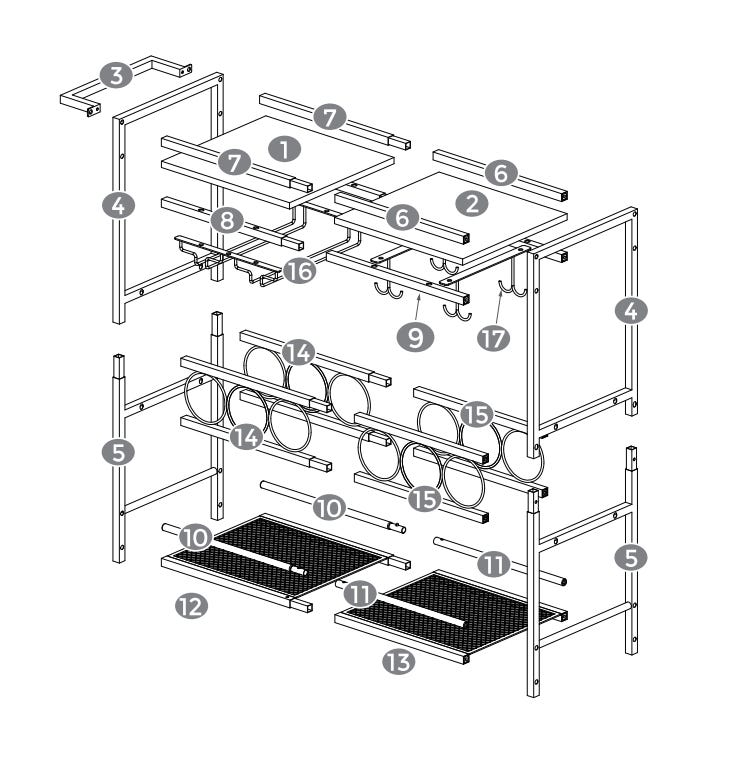
The big takeaway for me in all of this wasn’t the finished cart itself. It was discovering that I unknowingly rewrote my entire internal narrative about an important aspect of my capability in less than the time it would take to watch a movie.
That was pretty cool.
Learned Helplessness
In 1967, psychologists Martin Seligman and Steven Maier coined the term “Learned Helplessness” in a paper entitled, Failure to Escape Traumatic Shock. They did a Pavlovian experiment on dogs where some were able to escape an electric shock by pressing a panel, and others were shocked no matter what they did. In the abstract of their paper, they summarized their findings:
Dogs which had 1st learned to panel press in a harness in order to escape shock subsequently showed normal acquisition of escape/ avoidance behavior in a shuttle box. In contrast, yoked, inescapable shock in the harness produced profound interference with subsequent escape responding in the shuttle box. Initial experience with escape in the shuttle box led to enhanced panel pressing during inescapable shock in the harness and prevented interference with later responding in the shuttle box. Inescapable shock in the harness and failure to escape in the shuttle box produced interference with escape responding after a 7-day rest. These results were interpreted as supporting a learned “helplessness” explanation of interference with escape responding: Ss failed to escape shock in the shuttle box following inescapable shock in the harness because they had learned that shock termination was independent of responding.
In a review paper about the experiment published nearly a decade later, they explained that “exposure to uncontrollable events interferes with the organism's tendency to perceive contingent relationships between its behavior and outcomes.”
In other words: when you learn that nothing you do is going to improve your outcome, you have a tendency to stop trying.
If this sounds familiar to you, I’m going to talk about my own experience with this, and I hope you’ll see yourself in some of what I’m about to write. Because I’m finding that unlike dogs, human beings can overcome learned helplessness, given the right circumstances and time.
And that’s a very good thing.
I can’t look at research like the stuff I cited above without thinking about a little mantra I don’t remember ever coming up with, but which I used to repeat to myself very frequently, especially in recent years:
“It doesn’t matter. I don’t matter. Nothing matters.”
I wouldn’t think about saying it. I would just find myself muttering it. It was like a subconscious prompt running on autopilot.
It’s taken me quite a bit of time alone with myself to realize what that mantra meant to my brain. It wasn’t literally true. I’m definitely not a nihilist. In fact, I found myself saying it when things mattered quite a lot, and I was trying to calm myself down. I’ve come to realize that what I was trying to do in those moments was to convince the anxious part of my mind that the thing I was so worried about — always something or someone I felt I had no power to change — was ultimately not a big deal, in order to try to stop my internal panic about just what a big deal I felt it really was from growing worse.
On a deeper level, what I was actually saying was, “I can’t change the outcome, so stop trying.”
Like a dog resigned to another electric shock.
It was also something I stopped saying automatically once I was on my own for a while, and every decision was mine to make without the fear of any criticism or judgment that wasn’t my own. It went from something I had become accustomed to repeating almost daily to something that only re-emerged when dealing with particular kinds of conflict where I felt all the leverage was stacked against me and nothing I said or did would make a difference.
See, over the years, I had learned to stop trusting my instincts. I became convinced that I was a poor problem solver, because my way of problem solving was often questioned or subjected to scrutiny in ways that caused me to doubt myself to the point of giving up. The way I would see a problem in my head was often different from the way others around me would see it, and if the mental model was still in progress, an interruption or interrogation as to why I was approaching the problem the way I was often derailed the entire process while it was still inchoate. I began to associate becoming flustered or not understanding someone else’s approach (particularly if the problem in question was spatial or mechanical, but in other arenas as well) as a form of incapacity.
“I’m just not good at this stuff,” I’d think, and I’d get out of the way and let the most confident person in that situation handle it, even if I thought their approach seemed wrong. I might protest a bit, but not for long. After all, if I couldn’t explain why my way of doing it might be better, or at least, equally good, I had no good argument not to defer rather than insist. Before long, instead of bowing out of these kinds of situations, I just stopped trying.
It’s hard for me, it’s easy for them, I’ll just mess it up, so I’ll let them do it.
That was the basic thought process. And that solidified into habit over time.
I didn’t see how much that shrunk me over the years. How it limited my ability to simply execute basic tasks any adult should be able to do. If someone around me was faster or more assertive in their approach to solving a problem outside of an area where I had demonstrated competence, I would just let them, for fear I was going to screw it up and then be blamed.
When I learned last December that I was likely on the autism spectrum, and that along with that came hardwired problems with executive function — poor decision making, poor time management, inability to focus on non-interesting information or work, poor impulse control, struggles with emotional regulation, etc. — it fit my internalized narrative so well, it seemed like a slam dunk. It explained things.
It just didn’t explain them completely accurately.
Being all alone has removed the external influence of most outside opinion, and along with it, fear of judgment, abandonment, and rejection. To be frank, I’ve already been judged, abandoned, rejected to a degree I never thought possible, and with that comes a certain degree of perspective. There’s not much more to lose. Therefore, there’s no real risk left in attempting things I might not have tried at all not so long ago. I can approach problems without interruption, without having to explain, without worrying about what will happen if I make a mistake — except how I react to those mistakes. I’ve always beaten myself up for my mistakes. Severely. I learned early on that if I didn’t show I understood that I had done something wrong, it would be drilled into me in no uncertain terms. So I got very good at getting angry at myself first when I screwed up. If I was already punishing myself, then external punishment was less necessary, and therefore less severe.
It’s fascinating to watch that all starting to unravel now. I assumed these were parts of my brain I would have to actively re-wire, like other behaviors that were pre-cognitive. By that I mean: things that light up the limbic system as reflexive responses rather than going through the prefrontal cortex to be processed rationally before acting.
It turns out, context matters. Being safe to succeed or fail actually increases the likelihood of success for someone like me. When I started that cart last night, I thought, “Well, the worst that happens is that I break it and have to buy another cheap cart.” When I finished it with zero errors, it was like something inside me unlocked for the first time.
“Oh,” I thought. “You actually CAN do this stuff, and do it well. You just have to trust your instincts.”
Don’t get me wrong: my days of worry and anxiety are far from over. I still overanalyze problems I’m facing, especially if the potential consequences are significant. For example: I had to bring Evie in to the mechanic for the overheating issue today and I’m bracing for a four-figure repair I can’t really afford. But I identified a garage I wanted to work with, made the appointment, and dropped her off. I told them the diagnostics I had already performed and the likely places to check first, and they were actually impressed and grateful. “You’re my kind of customer,” the guy said. When they didn’t have the loaner car they requested, I got Uber set up on my phone and got myself a ride home. These are small things to the average person, but for me, they’re real wins — after all, I’m a guy who still hates picking up the phone to call anyone because I overthink the conversation before it even happens.
But instead of worrying about the cost, I’m focusing on the upside, namely: how much less stress I’ll feel when I know she’s safe to drive again and I don’t have to watch the temperature like a hawk at every red light.
I still struggle with aspects of executive function. But I’m watching a sort of ground-up rebuild of this internal architecture beginning to happen, and a lot of it is surprisingly autonomous. I’m kind of excited to see how far this will go. I’m sure some of my limits are actually built-in, but others were conditional, and could be very much improved.
And in that respect, sometimes little wins are actually big wins.
Sometimes you just need time and space and circumstances in which old wounds aren’t perpetually being re-opened, and you’ll be surprised to find your body and mind are doing a lot of the necessary healing on their own. Repeated successes only reinforce that healing. Stacking wins builds confidence. New habits, new concepts of self, and the next thing you know, you’re doing things you never thought you could do a year ago.
I have lost a great deal recently, and these things won’t fix any of that, but that’s outside of my control. I can only focus on the things that are up to me. And with that in mind, I think 2026 might just be a banger of a year for me.
If you’re struggling with any of the same things, I hope it will be for you, too.
If you liked this essay, please consider subscribing—or send a tip (Venmo/Paypal/Stripe) to support this and future pieces like it.
"And in that respect, sometimes little wins are actually big wins."
Indeed!
... and so the healing begins (continues?) 👍You might have strengthened my weak motivation to fix a mechanical problem around the house without surrendering to calling a pro for hundreds of dollars