


Note: I’m trying to stretch my fiction muscles, so I got a writing prompt and banged this out. This is just practice for other projects, but it came out kind of fun, so I thought I’d share.
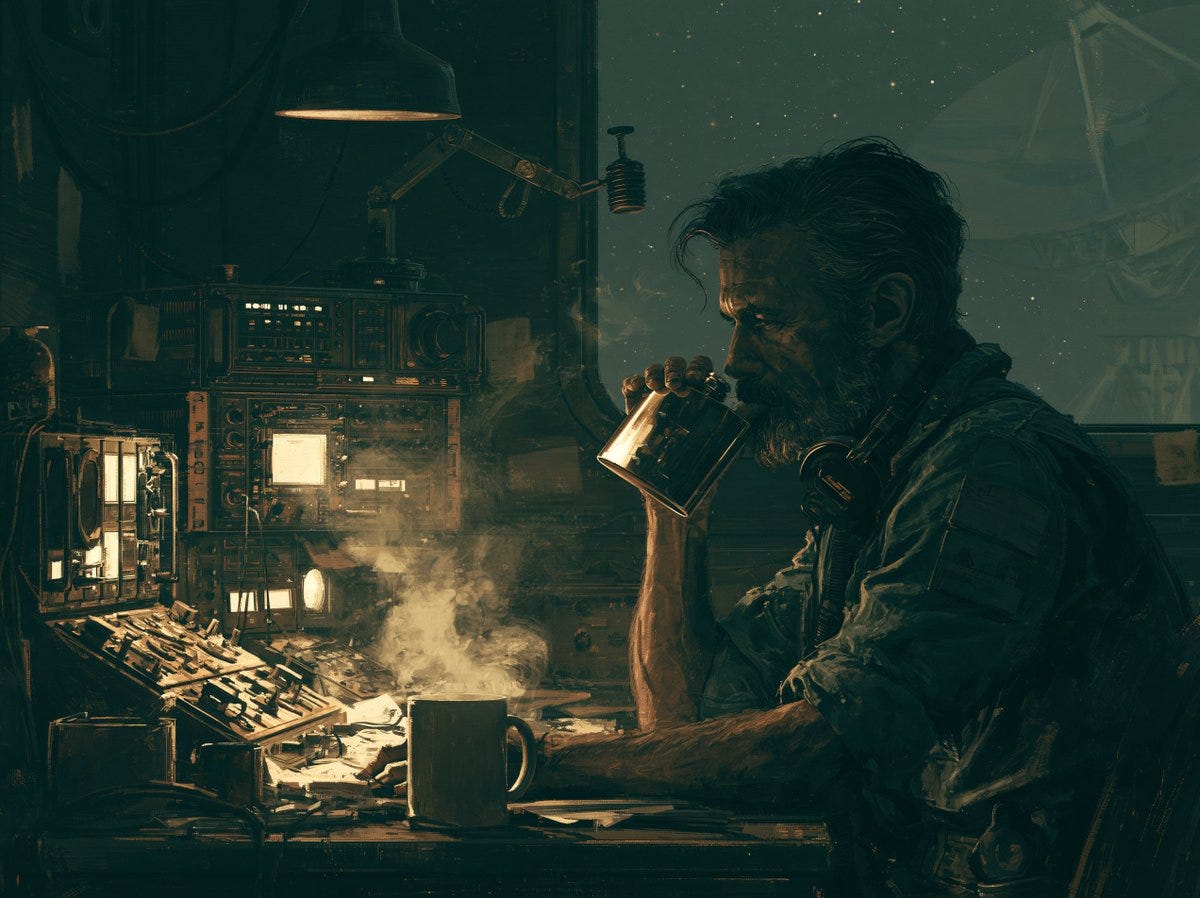
It’s cold inside the station.
I should be used to that by now, after all these years working the graveyard shift at A34, but somehow it always surprises me.
It’s got something to do with the desert, I think. Deceptively hot and sunny during the day, so when I leave the barracks for the station, the air is soft and pleasant, the dry heat wicking away sweat on the persistent breeze.
But by the time two or three in the morning rolls around, the sand dunes, which act like heat sinks, have already surrendered their thermal energy to the night. Grady calls it a convection effect, but I don’t even know if that’s the right term. All I know is that after sundown, that gentle breeze turns into a howling beast, throwing icy daggers. After dark, you really shouldn’t risk going out even as far as Big Betty -- that’s what we call the hulking radio telescope out back -- without wearing goggles and a mask. The way that sand blows around sometimes, it can blind you or choke you or both in a matter of seconds. Pretty much everyone who has ever worked the station has made that mistake once. Few ever make it twice.
I start out most shifts with my corporate BDU sleeves rolled up to the elbows, and finish most of them in my parka. I don’t know why they bother with the fake military uniform, but it’s durable and comfortable, just not particularly warm. The whole installation has shit for insulation. Everything is covered in a fine grit of dust, and the base is almost as old as the sand it sits on. There aren’t really any records anymore on how this operation got started. Those got wiped in the Carrington Erasure Event of ‘47.
Or at least, that’s what they told us.
Grady says the old-timers told him they used to have bookshelves full of physical records on site, printed on actual paper, but they’ve long-since turned to dust. Even now, there are some old, cracked and yellowed PVC binders from back in the day when the American Army ran this outpost, back before the dissolution. They had this technique where they’d coat the paper in a kind of clear plastic that held up fairly well. But they seemed to only use that technique on critical documents, like process and procedure instructions for the station equipment. How to check the bands, remote thrust vector adjustment calculations, that kind of thing. Kind of stuff that belongs in a museum, if we didn’t still need it here.
It’s still the part of the night where I can hold off the chill with a hot coffee and a generous helping of the ‘shine from Grady’s still. The coffee keeps me awake and the hooch puts me to sleep, so I do a little balancing act between the two. I’m not saying I’ve never fallen asleep at the wheel, but then again, it’s not like anyone has ever been around to catch me napping on the job.
Grady works days, I work nights. We split the day right down the middle. We meet for breakfast most days, me coming off the clock, him punching in. It’s the only time we ever see another human being, and I’m mostly fine with that. I took the job to get away from other humans, and I haven’t regretted that part yet. But there’s something that total isolation does to a man. Changes you in ways you don’t even realize until someone else points it out to you. Human beings weren’t meant for total solitude. So Grady and me, we get together in the mess hall if I’m not too tired, and we eat.
The rotation is supposed to have more redundancy built in. In the old days, the watch was broken into three eight-hour shifts instead of two twelves. A crew of six could do the rotation with days off in-between.
That would be nice, but they haven’t sent us any relief for over a year now. Not since O’Malley died from Valley Fever last October. Horrible way to go. Grady says that should have been treatable, says we used to have antifungals in the med bay for dealing with that kind of disease. Grady says a lot of things. I’ve got no reason to suspect that he’s lying, but he sure does run his mouth a lot. I guess that’s to be expected when you’ve been holed up, mostly alone, at the ass end of the world for the better part of two decades.
I’m just about to celebrate my own 7th anniversary here. Although “celebrate” is probably the wrong word. I’ve had worse jobs, to be sure. There was this one I had, right out of high school, back in the 60s, cleaning out the grease traps from behind restaurants. Smelled godawful. We’d slurp it up through a hose into a big tanker truck, haul it all to an old warehouse out at Three Points, then pump it into a holding tank. The boys that worked the warehouse would then run it through a bunch of machines. By some alchemical process I never really understood, it’d come out the other end as biofuel, which they’d sell at a tidy profit.
Growing up, I’d have bet money a job like that would have been done by clankers, but then again, when I was growing up they told us the damn bots were going to do all the work and give us everything for free. So then they built a few billion of the rust buckets, started mining all the precious metals and rare earths out of the solar system, and the great corporate houses moved their operations to low earth orbit, or to the Moon, because I guess it was more efficient that way. And so it should have been no surprise when they stopped making free stuff for Earthsiders. Too much of a pain, I guess, to ship stuff down the gravity well for people who are of no practical use and can’t even pay. We were left to fend for ourselves in the ruins of whatever was left behind. These days, most of the terrestrial bots are old salvage models. We’ve gotten pretty good at keeping them going until they’re worn clean through, but despite the stars being full of them, Earthside there just aren’t enough to go around.
Other than scarcity, there’s no reason one of the ‘noids couldn’t do this gig. They don’t need to eat, they don’t need to sleep, and even with the antique solar array at A34, they’d never run out of power. Turning knobs and filling out e-forms seems pretty low-effort for a machine with a brain, but what do I know?
Anyhow, Corporate wants human contractors on this gig for some reason. The work itself isn’t hard, unless boring counts as hard. They say this old facility requires a human touch, though I’m really not sure why. Still, if they think that, it’d be nice if they showed some appreciation. The supply drones come less and less often, and we’ve been understaffed the whole time I’ve been stationed here. Hell, if they were still sending medical supplies on a semi-regular basis, maybe Grady is right. O’Malley might still be alive, instead of in a shallow grave out behind the composter.
Speaking of the composter, there’s an unofficial part of the job we’ve been forced to take on in our downtime, when we’re not playing satellite babysitter. We’re so far from civilization, we have to grow most of our own food. The old manuals say there used to be a staff agriculturalist, but even in Grady’s time, that was never a thing. So he and I each take some of our time off-shift to tend the hydroponics, the little mushroom farm, and the meat cultivator. When the supply drops do come, they’re filled mostly with big plastic bags of amino acids and carbohydrates to feed the cell cultures. Meat’s about 70% water, and despite our arid location, we’ve got a deep well that still produces, and some half-decent reclamation systems designed for three times as many people as are actually on base. Water is one thing we’ve got a surprising amount of. I take ridiculously long showers, just because I can.
It’s the top of the hour, so I shake myself from my thoughts, crack my back, down the last of my now-lukewarm coffee in a single gulp, and start the signal rotation. The way it works is this: I go down the full list, checking each of a dozen satellites to make sure all systems are nominal, no degrading orbits, still sending and receiving pings, all that jazz. Every once in a while we have to make a slight orbital adjustment, but for the most part our whole job is just babysitting a bunch of machines up in space that have been there since before either of us were born.
The weird thing is, I have no idea what the damn things do. Sometimes I wonder if anyone is left who remembers why we bother at all. But I’m saving for retirement, and the pay isn’t bad. Because I live on station, my expenses are all covered, and there’s nowhere to spend any money if I wanted to, so I just accumulate the credits. Best of all, I don’t have to deal with trying to stay on the hamster wheel long enough to maintain a coffin unit in one of the shantytowns. I’ve got fresh air, peace and quiet, room to stretch my legs, and I get to spend every night looking at the stars.
Not a bad deal, all in all.
I cycle through each of the units, labeled S1 through S12, sending a ping, waiting for a status report. I’ve got a checklist I work through for each, punching the orbital determination data and ping responses into an old tablet with cracked glass and a battery so worn out it has to stay plugged in at all times or it immediately shuts down. You’d think important work would require well-maintained equipment, but what do I know? Altitude, inclination, ground track, data transmission. I fill out the forms for each satellite without even having to think. Every night is the same. There are never any surprises.
Which is why I almost miss the anomaly on S9.
There’s extra juice in the carrier wave, but I’m not expecting it so I don’t even see it. I’m checking boxes from muscle memory, except when I enter the signal value the tablet flags it with a little red triangle symbol with a white exclamation point and won’t let me proceed without annotating.
“Huh,” I say to the empty room, taking a swig of shine. “That’s new.” I chew on my thumb as I study the readouts.
Now that I’m looking at the instrument cluster, I can see the fluctuation. The needle, usually steady, is bouncing like it’s at a high school dance. I flip the rocker switch for the transducer and crank the volume knob. There’s a deep hum and a bit of static at first, but it resolves as I rotate the tuning knob, and then...is that music?
A piano plays in jaunty staccato. The sound is old and tinny, all mids and highs and practically no bass. It sounds jazzy, old-fashioned in a way I can’t quite put my finger on. I feel like maybe I’ve heard something like this in an old reel somewhere.
Then a man’s voice cuts in, just as tinny, and with a strange accent:
“Did a headache spoil a day for you? Are you still feeling a little miserable and upset? Well, of course, it would have been wise to take Alka-Seltzer earlier in the day, but don’t wait now. Take it right away!”
“Alka-Seltzer?” I ask the equipment. “What the hell is Alka-Seltzer?”
The equipment doesn’t answer, but the needle keeps swaying to the music when it comes back on.
I tap the little red triangle, make a note of the required field, then press “submit.” The screen refreshes, and the form for S10 comes up. I guess I’m supposed to continue the rotation.
I just stare at the screen, my eyes unfocused. I’m lost in my thoughts. It sounded like a radio broadcast, but there’s not a broadcast tower for hundreds of miles, and even if they were, the station is tuned to frequencies in a part of the spectrum that’s reserved for space-based communication.
“That broadcast had to be coming from S9,” I say. “But how?”
The tablet flashes a warning at me. I’m supposed to be entering data. I continue the rotation.
S10: Nominal.
S11: Nominal.
When I get to S12, the transducer, which I’d left on just in case, immediately starts outputting sound. My brain fumbles with it for a moment, before it resolves into something I can recognize.
It’s a woman’s voice, softly singing what sounds like a lullaby. It’s...familiar somehow, but I can’t place it. I sit and listen, and there’s a sweetness to it. I feel sad for some reason I can’t explain, and I can feel the hair standing up on the back of my neck. I’ve got goosebumps running up and down my arms. I rub them with my hands, then enter the data, notating when I get another little red warning triangle.
What the hell is going on?
I’ve finished the rotation, so I decide to get up and get my blood moving. The winds are fairly calm tonight, so I decide to empty my bladder outside before refilling it at the coffee pot. As I do my business, I look at Big Betty, her singular red light flashing in a slow, steady heartbeat, and beyond her, at the stars. A small green meteorite streaks across the sky, and I notice that I can see my breath as I watch it pass. Not windy tonight, but still cold.
Back inside, I top off my mug and breathe the steam in through my nose. The coffee smells slightly burnt from sitting on the hot pad, but that’s not what I’m after. The air is so dry out here that I sometimes wake up with nosebleeds. A little humidity in the nasal passages offers some relief. I’m looking, I realize, for small, comforting normalcies. I’ve been working this station for the better part of a decade, and the array has never returned so much as a beep. What am I dealing with here?
I sit back down and look at the system clock. Next round of checks in 20 minutes. Twice every hour. It strikes me, not for the first time, how odd it is that this system isn’t automated. We’ve got AI systems running all the orbital arcologies of the great houses, performing complex system management and life support and manufacturing tasks, coordinating remote space-based mining operations on asteroids flying through space at eye-popping speeds, but they need a couple of old washout skinjobs here manually cranking the dials and making orbital micro-adjustments?
It just doesn’t make any sense.
I watch the system clock anxiously, feeling anticipation build in my gut as the display ticks towards the bottom of the hour. I’d run the checks early, but the tablet will just lock me out. Safeguard against someone entering all the data for a shift up front and then quitting early.
Finally, the clock hits half-past, and I begin working through the checks, transducer on.
Right out of the gate, S1 is broadcasting a man’s voice, in what sounds like French -- a language I actually do recognize. I was raised by my grandfather, and he spoke a little. He liked to say random phrases in it just for fun, because it sounded funny to me as a kid, and he would make wild expressions to go with it, making me laugh. Sounds kind of like him, actually. Creepy.
S2 has a news broadcast of some kind, talking about people who were very excited about the demolition of some kind of wall. S3 sounded like a sporting event. The audio was compressed, staticky, and I had to turn it up to make out the words.
“Babe Ruth will be at his old right field stand for the Americans, the man with the all-time record of 699 home runs in his major league career, and who probably has been given more intentional passes than any other man ever in baseball. For the bid his batting average is very puny this year 191...”
The tablet blinked its warning at me, but I just stared.
I know that name. Professional sporting events were a distant memory Earthside, and what the Orbiters did was not something we had access to. Private, encrypted networks. Impossible to pirate without the help of a strong AI system. The kind they didn’t let us have.
But grandpa had been a baseball fanatic when was a kid. Back before the dissolution, the Carrington erasure, when the Orbiters were just beginning to build their space-based world on the backs of great gleaming rocket ships launching millions of tons of resources into space. His own grandfather had watched Babe Ruth as a young boy. Had told him stories he’d passed down to me. When had that been? At least 150 years ago now.
Every satellite is broadcasting. I go through them one by one, trying to pick out recognizable things. The transmissions all sound old, like the trick we’d learned as kids where you talk through two empty tin cans connected by a piece of string. I’m half-tempted to go wake Grady up and drag him in here to make sure I’m not going crazy, but I can’t pull myself away.
I make it all the way back to S12, and then something catches in the back of my throat.
It’s the woman singing the lullaby again, only this time, I realize why it sounds familiar.
“Oh, Danny boy, the pipes, the pipes are calling From glen to glen, and down the mountain side. The summer’s gone, and all the roses falling, It’s you, it’s you must go and I must bide.”
This time, I know the voice.
Tears well up in my eyes, spilling down my cheeks. I wipe them away with the backs of my hands, but they won’t stop coming.
My mother’s voice.
My mother died when I was 9. I never knew my father. Grandpa sold just about everything he had, scraping together the money to take her to one of the few corporate medbots still available earthside. They said it was cancer. Hard to say why. So much toxic junk was left Earthside when the Corporate aristocracy went orbital that it could have been almost anything. There was no one to really blame. Just another tragic moment in another insignificant life.
I have no recordings of my mother. My grandfather passed twenty-two years ago this summer. But that is her voice. That was her song, the one she always sang to me to calm me down when I was worried or anxious or just riled up from a crazy day. I haven’t heard that voice or that song in so long I don’t even know how I recognized it. It’s unlocked a memory I forgot I even had.
But how was the voice of my dead mother being broadcast from 250 miles above the surface of the earth, on an old military satellite only monitored by this particular station, the one where I work?
The singing stops. The tablet is flashing angrily at me, but I’m too busy listening for what might come next to notice, let alone care.
“Daniel?” my mother’s voice asks.
I’m crying again, hot tears streaming down my face, leaving droplet marks in the patina of dust on scratched and battered surface of the old steel desk.
Is she talking to me?
“Daniel, can you hear me?” the voice asks.
I try to speak, but nothing emerges, just a jagged croak. I cough, try to clear my throat, but before I can try again, a new panel lights up on the instruments, one I’ve never seen go active before. The one that indicates we’re not just receiving.
A34 is broadcasting now, from Earth back to space.
“Yes momma,” a voice says, and it’s my voice, but it’s not coming from my mouth. It sounds just like I did as a child.
“I just wanted to tell you that I love you very much, and I’ll always be with you, even when, some day, I have to leave this earth.”
“I know that, momma,” the voice that is mine but not-mine says, “but don’t be silly. You’re not going anywhere.”
“Not now, baby boy, but a time will come, and I want you to never forget. Now, it’s time to get ready for bed.”
“Yes, momma.”
I suddenly remember this conversation. I can see her, sitting there on that old, worn out brown leather sofa in grandpa’s living room, back before that stopped being a place where people could live. I can smell the old wood smoke from the cold fireplace, see the orange-and-brown afghan draped over the back of Grandpa’s chair, hear the creak of the floorboards as I shift my feet while we talk. I put my weight on my left foot, then my right, then left, then right. If I do it with just the right rythm, it makes a sound that reminds me of a donkey.
Hee-haw, hee-haw, hee-haw.
“Danny boy!” my mother says with a laugh, a crackle of static punctuating the musical sound. “Stop making that silly noise and go brush your teeth!”
A giggle, and the sound of running feet.
Just then, Grady bursts into the station.
“Danny, what the hell did you do?” he asks, wide-eyed, his remaining hair wild. He’s out of breath. He stands on the other side of the room, but I can smell the hooch on him from here.
“What do you mean ‘what did I do?’” I ask, half-growling, irritated at the interruption of the first moment that felt special in as long as I can remember.
“They’re coming!” He exclaims, pointing back behind him.
“Who’s coming?” I ask, my anger turning to confusion and alarm.
But that’s when I hear it. The sound of rotor blades. The buzzing of giant, angry bees. The desert outside the window lights up as two large quad copters come in for a landing outside, disgorging a half dozen of those weird insectoid-looking orbital security bots and three men in some kind of hazmat suits. The clankers methodically clear each of the buildings, then take positions both inside and outside the station.
The men in hazmat suits follow, once Grady and I are under the watchful, bulbous eyes, an unblinking multi-spectral camera array that never misses a thing.
“Well done, Mr. Devereaux,” the one who appears to be in charge says.
“What did I do?” I ask. “And who are you anyway?”
“Who I am is of no concern. What you’ve done is to complete an experiment that has been running for over a hundred years. A most unusual experiment indeed.”
“What experiment?” I ask. “What’s going on?”
“Sadly, your services are no longer needed.”
“I love you, Danny boy,” the transducer says, in my mother’s voice.
“I love you too, momma,” the station says, in my childhood voice.
The clankers raise their weapons and fire.
“I’m coming for you, Danny boy,” her voice says, as the room fades to black. “I’m coming for you all.”
If you liked this essay, please consider subscribing—or send a tip (Venmo/Paypal/Stripe) to support this and future pieces like it.
You’re a damn good writer Steve. I was locked in.
Late night now, I started reading, then scrolling, then blurring, then: "hee haw hee haw"!! I could hear those floorboard creaking - finished reading and then went back to the beginning to begin again. Excellent!!