


“When Obi-Wan was dismembering him, dude, it was fueling all his rage. And his whole fighting style is rage, man.”
It’s a cart wrangler voice and a cart wrangler conversation. The two young men are walking beside me, crossing the busy parking lot to where I managed to somehow jam the cart escalator on my first ever attempt at using it. I just wanted to get my orders down to where my car was parked in the shade of the garage.
I had interrupted their discussion outside of Wegmans when I asked them for help. They looked like they may have been on break, but I didn’t know who else would know how to fix the problem. I had joked with them that I knew that helping me get the damn thing unstuck was what they’d been training for their whole lives. The conversation I was now incidentally included in clearly had been going for some time.
“People don’t understand that there are a lot more powerful entities in that universe,” the taller of the two says, then peels away and walks back towards the store, as though this is his mic drop moment. The shorter guy, wearing a floppy bucket hat, seems skeptical of his colleague’s thesis, and makes no indication that he’s not happy to see the interaction go. Instead, he moves to the cart conveyer and starts punching a code into the connected touchscreen. The cart releases and starts descending into the bowels of the structure.
“Do you have any idea what I did to get it stuck?” I ask. “I’ve never used this before.”
“Honestly…no.” He says with a laugh. “Maybe it was the bag sitting up in the the child seat, but I’m really not sure. It can be kinda picky sometimes.”
I thank him and start moving quickly down the moving escalator steps, because the cart is already almost to the bottom, and I have no idea if it’s going to eject out into the active parking area. I grab it just as it rolls free, and re-direct it to the trunk of my car.
I load the groceries into divided sections so I can keep the multiple orders separate. Then I get in and fire up the engine, and swipe over to the navigation system on my phone. The car’s main info screen is black, which means Evie has decided that today is another good day for the system to just randomly not work, even though it was fine when I started this particular morning.
I’ve decided, since I don’t have any more money to put into fixing her quirks, to think of her like the Millennium Falcon: “She doesn’t look like much, but she’s got it where it counts, kid.”
And now I’m the one making Star Wars references. For heaven’s sake.
I take an early Saturday afternoon order out to a heavily-forested neighborhood full of upscale suburban homes. The instructions say not to deliver to the front door, because the customer is staying in an AirBnb in the back. When I arrive, though, she’s already standing in the driveway of an enormous brick house. She’s a tiny, dark-haired woman of indeterminate age. She could be 25 or 45, I honestly can’t tell. The thermometer is already reaching towards triple digits, and when I get out, I notice she’s barefoot on the pavement.
“Aren’t you burning your feet?” I ask, gathering her bags.
“No,” she says, with a little chuckle. “Maybe it’s my Asian feet.”
“I used to live in Arizona,” I tell her, as I scan her ID for the champagne she bought. “In the summertime, you can’t go outside barefoot even to pick up a package, or your feet will just cook.”
We pack the plastic bags into her larger zippered cooler bag together, and then she makes her way back, laden with her spoils, Sherpa-like, into the home that is not her home.
I pick up a triple order at Costco during a slow moment when nothing else is coming in. I hate orders like this, because Costco items are so bulky they should almost never be triple stacked. It’s incredibly hard to fit even three modest-sized orders into one cart. Two of the orders in this batch are bulky — multiple packs of paper towels, toilet paper, boxes of diapers and wipes — but one is a single item: a nearly 7 pound package of chicken feet.
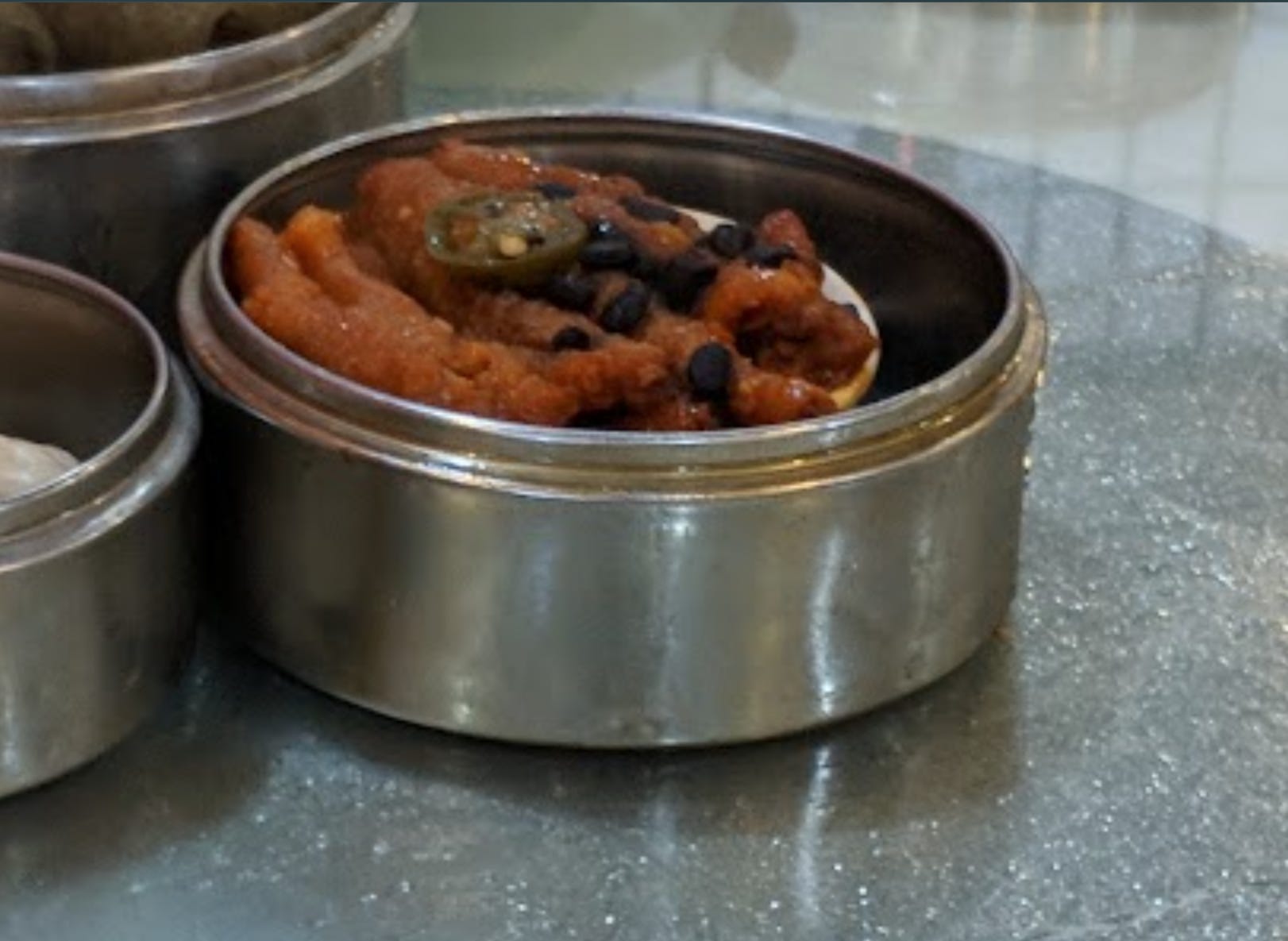
The GPS for the chicken parts delivery takes me downtown, to a business district. I expect to find a Chinese restaurant that might actually serve dim sum — a rarity in these parts for some reason. Feng Zhao — chicken feet in black bean sauce — is a staple in dim sum steam carts everywhere. When you order them, they look like this (sorry, I don’t have a better picture):
But the address is not a Chinese restaurant. In fact, it’s not a restaurant at all. Instead, I wind up outside a nail salon, and when I call the customer to be sure I’m in the right spot, they tell me I am. I walk into the salon, and all the ladies getting their manicures look up at me. The lady at the front desk is busy with a customer, so I wait, poultry appendages in hand.
Well this is awkward, I think.
Finally, she finishes up, and in Vietnamese-accented English, asks me what I need. I tell her I have an Instacart order for Jackie — which is a different name than was on the order, but it’s who the person on the phone told me to talk to — and hand the unbagged package of dismembered chicken limbs to the bewildered looking salon manager. She mumbles something under her breath that sounds like a question about why this is happening, and then quickly shoves the whole thing into a mini-fridge under the front counter, almost as if she’s embarrassed.
I just laugh and complete the delivery.
As I make my next drop, at a big, beautiful home near Five Points, I find that I’m still thinking about dim sum. There’s great Asian food in this city, but the dim sum options are scarce for some reason. My wife’s parents were both from the Guangdong province — the Cantonese region of Southern China. Dim sum is Cantonese cuisine, and I was introduced to it for the first time early in our relationship. For her family, it was a tradition to go to dim sum on weekends with any extended family members who were available, to eat and talk and “yum cha” — drink tea. Our tea of choice was always Guk Bo, a mix of dark, rich Bo Lay and dried chrysanthemum flowers.
When we moved away from her family, dim sum became our own independent tradition. Our kids developed a taste for it, I thought the flavors and the experience were amazing, and so it became one of my favorite things to do with my family for over 20 years.
As I leave the load of Costco boxes at the door, the memory of these family meals unexpectedly ambushes me with an explosion of grief. I make it back to my car, where I sit in the customer’s driveway for a full two minutes, wracked with sobs so hard I can’t even see to back out and continue my work.


Aside from their sudden and surprising nature, one of the worst things about these unintended excavations of emotion is that there’s just nowhere for them to go. No real way to draw out the poison, just temporary catharsis. The well always seems to re-fill, because the wound is not in the past, it’s ongoing. I do not mourn the dead; I mourn the loss of a living, breathing community of people I love who are all still alive, but from whom I have been exiled. We could all sit at a table together now, and nothing about the experience would feel the same. I am no longer an integrated part of a whole; I am merely an interloper, a temporary visitor, my presence always on a clock that is forever running out until I have to leave to go back to a physical dwelling that holds all my stuff but is not a home.
I have tried to make it livable. I have my shelves of nick-knacks and books, my large Hokusai print on the wall, the soft warm lights I use to push away the shadows while avoiding the harsh white light of the overhead LEDs, but it feels like a dorm room or an extended stay hotel, at best. A place to eat and sleep and bathe but not to truly live.
If home is where the heart is, mine is not here.
Oddly, cooking helps, if only a little. I work most days and get home late, so I typically don’t prepare anything fancy. I live mostly off of frozen foods that can be easily prepared in a microwave or air fryer. Chicken wings, tenders, or patties. Hamburgers frozen in stacks, separated by thin sheets of parchment paper. Segmented packages of chicken thighs. A Costco rotisserie can last me three or four days. Occasionally, I’ll buy an inexpensive steak or some pre-marinated chicken or pork. Sometimes asparagus gets cooked in the air fryer basket along with the meat. If I feel like putting up with the hassle, I’ll make a salad, heavy on the arugula. The same sides exist in a steady rotation: Korean sweet potatoes either crisped in the air fryer or bought warm from the roaster, french fries, frozen cheesy risotto in a bag from Trader Joe’s, the occasional microwavable package of macaroni and cheese — and I’m not going to pretend I never channel my inner 12 year old and have hot dogs with that.
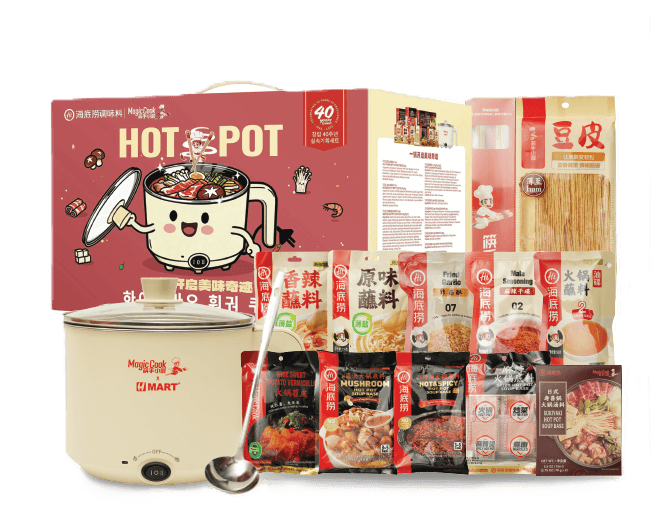
But I recently got a neat little hot pot kit from H-Mart — a national Korean grocery store chain that has long been my go-to for all things Asian. For just $25, I got an electric pot, a nice stainless steel ladle, and enough ingredients to make soup base for weeks. Here’s the marketing photo:
If you’re not familiar with Hot Pot, it’s a popular cooking style across China, with regional variations. You start with a savory broth — a spicy one if you’re from the Szechuan region or enjoy the zing — and then you take pre-sliced raw meats, vegetables, mushrooms, noodles, and bean curd, and cook them right in the broth. But it’s not just the Chinese: the Japanese have sukiyaki, the Vietnamese have lẩu, and I bet every country across East Asia has a version of their own.
The version that is most well known in America, though, is the Chinese variety. Hot pot restaurants have these big divided cauldrons, right in the center of the table, with their own heat source, and you order what you want and cook it yourself in one of several flavors of broth they have available.
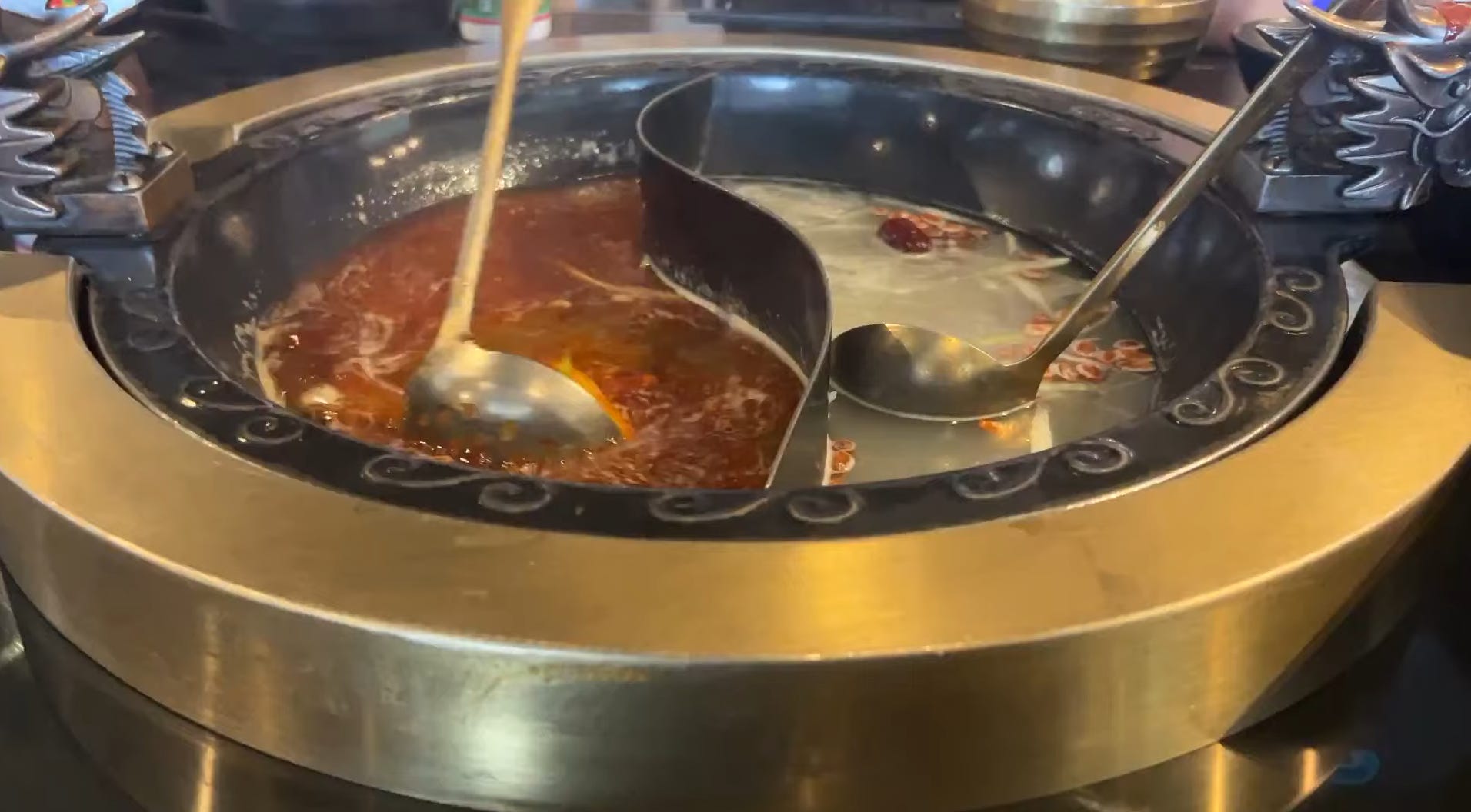
I think of it as the Asian version of Stone Soup.
It’s fun, but eating it at hot pot restaurants can be quite expensive. Making it at home isn’t just cheaper, it actually becomes something of a bargain. A few ingredients can go a long way. Even a small pot of broth can easily last several meals. My family started doing it recently, and when I found out how easy it was, I decided to try it out myself.
I buy baby bok choy, beech mushrooms, shiitakes, baby corn, and thinly sliced sheets of pork, beef, or lamb, rolled up and frozen and ready to cook. There are flat, wide sweet potato noodles that I love, and I’m sucker for the bean curd sheets that are about the same size. The broth is made either with a packaged mix and water, or beef stock mixed with Hondashi and a spoonful of Lee Kum Kee hot pot paste. A few dried dates in the pot adds a little sweetness to balance the spice. Since H-Mart is nearly half an hour away, near my old house, I have started to look for nearby substitutes. Wegmans shaved beef is cheaper per pound than the frozen shabu shabu rolls I buy from Asian grocers, and just as good.
Here’s what it looks like in action:


On my side of town, sadly, the Asian grocery stores are few and far between, but I saw that there was a little shop called Saigon Market, tucked behind a McDonald’s and a Hooters off the main drag near my place, at the far end of a Walmart parking lot.
Only upon arrival did I realize I’d actually been there once before. The man who owns it had struck me as very funny at the time. He’s a very diminutive fellow — maybe 5’5” at the most — with silver hair and obvious dentures. He looks to be in his 70s, but estimating the age of an Asian is almost always a losing game. He could be 934 years old and look very nearly the same.
The last time I’d gone, it had been winter, and as I’d entered he was in the midst of complaining loudly but hilariously about the cold. This time, remembering that, I immediately decided to touch on the topic of the weather to see what he’d say.
“It’s so nice out today,” I said. “It’s been so hot lately.”
“Tell me ABOUT it!” he bellowed, in thickly-accented English. He immediately launched into a rant about the compressor going out on his air conditioner, and what he’d had to do to get it fixed, and how you can’t get anyone to come fix things right now even if your food in your store is rotting. Every sentence got harder to understand, and I was working hard to assemble a working meaning from the few words I could make out. We talked on and off as I perused the aisles of his cramped little store, piled to the ceilings with spices and sauces and snacks and other goods and sundries from various Asian countries. His inventory was mostly Vietnamese and Thai, but there were also items that were Chinese, Korean, and Japanese. I walked slowly up and down the aisles, looking for identifiable products, making mental notes on the ingredients I could come back for later without needing to drive to the other side of town.
We kept talking intermittently, so I introduced myself. He said his name was Bo. I told him about my late father-in-law, how he’d grown up in China, and how when he came to America, had decided to buy a grocery store.
My father in law, Jimmy Gong, had grown up poor, in a rural village. His father had hunted snakes and frogs out of the waters of the local rice paddy and sold them at the village market for income. When the Japanese invaded China in 1937, they’d burned down his newly built school, and he said he remembered the bullets from their guns making splashes in the water as they fired at the children who fled up into the mountains, where they had to live on what they could forage, including eating the bark of trees. As someone who had known what it was like experience real hunger, when he came to America in the 1940s, he’d thought, “everyone needs to eat,” and eventually earned enough to buy himself a grocery store with the help of a loan from his in-laws.
The two shops were nothing alike in inventory or even size, but Bo’s place reminded me somehow of Jimmy’s old store, back in Tucson, before the space had wound up becoming used for something else entirely.
As I was walking up an aisle near the center of the store, I noticed that the TV mounted from the ceiling was playing audio in a foreign language that sounded familiar.
That’s not Vietnamese, I thought.
Bo was standing by piles of 25 pound rice bags, watching some kind of anime period piece, with characters dressed in a historical style that looked distinctly Chinese.
“Is that Mandarin?” I asked him, pointing at the TV. I don’t speak any Chinese, but I have an ear for languages, and can usually tell the difference between the sound of Mandarin, Cantonese, Japanese, Korean, and sometimes Vietnamese.
“Yeah.” He said with a smile.
“You’re Chinese?” I asked.
“Yeah. But I born in Laos. My parents from China. I speak Mandarin, but I never go to China in my life!”
“And you own a Vietnamese grocery store.” I said, laughing.
“Yeah,” he replied, returning the laugh. “And I Canadian citizen! Now I citizen here too. Nobody know WHERE I from!” More laughter.
I told him I had friends from Laos when I was kid. People with cool last names like Keomanivong and Hiavansavath.
Back in the fifth grade, when I lived in Connecticut, I spent a lot of time hanging out with my friend “John” and his cousin “Bob,” eating dry Laotian ramen noodles out of the bag, covered in spices from little foil packets. When I’d go to their tiny apartment, there was always an assortment of unidentifiable foods laid out across a broad table, and things that smelled exotic (not always in good ways) simmering on the stove. At that age, I was never adventurous enough to want to try anything. Each room of the place was lined with mattresses on the floor, and an old woman who spoke no English looked at me with suspicion whenever I was there. I bet over a dozen people lived in that tiny little place.
I didn’t buy much from the excursion to Saigon Market. A package of white beech mushrooms. Some frozen purple sweet potato spring rolls. A plastic soup bowl that is slightly bigger than my ceramic bowls, which always feel just a little too small for almost anything I use them for.
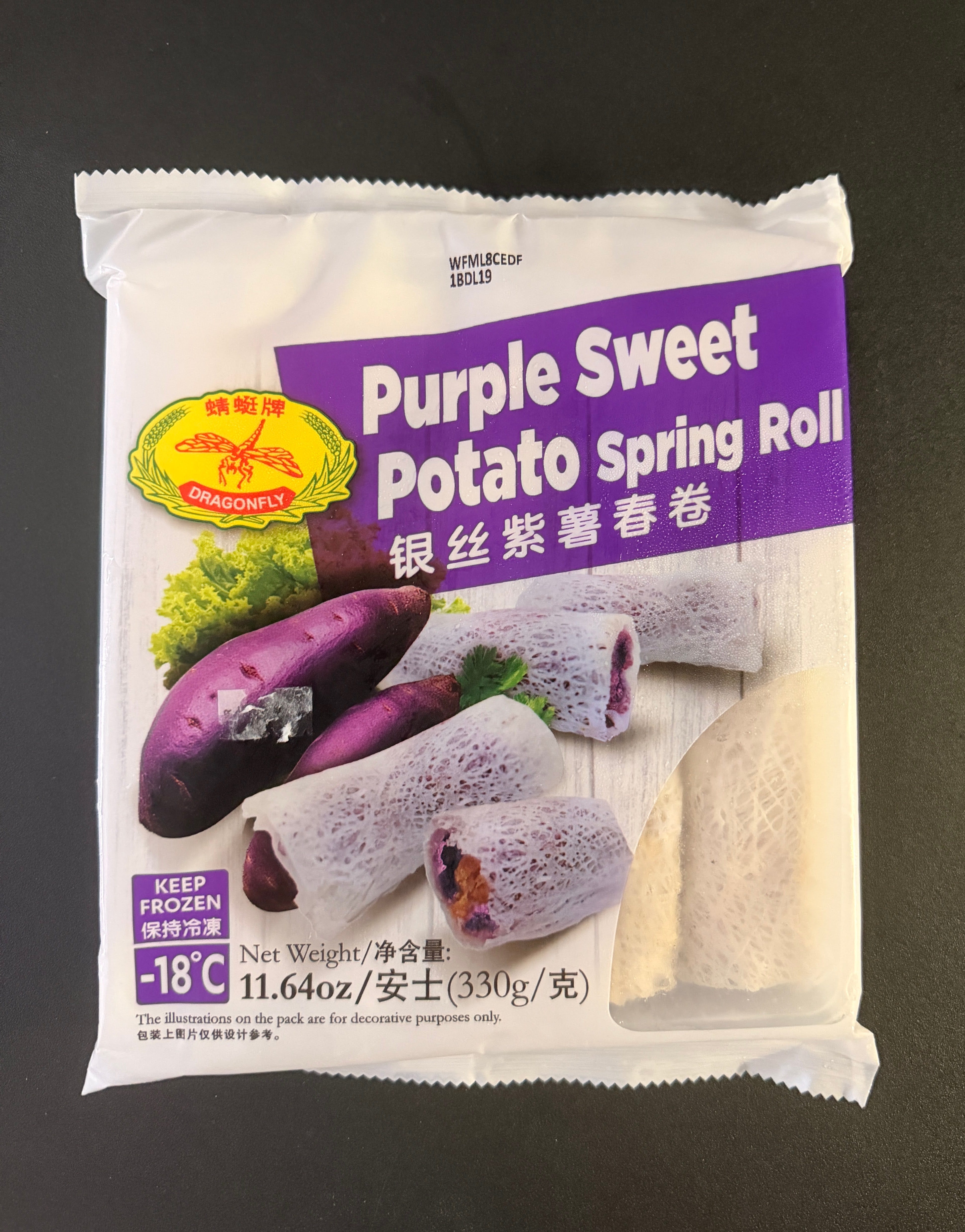
Other than the mushrooms, what I did not find were any of the ingredients I needed to make a new batch of hot pot. And I’m still not content with my version of the broth. I keep tinkering with the recipe, trying to get it dialed-in to my taste preference.
Which is how I wound up making a very delicious mistake.
On a recent Costco run, I saw that they had cases of pre-made tonkotsu ramen broth for about the same price as I’d pay for the regular culinary stock I usually buy to use as a base. I brought some home, threw it in the little electric pot, and flipped the switch to high heat, then sat down to watch a little television while I waited. Unlike the thinner stocks I usually use, it bubbled up and boiled over after just a few minutes, making a huge mess. A mess that smelled really lovely, though. After quietly cursing and cleaning the spill off the counters, the cabinets, and the floor, I poured myself a coffee mug full of the plain broth and went back to my show.
It was…so good. Just by itself, with nothing in it.
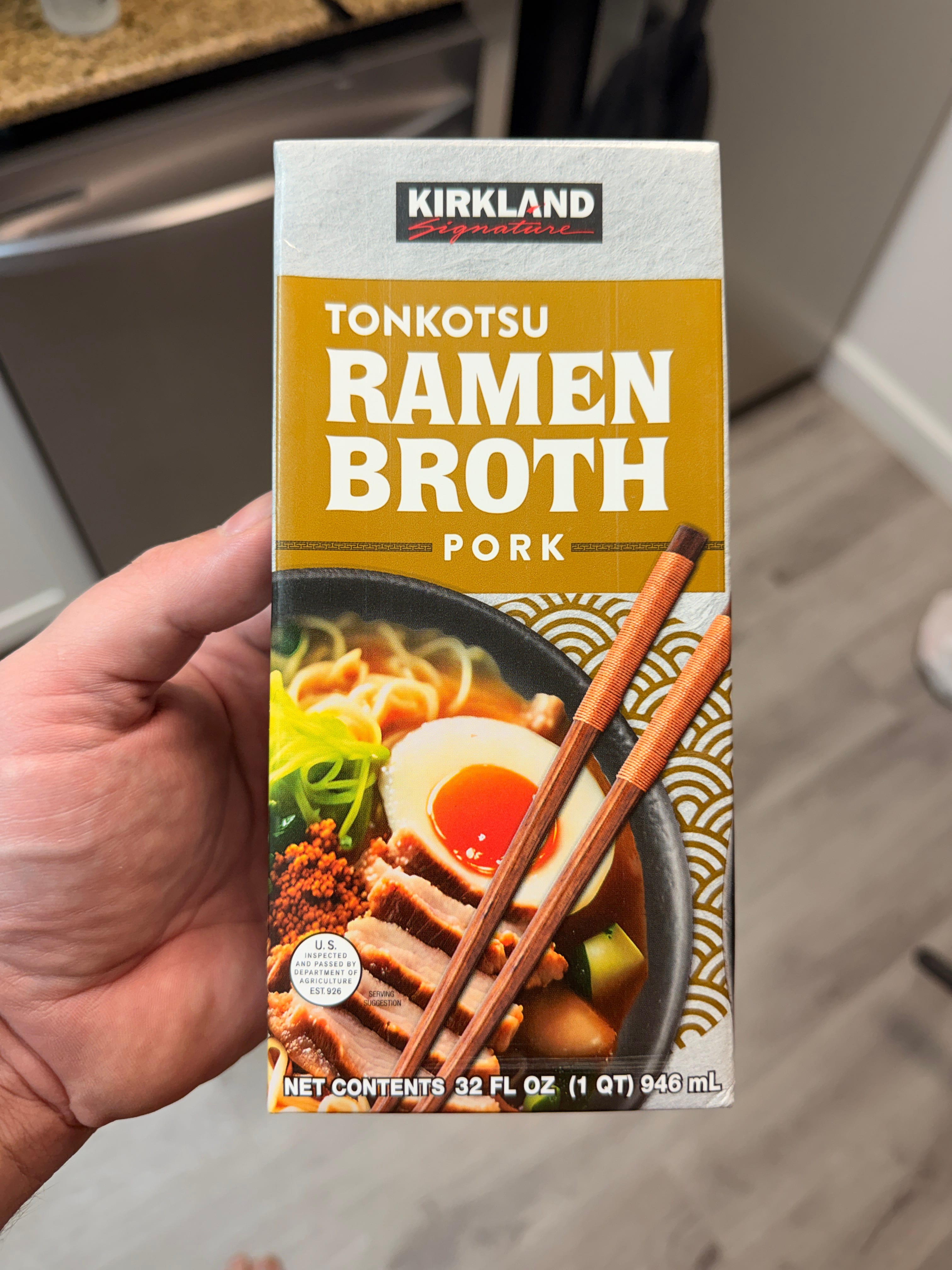
It’s been a couple of years since I’ve had tonkotsu, and so, I forgot just how creamy and flavor-forward it is. As good as it tasted, it was immediately clear to me that this was not the right flavor profile for hot pot.
A serendipitous error, which presented new opportunities!
With four 32 oz cartons of Tonkotsu broth, I decided I needed to get some ramen ingredients, and expand beyond my hot pot repertoire.
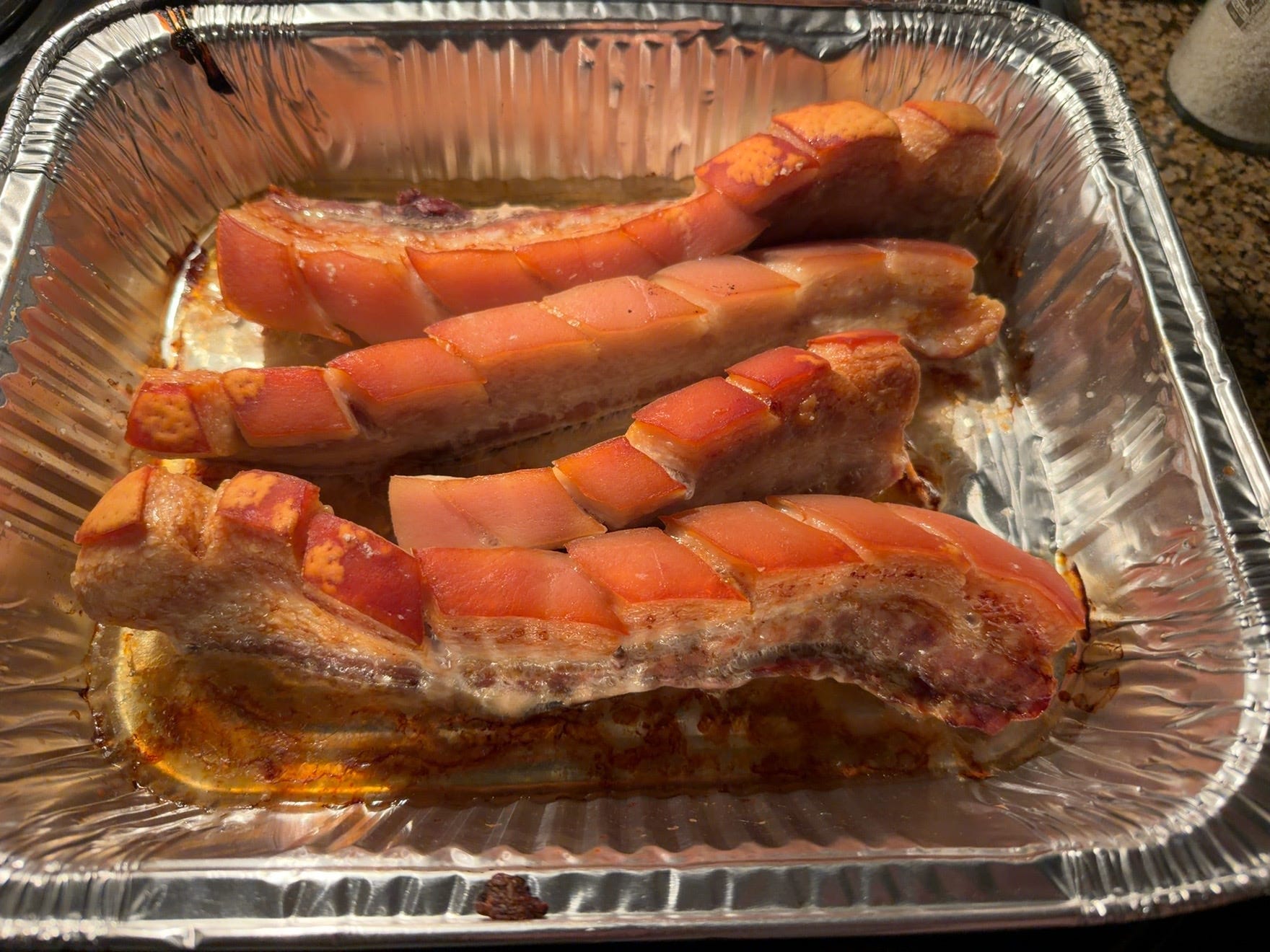
So after work one night, I went back to Costco, where I picked up some some pork belly, millet and brown rice ramen cakes, and an industrial-sized package of nori. I came home, turned on the soft-white lamps to help balance out the harsh overhead kitchen LEDs, turned down the air conditioner to a bearable temperature, looked up “Japanese Jazz,” and turned on the first suggestion — Ryo Fukui’s Scenery.
It took about five seconds to fall in love.
I sharpened my knives, then scored and braised the pork belly strips in the air fryer. I simmered the broth, watching it carefully this time so it didn’t bubble over again, and boiled pots of water for noodles and eggs. My tiny kitchen quickly became too small for all the prep, so I pulled my little folding table out of the closet where I keep it behind my hanging clothes, and set it up so I had somewhere to put extra ingredients.
A little culinary symphony was unfolding in my lifeless place, and for a little while, it almost felt like a home. This was how I used to cook for my family, jazz playing, counters littered with ingredients, pans bubbling away on the stove. I washed my Japanese chef’s knife and flung the water droplets off of it in a quick slashing motion before wiping it on a towel and re-sheathing it, like the samurai in movies always clean their swords after a kill. Then I laughed out loud at myself at the absurdity of it.
It was almost as if my place had come alive. Like I had tricked myself, just for a moment, into remembering the experience of joie de vivre.
The only thing missing was the people.
Which meant the only thing missing was everything.
Still. An inhabited life, right? This is the goal I’ve set for myself.
In any case, it always feels weird to me to go to all that trouble to make food just for myself, and I remembered how, despite my wife’s 100% Chinese blood, I was the “designated Asian chef” in my old life. The recipes are often complex and use a lot of ingredients, but I’m pretty good at process, and if I have a good set of instructions I can make some pretty damn delicious dishes.
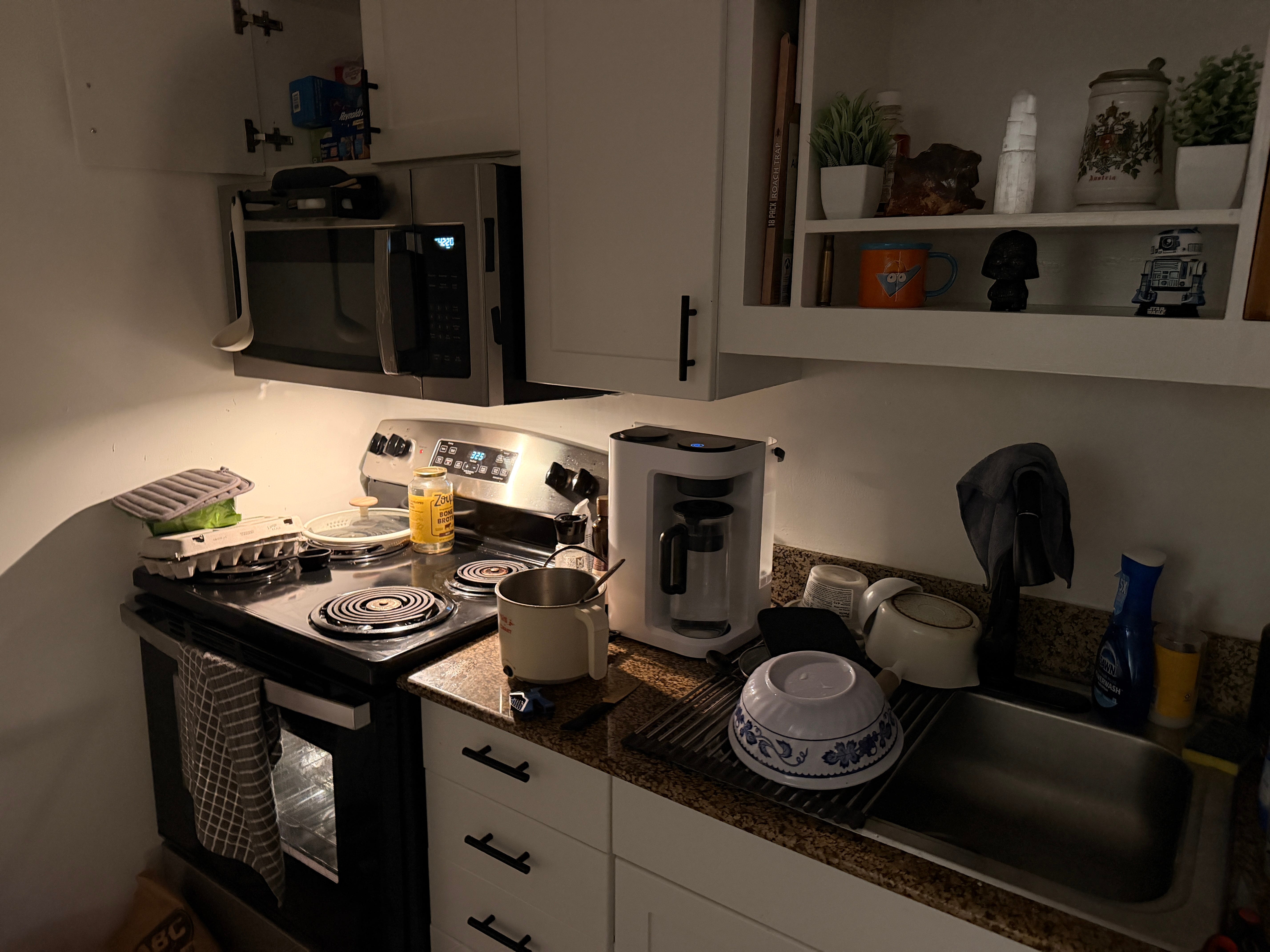
This ramen turned out to be no different. Into the pot went whole mushrooms, baby corn, and sugar snap peas. I softboiled a handful of eggs and started the ramen cake. The pork was popping and sizzling in the air fryer, and I checked it every five minutes or so and turned it as necessary. Another batch of pork went into the big oven for a longer cook at a lower temperature. That would be for later.
There was no time to properly marinate soy eggs, and I didn’t have mirin anyway, so I compromised. I peeled and sliced two eggs neatly in half lengthwise, then glazed each half with a drizzle of teriyaki sauce and sriracha. The pork had caramelized nicely, even if it took about ten minutes longer than expected. The noodles were finally soft enough to work with, so I drained and rinsed and drained them again. And then I built my bowl: noodles on the bottom, then vegetables and mushrooms, then the pork and eggs, with a few crumpled up sheets of nori slid in from the sides.
I’m not much for plating, but at the end, I thought it looked pretty good.
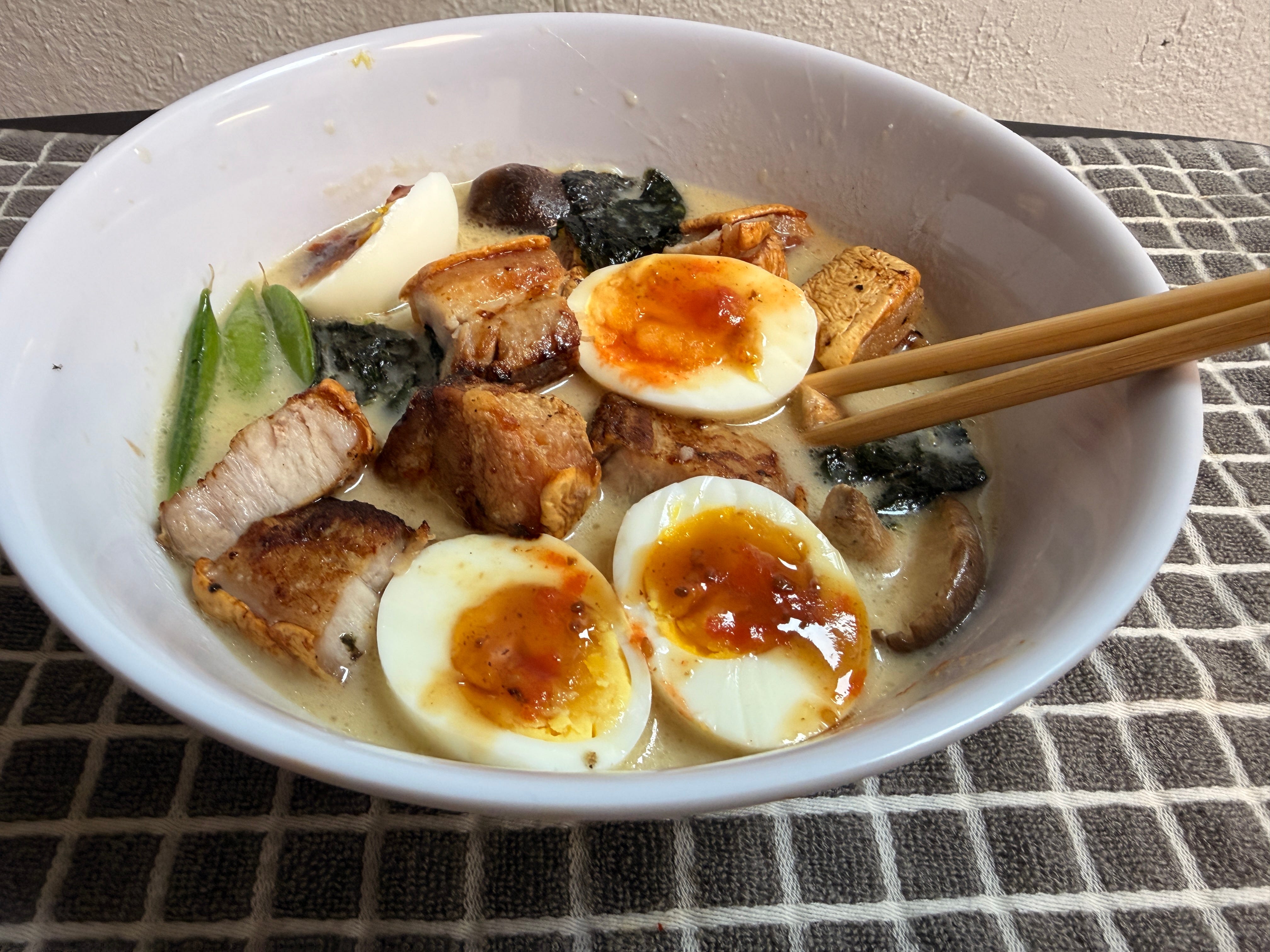
And it tasted just as good as it looked.
I hadn’t eaten in over nine hours, and I’d been working all day, so I hungry enough to overestimate my capacity. That bowl turned out to be more than enough, and I was so stuffed I was a little uncomfortable for a while. But it was late and I was eager to get back to Widow’s Bay — a new horror/dark comedy show I got hooked on after hearing Rod Dreher talk it up — so I decided to call it a night.
This isn’t the life I wanted, but it’s not nothing, either. It lies somewhere in the liminal space in between.
If you liked this essay, please consider subscribing—or send a tip (Venmo/Paypal/Stripe) to support this and future pieces like it.
Seriously, Steve, the ability to write as you do transports my otherwise addled brain to sights and sounds and....even smells......a true gift to this reader.
Ironically, I have an affinity for Asian culture, the people and their food. Before most of my children stopped talking to me and have no desire to, my kitchen had ingredients from Hong Kong to China and every Asian market in between. Blasted fish sauce can really become odiferous.
Your culinary endeavors are a part of your life and while we struggle through that which is not, it is a boon to the soul to hold tight to the good that was.
That ramen looks amazing! I'm like you Steve, married to an American born Chinese (actually Taiwanese) for many years, so I've adopted all the food as my own.