


This is a free post made possible by paid subscribers.
Writing is my profession and calling. If you find value in my work, please consider becoming a subscriber to support it.
Already subscribed but want to lend additional patronage? Prefer not to subscribe, but want to offer one-time support? You can leave a tip to keep this project going by clicking the link of your choice: (Venmo/Paypal/Stripe)
Thank you for reading, and for your support!
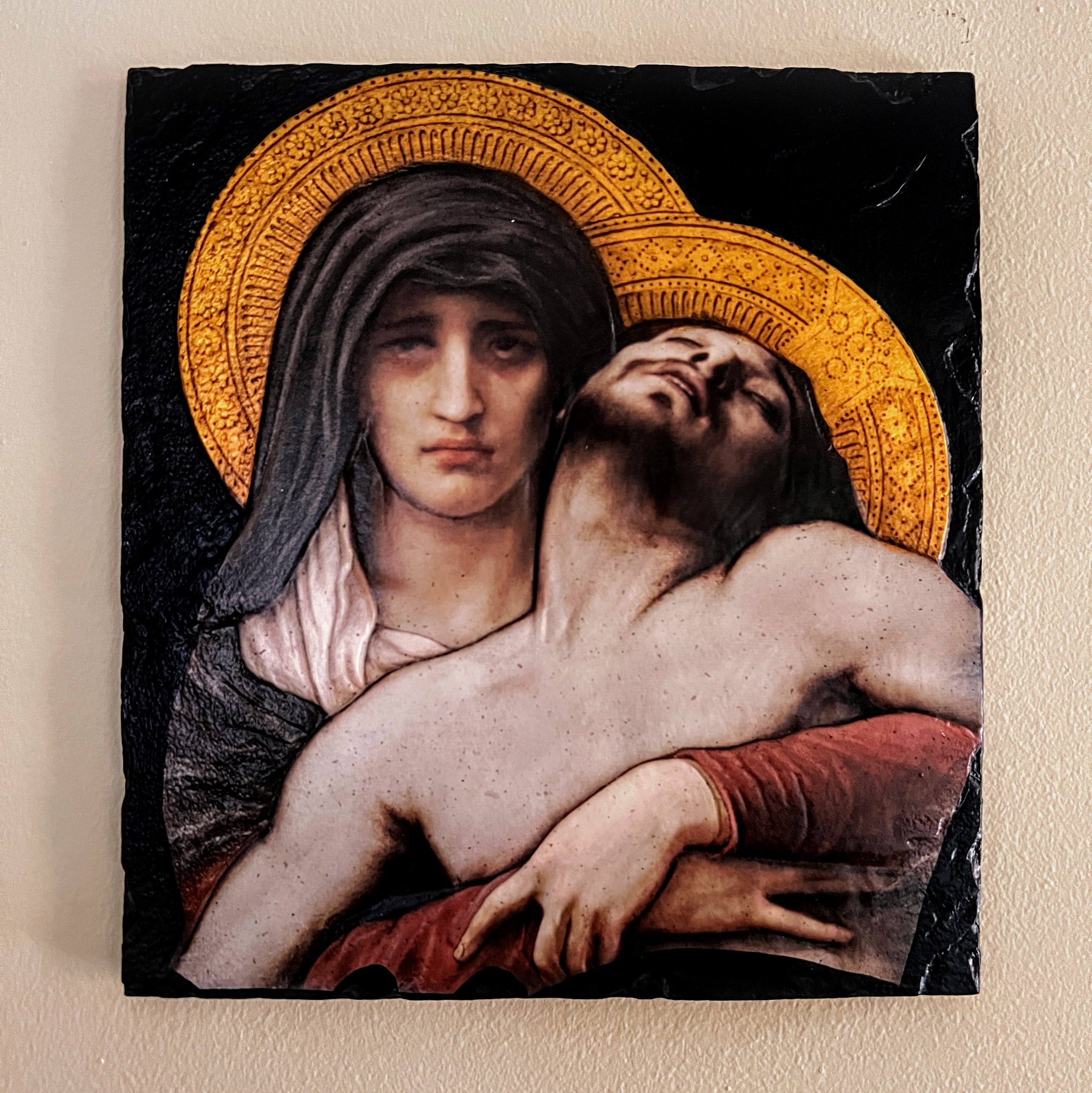
On the wall in the main hallway of the rectory at Holy Family in Grand Blanc, where I have been staying for the past few weeks, there hangs a small image of the Blessed Virgin Mary holding the lifeless body of Jesus with a striking expression on her face.
It depicts profound grief, but also a revulsion at injustice. “How could you do this?” can almost be heard within the piercing gaze.
What I love about this version is the way it isolates and focuses on that look, which the busier details of the full painting tend to distract from.
The original painting, known as the Pietà, by William-Adolphe Bouguereau, finds its current home in the Dallas Museum of Art. Most will be familiar with the image in full:

At the bottom is an inscription in Latin: “IN MEMORIAM DILECTI MEI FILII GEORGII DIE XIX JULII ANNO MDCCCLXXV,” which translates in English to, “In memory of my beloved son, Georges, on 19 July 1865.”
Bouguereau, you see, was not just painting from a sense of piety, but from personal loss:
Upon its exhibition at the Paris Salon of 1876, William Bouguereau’s monumental Pietà received unanimous praise from critics for its sincere emotion and poignant devotion (Doucet, Les peintres français, Paris, n.d., p. 164). More than a century later, the painting remains one of the most moving interpretations of, not only the Life of Christ, but of man’s personal tragedy as well. The immediate inspiration for Pietà came not from Bouguereau’s devout Christianity, but from the painful loss of his eldest son Georges who died on July 19, 1875 at the age of sixteen. After spending several months overwhelmed by grief, Bouguereau sought to lift his spirits by fully immersing himself in his art. For several weeks, he considered compositions that would permit him the fullest expression of his feelings while simultaneously commemorating his son’s life and passing. His sketchbooks from this period show a flurry of excited and even angry passages, with dozens of drawings that illustrate his slow and deliberate plan to paint his version of a Pietà. After what must have been an uninterrupted period of compulsive work, Bouguereau appears to have completed this magnum opus in only two months (M. Vachon, ‘Avant le Salon’, La France, March 20, 1876).
It only stands to reason that an expression of such complex depth could only be captured by an artist who had worn it.
Unlike Bouguereau, I have never lost a child to death. And yet, with a kind of preternatural understanding, I know the feeling being expressed.
There is a crushing finality to the end of a loved one’s life, and the sheer irrevocability of such a death is something with which most of us are intimately familiar.
But there is a different kind of loss, and I would argue that in many instances it can be the crueler form of grief. It comes when we must mourn someone who has not been taken by the cold hand of death, but who has instead chosen to become like the dead.
Someone who has decided, after a great many years spent together, to no longer to be alive with you.
One cannot bargain with the dead. One cannot plead, with any reasonable expectation, that they might rise from the grave and reunite their heart with yours. There is both a harshness and a peace that comes from the finality of death.
When we are forced to grieve the living, we know that they yet exist, just a text, a phone call, or a visit away.
It feels as though we therefore should be able to convince them to climb out of the proverbial tomb, and join us among the living. When they refuse to do so, it is not just a loss of the other, but a loss of self.
We find ourselves asking:
Why are they doing this?
Do I deserve to be abandoned this way?
What could I have done to make them stay?
Is there something that would make them reconsider?
We torture ourselves with the fantasy of repair, since that repair is at least hypothetically possible.
Can a heart that still beats be softened?
Can a cold shoulder be converted to a warm embrace?
Is redemption truly out of reach?
I’ve found that I have never grieved the dead as I have grieved the living. If for no other reason than that I am, in some respects, an irrepressible optimist. I have an almost inhuman endurance for trying again when it comes to something or someone I care deeply about. Like the beaten and bloodied boxer who won’t stay on the mat, I rise again and again, refusing to quit long after the damage I am receiving is becoming irreversible.
Maybe if I try again, this time, it’ll change.
Last night, I had a dream. I don’t remember it in great detail, but I was with my estranged wife. I held her close, and in the dream I could almost make out the unmistakable scent of her skin. I kissed her gently and repeatedly on the cheek as I held my face close to hers. But through it all, she never once turned toward me, never lost the far off and disinterested expression on her face.
I woke up disturbed, and as I do most days of late, cried out to God to come to my aid. It’s a game I play more and more lately: I pursue, he evades. And every day, the pursuit becomes just a little more urgent. And every day, I wonder if I’m just missing the response.
I sat with the dream buried in the back of my mind all day today. I didn’t know what to do with it, so I didn’t do anything.
And then, out of nowhere, I received a fresh and unexpected wound. My guts were in knots. I stumbled toward the chapel, stopping at the replica painting of Mary on the little square of slate.
I looked into her eyes, and saw my own heart reflected there.
And then I remembered something Fr. Joseph Krupp texted me about a week ago:
Good morning, my brother.
I remember that you still feel a special connection to our mother. Today is the feast of her presentation. That really got me thinking of and praying for you.
She loves you bro.
She stood at the foot of the cross, holding in her heart the tension between what she was seeing and what God promised.
I don’t know how she did it. I only know that’s what she did.
So if you catch yourself looking at the cross that you’re on today, ask Our Mother to stand next to you.
Ask her for the grace to remember that it’s not over.
I asked her for the grace to trust in what God promises more than in what you see.I’m praying for you, bro.
I couldn’t ask for a better friend.
So, with his words in mind, I looked at her face, and I begged her to stand with me at the cross.
Then I went down the hall and pleaded with her son.
I don’t know if heaven is taking my calls. I get caught between “I want this to be true” and “I actually believe it’s true.”
But where else can I turn?
What good is all this pain if there is nothing to redeem it?
I fidgeted and paced until the latest tidal wave of grief finally subsided. And then, unexpectedly, I thought again about the dream.
Maybe my brain is trying to tell my heart to let go.
The thought popped into my head almost as though I’d downloaded an explanation. I recognized the truth of it.
I could hold on, hoping that someone whose mind I’ve never changed in a quarter century could be convinced to choose differently, or I could begin to release my grip on the thing that has been drowning me, and stay alive.
Half a lifetime spent intertwined with someone you chose to be with you to the grave is no easy thing to release. Nor is the integrated family life that is greater than the sum of its spousal parts. I have no doubt I will be grieving for years to come.
But grief like this will take you to dark places. It occurred to me today that the choice to surrender what I cannot change is actually, not metaphorically, life or death. I can unclench my grip and live, or I can hold on until it buries me.
I doubt I’ll have this much clarity tonight when I am lying in my strange bed alone. Or a few days from now when some other sorrow surfaces with its claws around my throat. That’s the thing about grief: it never fails to find you when you least expect it, and it takes a very long time to get the hint and leave.
This is a choice I will have to make every day. Even — and especially — on the days when it feels least worth making.
But I am finally starting to make out the path to whatever future my life has in store, and it will no doubt grow clearer over time.
If you liked this essay, please consider subscribing—or send a tip (Venmo/Paypal/Stripe) to support this and future pieces like it.
Hi Steve, in AA we start every meeting with the Serenity prayer.
God grant me serenity to accept the things that I cannot change, the courage to change the things I can, and the wisdom to know the difference.
That last part is the hardest part. Too often people want so hard to change the things they can't. Maybe not now. Maybe never. But you can't change it. That's what people struggle the most with. Acceptance is the hardest part of grief. But you have to do it. Trust us.
I felt this. My own loss was so much smaller, less time and no children, but I know something of what you're talking about. There are people who change their minds, and there are people who just... don't. And I wish I understood. What the hell is 'moving on' anyway? How do people do it?... But we have to, and in time, it starts to happen. We start to get unstuck (including, God willing, from the things we get stuck in while we're trying to get unstuck). Praying for you Steve. (I've been trying to get back to praying more these days)