


This is a free post made possible by paid subscribers.
Writing is my profession and calling. If you find value in my work, please consider becoming a subscriber to support it.
Already subscribed but want to lend additional patronage? Prefer not to subscribe, but want to offer one-time support? You can leave a tip to keep this project going by clicking the link of your choice: (Venmo/Paypal/Stripe)
Thank you for reading, and for your support!
Note: This is part of my Global Storm series. You can see the first post, with links to all the others, right here.
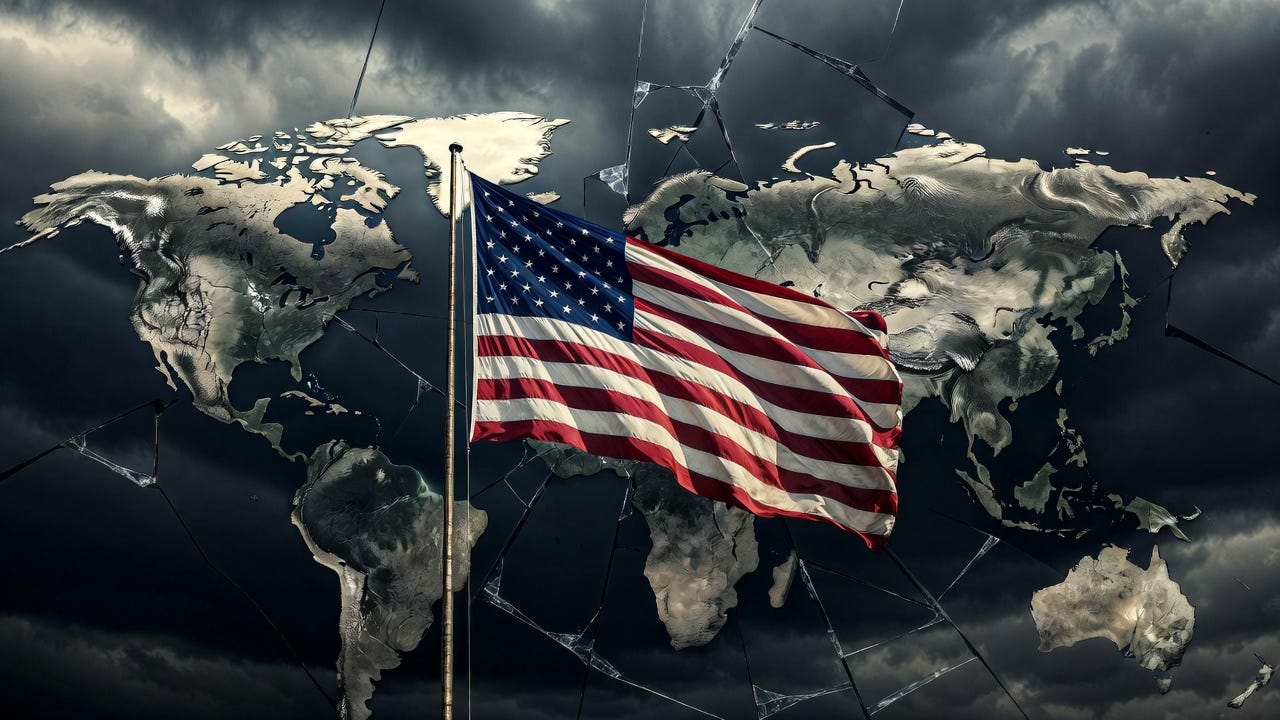
The modern era, the only way of life that almost everyone alive today has experienced, was forged from the fires of the Second World War.
It doesn’t really matter if this world, this Post-War Order, was born at Bretton Woods, or in the dropping of the atomic bombs on Japan, or on VE day, or when reconstruction began. The Order was fashioned out of all of these events, and more.
What matters is what it is, and how it was different than what came before — and why it’s dying now.
We saw the most overt signs to date that the Order is ending while watching the collapse of old alliances in real time at the World Economic Forum in Davos, Switzerland, just last month.
And at the very moment I write this, America has positioned an impressive and imposing array of military assets within striking distance of Iran, and has delivered an ultimatum that the Mullah-occupied Persians destroy their nuclear enrichment sites or we will do it for them. China has published satellite photos of US military assets to social media. Iran sells 80-90% of its oil to China, which is in turn selling missiles to Iran. Like the US strategic takeover of Venezuela at the outset of 2026 — along with its world-class oil reserves (which China also depended on) — we are fighting open proxy wars with our largest trading partner and only true rival on the geopolitical stage, and we are doing so in a way that aims to secure American dominance over the Western Hemisphere even as we retreat from military overextension and de facto role as the world’s police force.
What was theory and prologue just a few short years ago is now playing out on the global stage right before our eyes.
Why the End of the Order is The First Force
Because the Order is the system of rules and alliances and trade and military power that has governed the way our world operates for the past 80 years, its deconstruction will forge the conditions within which the other four forces will play out over the coming years.
Changes in labor, demographics, technology, spheres of influence, resources, the race to space, and the decohesion of a shared, familiar sense of reality will all be inextricably intertwined in ways that will, eventually and not entirely predictably, give rise to a new Order as the old one dies.
The Italian Communist Antonio Gramsci — of all people— perfectly captured the ethos of what we are witnessing as he wrote from his prison around 1930:
“The crisis consists precisely in the fact that the old is dying and the new cannot be born: in this interregnum, morbid phenomena of the most varied kind come to pass.”
We are witnessing a rise of ideological extremism, political polarization, loss of trust in institutions (and a consequent rise in belief in wild conspiracies), diminishment of traditional religious beliefs and mores, acrimonious breakups of old alliances, reckless pursuit of technical supremacy through AI, and a dangerously disruptive re-arrangement of the pieces on the global board.
We exist in the interstitial chaos between what was and what is, and we cannot see the entire movie with our faces pressed so closely to the screen.
The Post-War Order Explained
The first time I encountered the notion of the Post-War Order (along with its imminent downfall) as a cohesive idea was not in a history class, a textbook, or the evening news.
It was in a book that changed the way I look at how the entire world functions. That book, written by geopolitical analyst Peter Zeihan, is called, The End of the World is Just the Beginning: Mapping the Collapse of Globalization—The Collapse of Globalization and Its Aftermath.
(Just a heads up: It’s currently free if you have Kindle Unlimited, and I highly recommend it.)
In that book, Zeihan lays out how the only version of the world everyone alive today has ever known came to be — and where it’s headed. And he’s done so understandably and concisely. It’s a bracing scenario, to say the least:
At the end of World War II, the Americans created history’s greatest military alliance to arrest, contain, and beat back the Soviet Union. That we know. That’s no surprise. What is often forgotten, however, is that this alliance was only half the plan. In order to cement their new coalition, the Americans also fostered an environment of global security so that any partner could go anywhere, anytime, interface with anyone, in any economic manner, participate in any supply chain and access any material input—all without needing a military escort. This butter side of the Americans’ guns-and-butter deal created what we today recognize as free trade. Globalization.
Globalization brought development and industrialization to a wide swath of the planet for the first time, generating the mass consumption societies and the blizzard of trade and the juggernaut of technological progress we all find so familiar. And that reshaped global demographics. Mass development and industrialization extended life spans, while simultaneously encouraging urbanization. For decades that meant more and more workers and consumers, the people who give economies some serious go. One outcome among many was the fastest economic growth humanity has ever seen. Decades of it.
The Americans’ postwar Order triggered a change in condition. By shifting the rules of the game, economics transformed on a global basis. A national basis. A local basis. Every local basis. That change of condition generated the world that we know. The world of advanced transport and finance, of ever-present food and energy, of never-ending improvements and mind-bending speed.
But all things must pass. We now face a new change in condition.
Thirty years on from the Cold War’s end, the Americans have gone home. No one else has the military capacity to support global security, and from that, global trade. The American-led Order is giving way to Disorder. Global aging didn’t stop once we reached that perfect moment of growth. Aging continued. It’s still continuing. The global worker and consumer base is aging into mass retirement. In our rush to urbanize, no replacement generation was ever born.
Since 1945 the world has been the best it has ever been. The best it will ever be. Which is a poetic way of saying this era, this world—our world—is doomed. The 2020s will see a collapse of consumption and production and investment and trade almost everywhere. Globalization will shatter into pieces. Some regional. Some national. Some smaller. It will be costly. It will make life slower. And above all, worse. No economic system yet imagined can function in the sort of future we face.
This devolution will be jarring, to say the least. It’s taken us decades of peace to suss out this world of ours. To think that we will adapt easily or quickly to such titanic unravelings is to showcase more optimism than I’m capable of generating.
It is a perfect storm of shifting spheres of influence, economic change, the fragility of just-in-time and one-nation-one-export supply chains, the demographic constriction that follows industrialization and urbanization in every country where those conditions exist, and an entropic shift back to multipolarity.
Having finished the book just a short time before Donald Trump’s second presidential election, I began to realize that I was seeing Zeihan’s predictions play out in real time.
What Comes Now?
It’s impossible to predict with certainty what the future will hold. We can only paint with broad strokes. Here are some major things to watch for in the coming years:
Monroe Doctrine 2.0 and a Return to Multipolarity
Declared by President James Monroe at his State of the Union Address in 1823, the Monroe Doctrine codified the prohibition of foreign powers (specifically European, at the time) from any additional colonization or excess influence in the Western Hemisphere. The Americas were within the direct sphere of influence of the United States, and any meddling would be seen as a hostile act. (In return, America agreed to stay out of European wars.)
President Teddy Roosevelt expanded on this in the Roosevelt Corollary in 1904, which declared that the US could intervene in Latin American countries, if necessary, in order to stabilize them.
Obviously, we didn’t stay out of European wars for even a century after the declaration of this policy. And by the end of World War II, we became, “America, Global Cop.”
But we are returning to a multipolar world. Regional power blocs have hardened. China in the Asia-Pacific Region. Russia in West-Asia/Eastern Europe. Europe is…kind of a mess right now. Fragmented. Immigration is increasing violence and cultural clashes and political unrest. But still a power base.
And then, of course, there’s America and the entire Western Hemisphere.
The current American administration is already making explicit reference to the aforementioned earlier American policies, coining the terms “The Donroe Doctrine” and “The Trump Corollary.”
The US is rapidly moving to excise foreign — particularly Chinese — influence in the West. The Maduro takedown and subsequent US takeover of control of Venezuelan oil — a key supplier of Chinese and Cuban oil imports — was a big step. As is pressure on control (and rumored reclamation) of the Panama Canal. In January of this year, in response to these pressures, the Panamanian government nullified contracts on Chinese-controlled ports on either end of the canal. Cuba has been labeled an “unusual and extraordinary threat” by the US because of its support of hostile nations, and economic and resource pressure are being applied with a heavy hand to the Communist stronghold right off our coast. Regime change in Cuba is on the table. Tactical strikes on drug-trafficking boats has been an ongoing program, and a proposed bill may bring back the concept of “Letters of Marque and Reprisal” — authorizing privateers to hunt enemies of the United States within sanctioned regions.
Troop drawdowns, at least for now, are somewhat anemic. We’re pulling out remaining forces from Syria and Iraq. We’re talking about reductions in Germany and Poland. But over time, look for a reduction of the US military footprint overseas.
The Disruption of Global Trade
We are so used to the majority of products we buy being made overseas. The “Made in China” label is almost ubiquitous.
But the Trump administration has been liberal with the imposition of tariffs, to the chagrin of the US Supreme Court. And US imports actually grew in 2025.
That doesn’t mean the status quo is sustainable. Shipping traffic is down in both the Suez and Panama canals. Just-in-time supply chains are straining, if not breaking. (We saw this in real-time during COVID). In the absence of strong military presence in the maritime shipping lanes, piracy — yes, actual, literal ship-based piracy — is making a comeback.
And if our global trade deficit has actually grown, we’re pulling back from sources like China — 2025 saw a year-over-year drop of as much as 35% on Chinese imports. Within a decade, US reliance on Chinese-manufactured goods will likely be even more significantly-reduced. And China’s manufacturing sector is shrinking fast, due to its accelerating demographic crisis.
And we’re re-shoring manufacturing. Defense, EVs, semiconductors, renewables, data centers, and more are all seeing significant domestic investment.
Demographic Collapse
This is one of the Five Forces, and we’ll have a whole essay on this soon, so I won’t go into great detail here.
Suffice to say that Total Fertility Rates (TFR) way below replacement levels in the developed world and overinflated population data in countries like China where they don’t do a conventional census means shrinking tax and labor bases, top-heavy elderly populations, and potential systemic collapse in a number of nations.
Shrinking populations mean diminished labor pools, smaller tax bases, and top-heavy elderly populations.
Social welfare programs will be insufficiently funded. Infrastructure will begin to deteriorate and fail. As more highly educated younger cohorts look for white collar jobs that are in increasingly short supply — particularly as AI takes knowledge-based jobs rapidly off the board — many manufacturing jobs will remain unfilled.
These problems will compound over time.
All of this affects the strategic positioning and relative strength of regional/global powers.
European Disintegration
Put simply, Europe is in real trouble.
Migration from the third world is wrecking European nations, increasing crime, changing political tensions, and picking the last meat off the bones of the carcass of Christendom.
This is giving fuel to “far-right” movements — I prefer to be conservative about how this ideological tag is assigned without careful disambiguation — but political backlash is real.
Orwellian policies in many EU countries and an increasingly disaffected native population while replacement birthrates remain among the worst in the world are going to increase the dystopian situation in what remains of the apex of human civilization, now in accelerated decline.
AI & Robotics Filling Demographic Gaps
This touches on two of the additional five forces, but expect to see an acceleration in machine-based labor replacement where demographics fail.
AI is already causing attrition in a number of industries. White collar layoffs are in the tens of thousands. Just today, Jack Dorsey, the founder of Twitter (now X), announced the layoff of 40% of the 10,000 employee workforce at his financial services company Block, because, he says, they’re “already seeing that the intelligence tools we’re creating and using, paired with smaller and flatter teams, are enabling a new way of working which fundamentally changes what it means to build and run a company.”
4,000 people lost their jobs — literally just today — to AI. And the company’s stock didn’t dip after the news — it’s up 20% as of this writing.
That’s only going to accelerate.
And while jobs that require physical manipulation of materials are further down the timeline, look for a ramp up on AI-powered robots to start filling human gaps sooner than most people think possible.
Concluding Thoughts
There’s simply no way to be comprehensive on a topic this broad within the scope of a single essay, and we risk choking on all the details.
Suffice to say that the world we grew up in isn’t just changing, it’s already gone. We’re just stuck in the liminal in-between, the delta between life-as-we-knew-it and life-as-it’s-going-to-be. And new factors emerge all the time. When I started writing this, for example, Pakistan and the Taliban were not at war. Before I finished, they were already shooting at each other.
And this is only the First Force. Force Two is the digital tsunami that is compounding the pace of change: the rise of AI.
Look for that piece to drop late next week.
I welcome your thoughts in the comments.
If you liked this essay, please consider subscribing—or send a tip (Venmo/Paypal/Stripe) to support this and future pieces like it.
Great article, Steve.
While it might not seem pertinent now, a good long look should be cast in the direction of that which sustains the lives of all the players in the game.
Agriculture and what is coming to a store near you...
The corporate take over of independent farmers...and any hope of a "victory garden" to feed your family and neighbors, are being legislated away.
Water is the new gold and natural resources are being swallowed up by factions not wanting to play well with others.
The new paradigm has everything to do with control over every aspect of what will be called life. I've watched it unfold first hand.
That's a big topic to take on but for me, AI is the thing that is really changing everything. I talked a bit to Claude about what Dorsey just did at Block and it said, "One concrete detail that emerged: Block has been using a proprietary AI tool called 'Goose,' designed to automate workflows and increase productivity across the company. That's a real example of what Dorsey means by 'intelligence tools we're creating and using.'"
This is key. Every company is in a race right now to develop the new tools using AI that enable them to be leaner and flatter companies. Every person should be doing the same. By that I mean that everybody who can should be using AI right now to develop the tools to make him be able to do much more, much faster than ever thought possible. That's what I'm doing.
The thing is, this is temporary. How long will it be before the tools we develop today are outdated and replaced by even better tools - requiring even fewer employees. Until you get to the point where you have entire factories run with no humans present. Gee, like they already have in China.
The entire planet is in a race. But most people have no clue. And nobody knows where this will end.