


This is a free post made possible by paid subscribers.
Writing is my profession and calling. If you find value in my work, please consider becoming a subscriber to support it.
Already subscribed but want to lend additional patronage? Prefer not to subscribe, but want to offer one-time support? You can leave a tip to keep this project going by clicking the link of your choice: (Venmo/Paypal/Stripe)
Thank you for reading, and for your support!
Over the weekend, Former President Barack Obama made a comment on a podcast saying that aliens are “real,” but that he hasn’t seen them. This isn’t the first time he’s made comments along these lines, and I made a video detailing all of his public appearances on this issue over the years:
The story has been making waves since it came out, and Obama tried to walk back his comments on Instagram over the weekend (that statement is included in the video above).
At a White House press briefing yesterday, Karolyn Leavitt was asked by a reporter about Obama’s comments, and about whether Trump was planning on doing a disclosure speech, as has been talked about by his daughter-in-law, Lara Trump, in recent days. Here’s Leavitt’s reply:
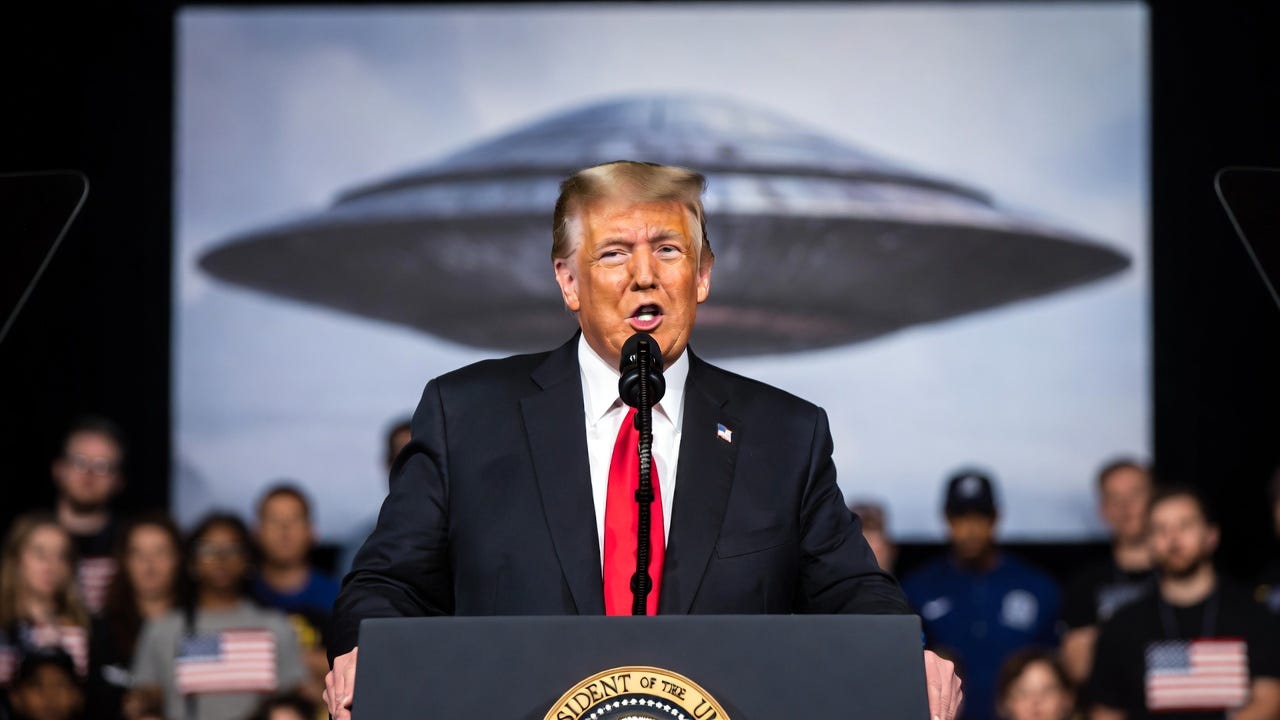
Today, on Air Force 1, Peter Doocy asked Trump the same question directly. Trump criticized Obama for what he said, but then said that maybe he would “get him out of trouble” by declassifying the documents:
Not long thereafter, the Trump posted the following comment to Truth Social. Several hours later, the official White House account shared it on X/Twitter:


It was followed immediately by supporting statements from certain members of Congress, along with others. Rep. Nancy Mace, who has been involved with UAP hearings in Congress, chimed in with Congressional support of Disclosure:


Some other representatives who have also been investigating whistleblower claims also voiced their support. Rep. Tim Burchett:


Rep. Anna Paulina Luna:


Rep. Eric Burlison:


Rep. Jared Moskowitz:


Investigative journalist Walter Kirn has been dropping breadcrumbs about this issue for months. Here he is tonight:


He’s not the only one connecting the dots between Epstein’s scientific meddling and the UAP issue, but he’s the one to watch. Walter…knows things. You can just tell.
We could go on and on with this, but it’s going to be blowing up for a while.
There’s a reason why I put UAP disclosure in Force 5: The Reality Crisis, in my piece about the Global Storm that is re-shaping our world. Whatever you think about this topic, it is no small issue. It has the very real possibility of introducing a widespread phenomenon known as…
Ontological Shock
One of the things people talk about in the UAP community an awful lot is the idea of “ontological shock.”
The Google AI says that ontological shock is defined as “a profound, disorienting experience occurring when an individual's fundamental, deeply held beliefs about the nature of reality, existence, or the self are suddenly shattered by unexpected, contradictory, or anomalous information. It is a cognitive crisis that challenges one's basic assumptions—often stemming from trauma, advanced technology, or mystical experiences—leading to feelings of instability, existential confusion, and, at times, transformative personal growth.”
Last September, just a week before I had to leave my family home and enter into my own version of ontological shock, I wrote a thing explaining why I’ve been so interested in the UAP topic for so many years.
I’m glad I wrote it then. I don’t think I could have written it later:

The ending of my marriage and the UFO story don’t seem like things that should be categorized anywhere near each other, but they are actually connected in one profound, underlying way: ontological shock has been a feature of every day of my existence since September 23, 2025.
See, I believed reality worked in a very specific way. I believed in the Catholic religion and all of its explanations for everything. I believed that marriage was forever, and that the woman I loved would be with me until death. I believed God wanted us to be together. I believed that if I made mistakes, I just had to repent and work to be better, and if I just kept trying to be the best man I was capable of being and asked God for help overcoming the obstacles that stood in the way of that pursuit, that love and grace would carry the rest. I believed that we would grow old together and watch our children’s children come home to us.
My exposure to ontological shock came when I found out that none of that was as true as I had previously believed. Some of it wasn’t true at all. The map I had for the territory was grossly inaccurate.
Not a day has gone by in the past five months where I haven’t had to confront the fact that nothing in my life will ever be the same. But in addition to that, I was already reeling for several years prior, because my belief system had collapsed first, and I couldn’t find my way back to it. It was fundamental to my understanding of the universe, and as I said, I based everything else on that framework.
Sometimes, the sheer magnitude of these two critical ruptures is enough to knock me completely out of commission.
That is what ontological shock feels like.
Your very concept of reality is so shaken that everything feels surreal. You involuntarily dissociate. You cannot accept that you are not dreaming. You go through the motions of your everyday existence in something like a trance. You feel hollowed out. You find yourself by turns angry then surprised then terrified then grief-stricken. People keep telling you that you’ll eventually come to acceptance, but every time you think you’re making progress, something will come up that pulls you back, that makes you question it all over again, as your mind scrambles for purchase on something that feels like solid ground.
Ontological shock is fundamentally disorienting, and the more deeply held and the more rigid your beliefs were before you were exposed to a rupture, the harder the shock hits you, and the longer it takes to overcome it.
This is the precise reason why some UAP whistleblowers have claimed factions within the government have fought to keep the knowledge Trump is now acting to reveal locked away as a secret. In his book, Imminent: Inside the Pentagon’s Hunt for UFOs, Lue Elizondo, who used to head up the Pentagon’s UAP program, observed the inherent challenges — and the dangers — of full public disclosure:
As some very bright political science scholars have recently observed, world governments are spectacularly ill-equipped to manage knowledge that threatens the notion of human supremacy, divine authority, and dominion over this planet. Since the dawn of time, nations have perpetuated the idea of individual sovereignty. Russia is Russia, China is China, and the US is the US. Likewise, national identity and allegiance is a result of national sovereignty. You are Canadian. They are French. I am American. That’s how the world perceives itself. Tribalism on a global scale. Leaders of these national-level organizations, institutions, and bodies have no interest in encouraging a different truth: We are all God-fearing, we all pay taxes, we all love our children, we are all in control of our destinies. We are all one.
AAWSAP/AATIP went from being the ballroom darling to the Wicked Witch of the West, almost overnight.
I wondered privately: What would happen if world governments shared what they really knew about UAP? What if humans bravely chose to confront the possibility that we are not the apex species in our solar system or even on this planet, as we’ve long been told and believed?
After all I’d learned, total government transparency on the topic of UAP seemed like a pipe dream. To pull it off, you’d have to figure out a way to smash the existing government fiefdoms to bits, while not threatening the institutional status quo, while not breaking any laws, while informing our government leaders and decision makers of the problem, while not running afoul of religious and theological belief systems. And that’s the easy part.
One must also unify and rally international allies, allay public fears and insecurities, challenge scientific and academic communities, and have a robust public outreach campaign—all at the same time. To accomplish this would require a herculean effort, not unlike a World War II military campaign. The level of coordination required would be all-encompassing and almost an impossibility.
This exact sense of urgency and dangerous mystery are the things that underscore Steven Spielberg’s newest film, Disclosure Day — a film many have speculated may contain government-controlled factual information woven into a fictional story. The idea is that certain narratives, presented as entertainment, help people begin to accept what’s coming before the full details come out. Some in the entertainment industry have talked about being approached by intelligence officials to this end. It’s a way to potentially pre-emptively soften the blow, so the fallout from the revelations are less disruptive.
The trailer below does an excellent job highlighting the tension between the right people have to the truth and the destruction that truth might well cause if it gets out. But also implied here is the idea that too much delay could lead to what’s known as catastrophic disclosure — the truth coming out with no control over how it happens. Quite possibly on a timeline chosen by whatever it is that’s visiting here. If you haven’t seen this, it’s chilling:
And if this all feels a little too far fetched for you, the following is another trailer — not for a fictional film, but for a documentary that has already been released, called Age of Disclosure. I watched this with Fr. Joseph Krupp a couple months ago, and it’s very bracing. It features a collection of many of the highest-ranking members of the government, military, an intelligence community to ever go on record about this topic. Some of the claims they make are, frankly, staggering:
9 years ago, I stumbled back into this topic and fell down the rabbit hole after decades away from my boyhood interest. 9 years, and I feel like I’ve only scratched the surface.
But if Trump feels that the time is right to make this move, then there’s undoubtedly a reason, and my guess is that it’s not just public interest. Public interest has always been there. It never stopped after Roswell in 1947.
The question is: what’s coming that is forcing his hand? Why now, when the can has been kicked down the road for so long?
I hope that this time, we’ll actually find out, and that we won’t regret it when we do.
If you liked this essay, please consider subscribing—or send a tip (Venmo/Paypal/Stripe) to support this and future pieces like it.
Aliens from another planet....
Vast are the numbers of children in "the old days" who watched sci-fi flicks, yours truly being among that number.
We were entertained but not for a minute did we sit and ponder the possibility of that any of it was true. Whatever else we were as goofy kids playing with our Tonka trucks on our dirt roads in the back yard, aliens from outer space wasn't on our radar, no pun intended. Bomb shelters were.
We spent hours making bomb shelters in the woods next to our house. Why? Because BOMBS were our aliens from outer space.
My point?
Step outside the box located somewhere in your home, where for decades, that box brought to life the most high tech visual real life aliens for your imagination to explore.
It's ironic that as programming became more and more focused on "what's out there", so too did the earthlings.
Coincidence? I think not.
To quote my dear son with autism..."we don't know what's real, no matter how real they make it seem.
“Jason Adkins interviews philosopher, theologian, and author Daniel O’Connor, who argues that belief in extraterrestrials and superintelligent AI may be part of a growing cultural movement away from Christ — and toward idolatry and deception. Drawing on theology, Church history, science, and pop culture, O’Connor proposes that the so-called “First and Last Deception” mirrors the serpent’s lie in the Garden of Eden: that humans can become like gods through a non-human intelligence.
Whether you're a skeptic, a science-fiction fan, or someone curious about how Catholics should think about aliens and AI, this conversation offers a clear, thought-provoking, and spiritually grounded perspective.”
https://overcast.fm/+ABMI1q_mtwo